The Fabulous Thorntons
By Gray Clapham
This story has been researched and written by Gray Clapham, great grandson of Neville Hale Thornton. It initially follows the life and times of Neville after his arrival in New Zealand in 1866 and continues with the stories of his daughters, particularly the Australia-born eldest who became famous in New Zealand as the burlesque star and theatrical entrepreneur ‘Miss Amy Vaughan’. Most of this information has been gleaned from the New Zealand National Library’s Papers Past archives, the My Heritage ancestry website and also the website findagrave.com. Some observations are thoughtful conjecture by the writer.
The first part of the adventurous life story of Neville Hale Thornton was exceptionally well told in the memoir he wrote of his life up until the moment, as a 32-year-old, he sailed for New Zealand from Australia in 1866. This is an attempt to document his story after he arrived in Hokitika until his death in Wanganui in 1912. The story also follows the fascinating lives of his daughters—Amy, May, Daisy and the mysterious Annie. For those who have not read the memoir Neville Thornton wrote about his earlier years in an earlier chapter on this website (Neville Hale Thornton), let me briefly recap.
Neville was born in France on Christmas Eve 1834. His English father had earlier been shipwrecked on his way home to England to recover from wounds received while serving as a captain with the East India Company. He was rescued by a French ship and taken to the French port of Le Havre. The ship’s captain took him to his home to recover from his ordeal where he met and subsequently married the captain’s sister.
Neville was born to this marriage on the same night his father, who was back in England seeing to his affairs there, died in a horse riding accident.
As a result of his birth, Neville spent his childhood and teenage years alternating between his French and British families, attending schools in both England and France and thus becoming fluent in both languages.
When he was 16, and while he was attending a college in Paris, he and several other young boys were recruited to act as interpreters between the French and English allies who were at war with the Russian Empire in Crimea.
Through his own connivance he found himself attached to a French colonel at the frontline of the hostilities and in a youthful act of bravery and, after being severely wounded, he was awarded the cross of the French Legion of Honour.
Eventually back in England, he was advised to seek recovery in a warmer climate. On his passage to India he lost all of his money playing cards and was forced to leave his ship in Adelaide, Australia, from where he began several adventurous years on the swag through the goldfields of Victoria and New South Wales.
Along the way he became a cook, a gold miner, a conman, a policeman—he shot and killed several men—and ultimately learned the skills of a theatrical scenic artist.
This is where part one of his own story ends and part two, my story about him, begins.
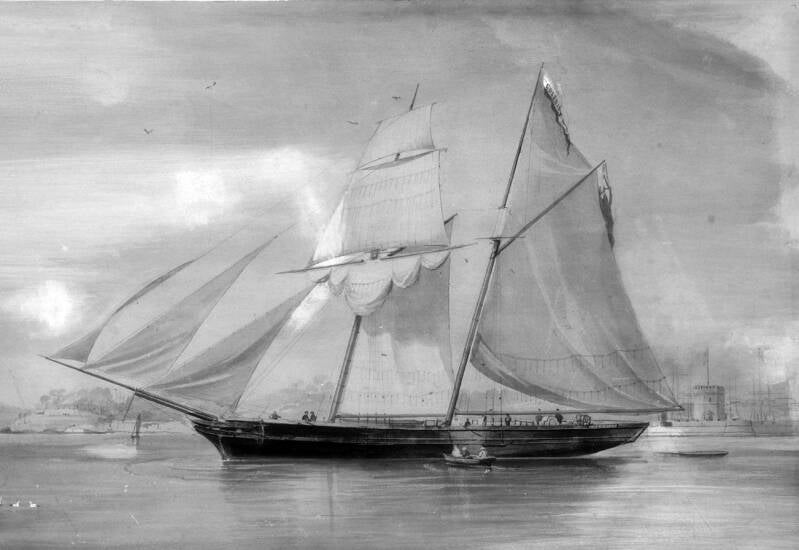
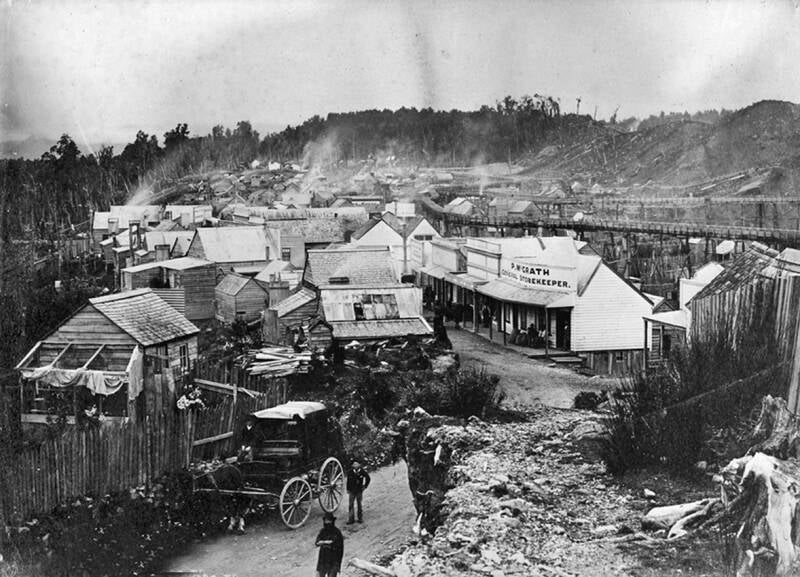
Left: The schooner ‘Colonist’ on which Neville Thornton and his daughter Amy sailed from Sydney to Hokitika in 1866. Right: Hokitika in the 1860s after the discovery of gold on the West Coast. This was where Neville Thornton first landed in New Zealand to begin his long and colourful career as a scenic artist and theatrical entrepreneur.
Neville Thornton begins his life in New Zealand
Quite quickly after his arrival in Hokitika, from his recent experiences as a scenic artist in the theatres of Sydney, Neville Thornton became something of a celebrity in the bustling vaudevillian entertainment industry in New Zealand. His renown enables us to trace chronologically his endeavours, milestones and whereabouts through literally hundreds of newspaper news items, reviews and advertisements (1626 search results to be precise) archived by the New Zealand National Library on its website Papers Past.
To set the scene: In the last decades of the 19th century, before the invention of film and the advent of the moving picture industry, scenic artists played a crucial role in creating the visual environments for live stage performances for drama, opera, ballet, burlesque and other theatrical spectacles.
The job of a scenic artist, even to this day, is to paint or otherwise create large-scale backdrops and props for theatre performances; to bring the location, atmosphere or environment of the story taking place to life.
In New Zealand during the gold rush of the 1860s, which started in Otago and spread to the West Coast, new towns were springing up wherever gold was found. By late 1866, Hokitika was one of New Zealand’s most populous centres and money was to be made in all forms of business, particularly in keeping the restless gold prospecting population entertained.
Wikipedia says: “Following the gold rush of 1864, Hokitika had become one of New Zealand’s most populous centres with 25,000 people living there by 1866. It was widely seen as a hotbed of sin and iniquity with few women and almost 200 pubs. Its population was an eclectic mix of Australian, Irish, Scottish, Chinese and other nationalities. By 1867, Hokitika was New Zealand’s sixth largest town with its Tasman Sea port ranking as the country’s busiest harbour.”
Neville Thornton, with his experiences and connections in Australia in creating the backdrops and props for the theatre scene in Sydney, quite rapidly became sought after and celebrated in New Zealand as a leading scenic artist of his time.
(Note: Scenic art could be likened to today’s movie special effects. At a stretch it could be said that Neville was the “Peter Jackson” of his era.)
Blessed with sharp intelligence and an abundance of self-confidence, he was not content to merely bask in the praise of his talents as an artist. He astutely observed that the real money in the business of entertainment was being made by the entrepreneurs who produced the stage shows that filled seats in theatres, town halls and opera houses the length and breadth of New Zealand.
Neville featured in hundreds of newspaper clippings promoting his theatrical enterprises through the last three decades of the 19th century and beyond. The Thornton family toured New Zealand performing under various names and combinations, sometimes referred to as the Thornton Dramatic Company or The Thornton Dot Troupe—often billed as, “the well-known artist and actor Neville Thornton and his talented daughters”.
The roadmap to Neville’s life story can be signposted by his three marriages.
The first marriage was central to his experiences in the goldfields of Australia and in blessing him with an extremely talented daughter. According to Neville’s memoir, while living in Wagga Wagga, New South Wales, he became “acquainted with a young woman staying at Mrs Price’s boarding house”.
Neville unceremoniously states that this woman became his wife, although he never recorded her name in any part of his memoir. However, a search of New South Wales government archives records the marriage of a Mary Ann Ward to Neville Hale Thornton in the district of Wagga Wagga in 1860.
Neville wrote that their daughter, Amy Neville Thornton, was born on 13 May, 1861, in New South Wales, a date confirmed by New South Wales birth records. Mary Ann died a year later, reportedly of cholera, on 13 May, 1862, leaving Neville on his own with the baby girl.
In his memoir Neville describes his loss this way: “About this time there was a deal of sickness on the rush, a kind of swamp fever caused by the exhalations from the stagnant swamp situated at the back of the main street and into which all the sewerage of the township was drained. My poor little wife sickened with the fever and in spite of every care and attention she died, leaving me with our little one just twelve months old, on the anniversary of her own birth, marriage and now death.”
(Note: There is some conjecture over the spelling of the first-born daughter’s Christian or given name. The birth record from Australia lists her as Amy Neville Thornton. Almost always in advertising and newspaper stories the name ‘Amy’ is used during her life in New Zealand. However she is referred to sometimes as ‘Aimee’. Given that Neville was half French, with French his first language, and having gone through school in France, it might be that he spelled his daughter’s name the French way, ‘Aimee’, and sometimes with an e-acute French inflection, ‘Aimée’. For the purpose of this story I have used the spelling of ‘Amy,’ which was how it appeared in the newspapers and on posters 95 per cent of the time. It is of note, however, that one of his grand-daughters, Aimée Clapham (later Richardson), chose to use the e-acute accent. My own daughter Jaimée was given that spelling as a nod to her heritage.
Some five years after his first wife’s death Neville, aged 32, wrote that he sailed with Amy on the schooner ‘Colonist’ in the company of a professional theatrical troupe from Sydney, arriving at Hokitika on the West Coast of the South Island of New Zealand.
In the final paragraphs of his own story of his time in Australia, he wrote that while working in Sydney in 1866 he was contracted through an agent to work as a scenic artist and to join a troupe preparing to perform for a season at the Prince of Wales Theatre in Hokitika, a newly-built establishment owned by a Mr J. J. Bartlett.
He wrote: “At length we left Sydney in the fine schooner ‘Colonist’. The leading lady was Mrs Charles Poole, Mrs Crosby, Chas Eigenschenk, Clifford, Andrews and others well-known in the profession.”
In an advertisement in the 19 April, 1866, edition of the West Coast Times, the Prince of Wales Theatre announced its grand opening would be on 21 April and welcomed a group of recently arrived theatre professionals from Sydney, which included “the distinguished and talented comedienne” Mrs Chas Poole plus “renowned stage actors Mrs Crosby, Mr Charles Burford, Mr William Andrews, orchestra leader Chas Eigenschenck and the scenic artist Neville Thornton”. This was the first time Neville Thornton’s name appeared in a New Zealand newspaper.
Hokitika’s correspondent for the Lyttelton Times wrote: “Bartlett’s Prince of ‘Wales Opera House is completed, barring some of the internal decorations. This theatre is capable of holding 1600 persons; it is well planned, and the stage is as large as any in New Zealand. There are bars, and a cafe, billiard-room, etc. In fact, the place is, I fear, too good for Hokitika. Mr Bartlett, who is a very deserving, energetic man, tells me that, as soon as he can get together a suitable company, he is going in for legitimate drama.”
It must have been a successful opening season for in December of 1866, at the end of their engagement at the Prince of Wales, Neville’s name was included in a letter to the local newspapers signed by a long list of actors, performers and stage workers offering to work for free in a “complimentary benefit tendered in acknowledgment of the honourable manner in which you (Mr Bartlett) have, during our engagement, carried out your arrangements with us.”
After the departure from Hokitika of his Australian colleagues, Neville decided to stay on in New Zealand and travelled around the country with his five-year-old daughter and often in the company of another accomplished scenic artist and man of the theatre, Australian Frank Varley, who had been working in New Zealand before Neville’s arrival and knew his way around.
Neville’s name next appeared in the newspapers in April of 1868 when the Wellington Independent reported that he had been contracted to work on scenic art for the Wellington Odd Fellows Hall. Odd Fellows Halls in New Zealand, established from the 1840s by friendly societies, served as community hubs for social security; providing sickness and funeral benefits before the advent of the welfare state. These buildings were used for lodge meetings, social events, concerts and as public infrastructure.
In May, Neville was noted as the scenic artist for the opening show at the Odd Fellows Hall and, for the first time, Amy Thornton featured on the bill as a performer.
The scenic artist must have fancied himself also as an actor for in August he and Amy were both billed as actors in another show, this time as ‘Mr Neville Thornton and Miss A. Thornton’. There were also a couple of shows staged in “benefit of Mr Neville Thornton”. Amy, for the first time being billed as ‘La Petite Amy’, was now seven years old. This set a pattern for the rest of Neville’s theatre career in New Zealand—working on the scenery, acting himself when needed and promoting Amy as a stage performer.
By January of 1869 Neville had moved to Auckland and was working at the Prince of Wales Theatre where he was employed as its scenic artist for several months. The Prince of Wales in Hobson Street, built in 1862 as the Brunswick Music Hall, was a prominent 19th-century venue for hosting dramas, magic performances, and popular entertainment in the 1860s and 1870s. It was a cultural hub in early Auckland, featuring performing artists and touring companies and was leased and managed by a colourful theatrical impresario, R. J. De Lias. More of him was to come.
Not long after arriving in the city there was a court case where Neville alleged he was the victim of an assault in Queen Street, reportedly by a man named Samuel Raines who took exception to Neville getting into a conversation with a certain woman and Neville took exception to being interrupted. A policeman who arrived on the scene said he saw the two men “locked in antagonistic embraces” but didn’t know which was the aggressor.
The judge asked why the woman involved was not in court as a witness. Neville said he did not wish to “expose” the woman. The judge said that was a pity as the woman could have stated who actually committed an assault on whom first—and he therefore dismissed the case for want of sufficient evidence.
Advertisements throughout 1869 had Neville working at the Prince of Wales Theatre and also the nearby Duke of Edinburgh Theatre, playing minor acting parts in some of the performances, teaming up with Frank Varley on scenery jobs on more than one occasion.
In August of 1870 there was a performance at the Prince of Wales “for the benefit of Mr Neville Thornton and Miss Amy Thornton” prior to their departure for the South Island.
The term “benefit performance” often appears in this story, so it should be explained. In the late 19th century, theatres would hold benefit performances as part of a theatre worker’s remuneration package, to defray the expenses of the work they had undertaken or to support actors and their families in times of need.
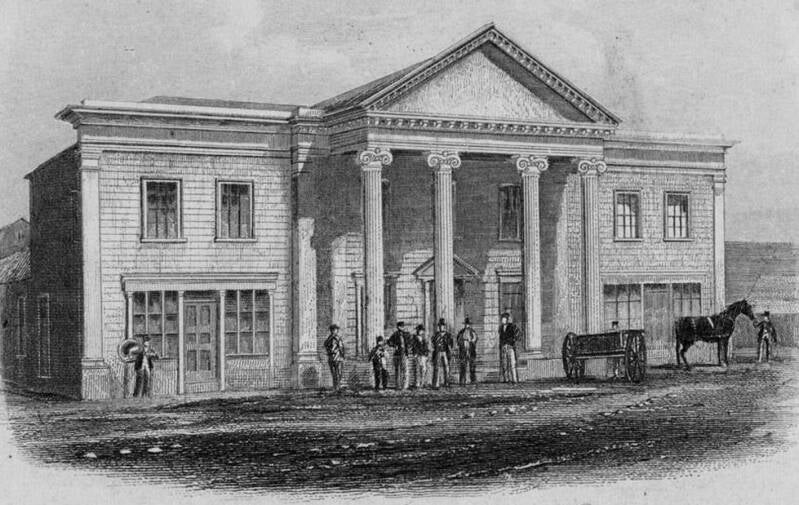
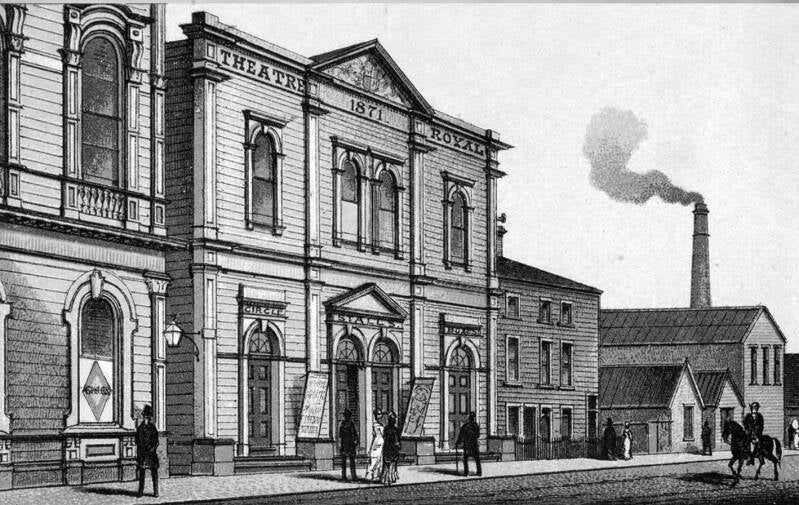
Left: The Odd Fellows Hall in Wellington. Neville created the new hall’s scenery in 1868. Right: The Theatre Royal in Wellington where Neville Thornton painted the scenery in 1877 and where the Thornton family staged a number of shows throughout the 1870s and 80s.
On the road with 'La Petite Amy'
In November of 1870, Neville turned up at the Theatre Royal in Christchurch and received congratulatory reports for his work in updating the scenery there. He remained in Christchurch for several months and it appeared he may have been unwell at the time as he was given a complimentary benefit performance in June of 1871. The Christchurch Star reported: “Mr Thornton has just recovered from a long illness and there is no doubt he will have a bumper house.”
There was another benefit performance in September in which “Little Amy” was referred to as the “principal dish” by one reviewer. It was also noted—and reminds us that Neville could pass himself adequately as a native of France—that “Mr Thornton essayed the part of a Frenchman superficially acquainted with the English language to great effect”.
In January of 1872 the Timaru Herald reported Neville Thornton and his daughter, ‘La Petite Amy’, providing entertainment at the Hall of the Mechanics Institute, where “Mr Thornton had painted some new and handsome scenery especially for the occasion”, noting that, “Mr Thornton is well-known in Christchurch and Dunedin as an actor, especially of French character”.
In July of 1872 Thornton reappeared back on the West Coast, putting on a show at Hokitika’s Sheehan’s Bijou Theatre which was billed as a benefit for ‘La Petite Amy’.
The Westport Times reported: “Since the departure of the (Australian) comedy and burlesque company (referring to Neville’s first stay in Hokitika), Mr Neville Thornton, whose repute as a scenic artist has few equals in the colonies, has been busily engaged in painting some elaborate scenery which will be introduced for the first time.”
The Times effused that: “Little Miss Thornton—who, as a member of the late troupe, became exceedingly popular, and added not a little by her comic powers and clever dancing to the success of the entertainments—tonight will essay a varied cast of characters. In addition to her usual comicalities, she will appear in two Shakespearean scenes, wherein, if report speaks truly, she proves a perfect prodigy of cleverness, sustaining the pathetic characters with graceful action and a truthful conception, marvelous in a child of such tender years.”
During 1872 and 1873 Neville and 12-year-old Amy were on the move and there were reports of performances and benefits in places like Westport, Greymouth, Nelson and Lyttelton. This would have had to be around the time he met his second wife Sarah, given that their first child, May, was born in 1873.
By December of 1873 ‘La Petite Amy’, had captured the attention of the New Zealand media. While in Nelson to paint new scenery for the local Masonic Hall, Neville appeared to be making the most of Amy’s youthful talents.
The Nelson Examiner reported: “An entertainment will take place tonight at the Masonic Hall, which should be well encouraged. Miss Amy Thornton (‘La Petite Amy’) will make her farewell appearance. The stage has been beautifully decorated by Mr Neville Thornton. We are almost afraid to say in how many characters ‘La Petite’ will appear. The wonder is how so young a child can have so true a conception of such a varied round of characters, embracing as these do Shakespeare, comedy, burlesque, dance and song, feats of legerdemain, and tricks of science. We hope that Mr Thornton and his little girl will see a crowded house on this their last appearance in Nelson.”
The above report was published in December of 1873, the year May Sarah Thornton (this author’s grandmother) was born in Nelson.
It was on 28 January, 1874, that there was the first-ever mention of a “Mrs Thornton” in the picture, when the Marlborough Express promoted a performance of the “gorgeous, spectacular, burlesque ‘Aladdin: The Wonderful Scamp’” at the Wairau Race Club in Blenheim.
Who was this second Mrs Thornton? No evidence of a marriage has been located; definitely not in the official New Zealand registry of births, deaths and marriages. No hint can be found of Sarah’s maiden name, where she came from, of her family or her life before she met Neville Thornton.
Sarah Thornton, who the website findagrave.com says was born 1854, died by accidental drowning in 1887, aged 33. The dramatic details surrounding her death follow later in this story. Sarah would have been about 18 or even younger when she became involved with Neville Thornton, and aged 19 when May was born in 1873. Neville was then aged about 39 or 40.
(Note: This is purely conjecture, but could it be that this Sarah was a teenage waif—possibly involved with the theatre in some way—who became pregnant after a relationship with Neville, most likely in Hokitika?)
Over a four-year period the registry of New Zealand Births, Deaths and Marriages lists the following children born to Neville and Sarah Thornton: May Sarah Thornton, born 1873; Daisy Marguerite Thornton, born 1875; and a son, George Neville Thornton—who died in 1876 as a newborn baby aged just 14 days.
In May of 1874, Neville, his wife Sarah, his own daughter Amy, and the recently-born baby May, arrived in Wanganui where they stayed for several weeks while he worked on the scenery at a local hall. The Wanganui Chronicle reported that an upcoming performance to raise funds for the Wanganui Library Fund was to feature “the little favourite La Petite Amy and Mrs Thornton, both taking prominent parts in drama and comedy”. So it must be fair to assume that Sarah had some prior experience on the stage.
In November the family was reportedly resident in Taranaki where Neville had provided new scenery for the local Odd Fellows Hall and where he put on his own production there featuring ‘La Petite Amy’ (now 13 years old). Once again she received glowing reviews as her climb to stardom gained momentum.
The Taranaki Herald wrote: “The chief performer was ‘La Petite Amy’; and well and ably did she sustain the various parts set down for her in the programme. It was really too much to expect that a child of her years would be able to keep the interest of the audience from flagging for the space of nearly three hours; yet Miss Amy succeeded in doing this—acting throughout in an easy, graceful, and attractive manner which is seldom witnessed in one so youthful.”
In New Plymouth in January of 1875, Neville’s third daughter, and second child to Sarah, Daisy Marguerite Thornton was born.
The family remained in New Plymouth until March of 1875 where a “grand farewell benefit and performance” was held at the Odd Fellows Hall. This time, for the first time, Sarah (named as Mrs Thornton) was given equal billing with Neville in the newspaper advertising, with “Mrs Thornton” playing the lead role in a dramatic performance of ‘Black Eyed Susan’ alongside Neville.
From March of 1875 it appeared the Thorntons had moved back to Auckland where Neville was once again working on scenery at the Prince of Wales Theatre, this time it would seem in a full-time capacity. In April, a complimentary benefit for Neville was held and featured the “first appearance of ‘La Petite Amy’” in Auckland.
In August, there was a three-night performance staged by Neville at the Theatre Royal in the gold mining town of Thames featuring Sarah (billed as Mrs N. Thornton) and “‘La Petite Amy’ in their comic duets, songs and dances”.
It could be that Neville had taken a week off from the Prince of Wales to test ‘La Petite Amy’s’ pulling power. The Thames Advertiser previewed the arrival of the Thorntons and it was all about Amy: “The Theatre Royal (in Thames) is to be reopened on Saturday evening by Mr N. Thornton and his company, the chief attraction of which is the talented ‘La Petite Amy’. This young lady (daughter of Mr Thornton) has been spoken of as a prodigy and from what we can gather the encomiums were not ill-deserved. This little lady may, in fact, pride herself upon having achieved quite a triumph.”
Neville continued his full-time work in Auckland at the Prince of Wales and it was not only Amy who was getting the acclamations. On 6 October, 1875, a new scene Neville had created was “greeted by a burst of applause which has never been equalled for enthusiasm in Auckland, a just compliment for the artist”. The New Zealand Herald reported that he was “obliged to bow his acknowledgments to a general call”.
In October Neville received praise for his acting skills when playing the Duke of Venice in a Prince of Wales performance of ‘Othello’ and other roles including Horatio in ‘Hamlet’. On 29 November the theatre provided a grand complimentary benefit for “Miss Amy Thornton”.
Neville continued working at the Prince of Wales through December creating “no less than 15 new scenes” for the theatre’s “great Christmas pantomime” staged on 24 December, 1875, where “Mr Thornton was obliged to appear on stage to bow his acknowledgments”.
Neville remained credited for his scenic work at the Prince of Wales into February of 1876. However, it appeared Neville had his own plans when the Daily Southern Cross reported in November of 1875: “Mr N. H. Thornton has formed, what he terms, a ‘Bijou Theatre’ company with which he proposes visiting the townships in the neighbourhood of Auckland prior to extending his travels further afield. The artists he has brought together have a very high reputation in the several departments of tragedy, comedy, dance, song and music. The company consists of Mrs Thornton, ‘La Petite Amy’ Thornton, Mr Thornton himself, with Messrs. Alexander O’Brien, C. Herbert and H. Milburn. They open tonight at Onehunga.”
(Note: A Bijou Theatre —French for “jewel”—was historically a small or intimate theatre, commonly used in the late 19th century for vaudeville acts.)
On 25 February, 1876, the Prince of Wales Theatre announced it would re-open for the new season with, “Miss Lydia Howarde, one of the greatest burlesque actresses in the Australian colonies, who makes her first appearance here”, with Neville Thornton billed as the scenic artist.
In February of 1876 Neville was reportedly invalided due to an infection involving the forefinger of his right hand “having been poisoned by some of the ingredients he makes use of in forming his brilliant colours”.
In March, Neville found the time to take part as a celebrity guest in a “Spelling Bee” as part of the first anniversary of the Pioneer Juvenile Lodge of Good Templars where he emerged the winner, apparently with some embarrassment, at once returning the prize, with the Daily Southern Cross commenting, “Mr Thornton, the well-known artist employed at the Prince of Wales Theatre, showed tact in resting satisfied with the mere exhibition of his orthographical prowess and returning the trophies of his easily earned victory to be competed for by more youthful aspirants”.
In April of 1876, Neville was off again with his Bijou Troupe putting on several nightly shows at the Temperance Hall in Tauranga, assisted by members of the local Amateur Dramatic Club.
A review of the entertainment offered gave us a view to the openly racist attitudes that pervaded colonial society in New Zealand at the time. The Bay of Plenty Times wrote: “The programme commenced with the burlesque, ‘Black versus White, or The Unsanguinary War of the Races’, a skit on the late Waikato war, written by Mr Powell, a local celebrity. The male parts in the play being admirably sustained by the amateurs, and the female characters by the professional (Thornton women) players. This piece, from the variety of its humorous situations, the wit of the dialogue, and the not-to-be-forgotten Maori chief and tribe who appear, fairly brought down the house.”
In June there was a performance by Thornton’s Bijou Theatre at the Newmarket Hall under the distinguished patronage of Sir George Grey. In 1876, Sir George Grey was a prominent political figure in New Zealand, acting as the Superintendent of the Province of Auckland and a Member of Parliament for Auckland City West. It would appear Neville had made the acquaintance of Sir George as this was just the first of several performances the former Governor and future Premier of New Zealand lent his patronage to.
Also in June, there was a report from the Auckland Police Court of Neville Thornton taking his landlord, a Mr Henry Schumaker, to court for abusing him by calling him a “swindler and other epithets”. Schumaker had prevented him from removing his furniture as he vacated his rooms unless 10 shillings beyond the rent that was due was paid to him. Thornton said he left the rented premises because Schumaker had failed in carrying out his promises and because the adjoining house was used as a brothel. He said he objected to paying the unjust demand of 10 shillings in lieu of notice.
A witness told the court he heard the word “swindler” used by Schumaker towards Mr Thornton. Mrs Thornton (Sarah) said she too heard the word “swindler” used to Thornton. The Court ordered “Schumaker to be bound over for £20, to keep the peace for three months, and to pay the costs of £2 4s”.
Also in June of 1876, Neville took a case to the Resident Magistrate’s Court against R. J. De Lias seeking damages of £27 over a breach of agreement. It is of note that R. J. De Lias was the lessee and manager of the Prince of Wales Theatre. Neville was now working on scenery for the new and soon to be opened 1500-seat Theatre Royal, which went on to be a prominent Auckland theatrical venue after its opening in August of 1876.
However, the dispute must not have been all that serious, as in mid-June Amy appeared at the Prince of Wales for a complimentary benefit and in July both Amy and Neville acted in a play there. It was also reported that Neville was engaged on new scenery at the Theatre.
Neville’s case against De Lias was adjourned for some weeks as Sarah Thornton, who was supposed to be an important witness in the case, was unable to appear in court as she was about to give birth. This was the birth of the boy, Neville George Thornton, who died as an infant after surviving just two weeks.
The New Zealand Herald noted the death: “Thornton: On Sunday, 13th August, George N. Thornton, aged 14 days, infant son of Mr and Mrs N. H. Thornton, scenic artist.” It is pertinent to note that Neville appeared at the opening of the new Theatre Royal, responding to a curtain call from the audience, the night after the boy’s death.
On 24 August, Neville’s case against De Lias was apparently settled out of court. De Lias’s lawyer said it would have “turned out but a little comedy at most but he was happy to say that it had pleasantly ended in a farce”. The judge said he was pleased to hear that it had so ended. A few months later, in October, R. J. De Lias had taken over the lease of the recently opened Theatre Royal.
In the middle of 1876, despite having lost his newborn son, Neville was definitely a busy man-about-town. In September he was co-credited with a Mr H. Holmes for the scenery for a new play at the Theatre Royal, created scenery for a fundraiser concert put on by the Newmarket Literary Institute at the Public Hall in Newmarket, and was credited along with Holmes, Adams, Solon and assistants for the scenery for ‘Rip Van Winkle’ at the Theatre Royal, as well as acting parts in other productions including ‘The Yankee Teamster’, after which Neville had to answer repeated curtain calls for the calibre of his scenery.
In October of 1876 Neville was in court again, this time as the defendant after apparently falling foul of the council’s diligent Inspector of Public Nuisances, a Mr George Goldie, who was alleging that Neville had been in breach of Bylaw No. 6, section 72, clause 540, in that he had “neglected to keep clean his private yard”.
Such was Neville’s fame at that time that the Auckland press were all over it, with the Auckland Star headlining a lengthy account of the proceedings as ‘The Inspector and the Artist’.
Inspector Goldie gave evidence that when he visited the property in Coburg Street he found “a number of kerosene tins filled with filthy matter”. He introduced a witness, a neighbour, Mr O’Connor, whose wife it was who had alerted the authorities.
Neville argued that the mess was already there when he rented the house. Mrs Thornton (Sarah) gave evidence that the rubbish had been tossed over the fence by Mrs O’Connor, who was in the habit of throwing “stinking fish and rags” onto the premises. However, Neville was found guilty when the judge ruled that he should have cleaned the mess up anyway and charged the landlord for any expenses. He was fined 10 shillings with costs of £3 13s 6d.
Neville continued at the Theatre Royal, where R. J. De Lias was again his boss, often being “called to the curtain” in recognition of his scenery. Amy, who was now 15 years old, was sometimes performing on her own, and receiving enthusiastic reviews, in Saturday night concerts at the Temperance Hall.
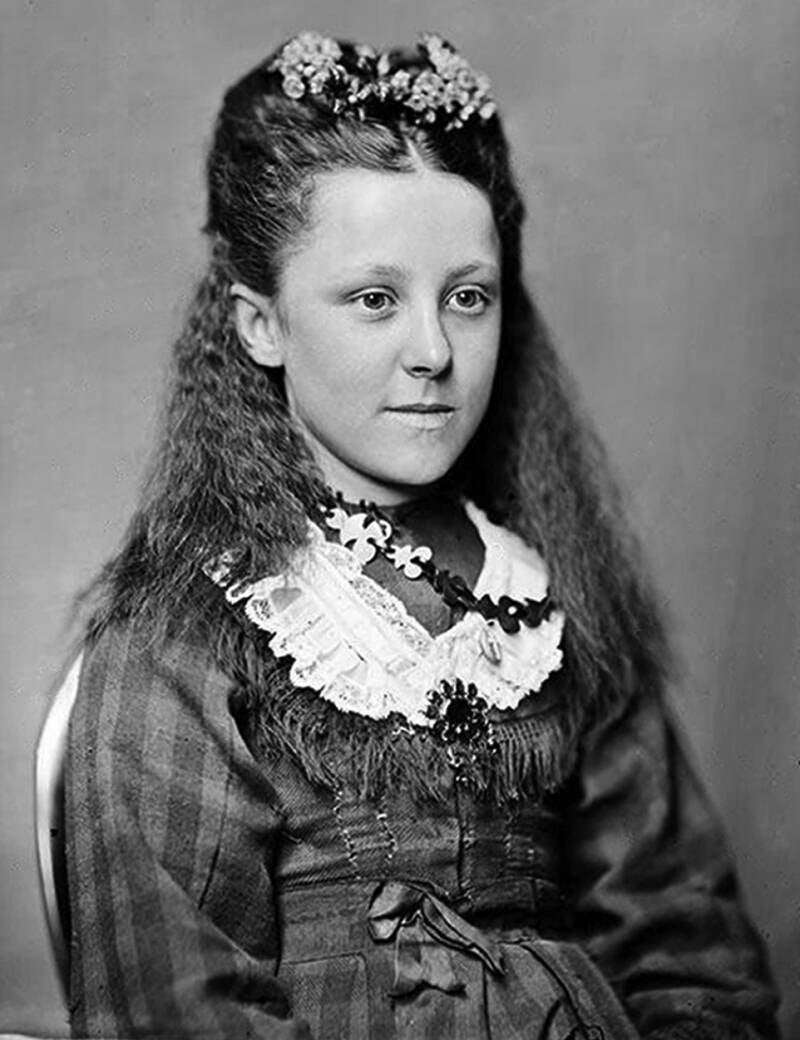
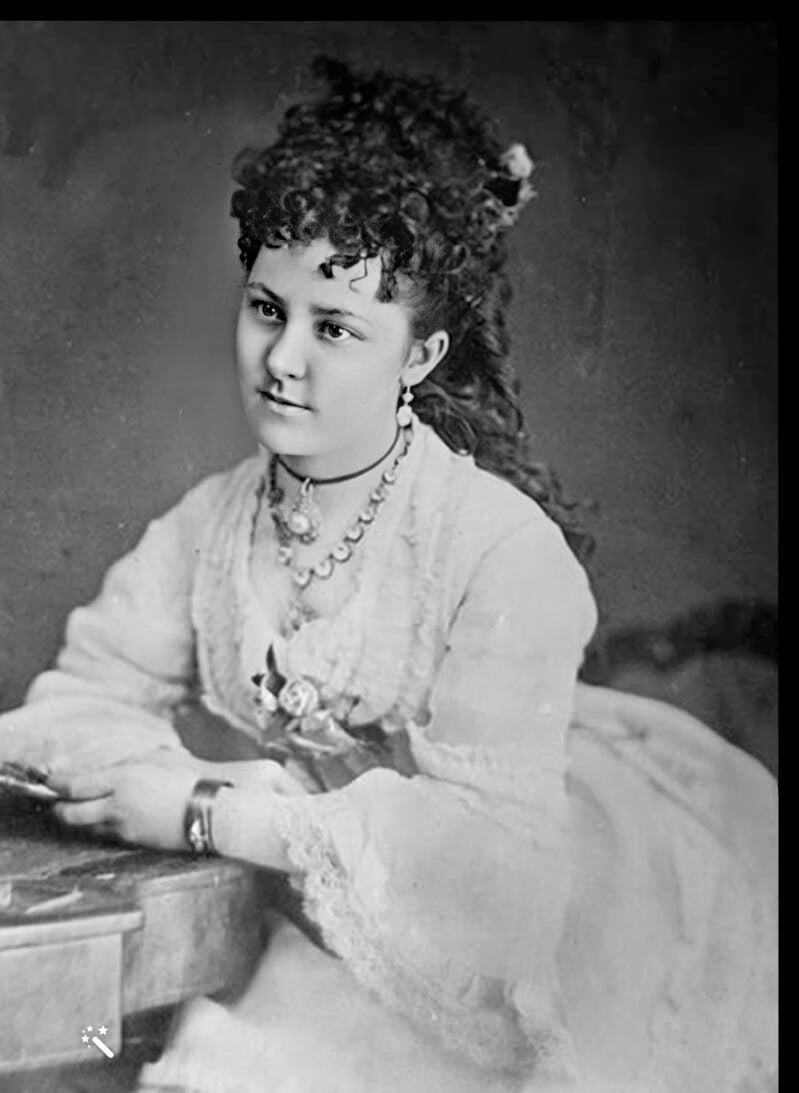
Two of very few images to be found of a young of Amy Thornton. The image on left is from a glass plate negative held by the Nelson Provincial Museum, simply titled 'Portrait of a Girl'. The image on the right is also from the same source and is captioned 'Miss Amy Thornton as Louise in Fritz'. It was taken by Robert Henry (R.H.) Bartlett—one of the most prominent early commercial photographers in New Zealand.
In December of 1876 Neville was before the court again as Inspector Goldie continued his vendetta and Neville was fined for allowing his closets (toilets) to overflow.
But Neville was too busy to worry about emptying his closets as he had been burning the midnight oil on yet another project. He had taken a lease on the Odd Fellows building in Lorne Street, known as the Lorne Street Hall, and had created his own theatre. The Auckland Star had the news: “The work is now complete with a new stage and proscenium and is a very handsome and useful addition to this popular place of entertainment. Mr Thornton has designed the whole of the work and of course done all the painting. The hall, in its improved state will open on Wednesday evening with a select company and some interesting pieces.”
The new hall opened on Saturday, 9 December, 1876, as the Bijou Theatre featuring his big drawcard, Miss Amy Thornton, “assisted by a host of professional and amateur talent”. However, there was bigger news in the entertainment scene in Auckland when the “celebrated artistes”, the Lingards came to town.
William Horace Lingard was a well-established comic singer, actor and dramatic author, originally from the British music hall scene of the 1860s. He and his wife, Alice Dunning Lingard, a former music hall dancer, had visited the United States in 1868 where they made names for themselves. In 1876, the Lingard company was touring Australia and New Zealand for the first time and after arriving in Christchurch in September they were now playing at the Theatre Royal, run by R. J. De Lias and where Neville was credited with painting the scenery.
Neville’s Bijou Theatre in Lorne Street opened on the same night the Lingards’ season opened at the Theatre Royal. The Auckland Star reviewed both shows the day after, commenting that the Theatre Royal attracted a “large and respectable audience”. The Star reported the Thornton family and their supporters opened the Lorne Street Hall as the Bijou Theatre in the presence of a “good audience”. It noted that Miss Amy Thornton appeared successfully in every scene and “displayed a versatility of talent”.
The Lingards played nightly at the Theatre Royal, with a well-filled house greeting the first production in Auckland of a play which the New Zealand Herald said “has elsewhere established itself in the popular favour”. That play, ‘The Two Orphans’, was a classic 19th-century French melodrama featuring two sisters—Henriette and the blind Louise—separated and navigating perilous adventures in Paris.
The New Zealand Herald saw fit to comment: “The scenic artist, Mr Thornton, deserves a tribute of praise for the really capital manner in which he has painted the scenes and generally arranged the properties. Mrs Thornton overdid her part; less display of cruelty would make the character appear more natural.”
Neville had created the scenery for this production and Sarah, despite the initial bad review, was playing a minor part as the season continued.
The Lingards stuck around Auckland until the New Year of 1877 and by then both Sarah and Amy Thornton were embedded in the cast.
The Lingard entourage left Auckland on 9 January with shipping records listing a Mrs and Miss Thornton accompanying the Lingard troupe as passengers on board the ‘SS Southern Cross’ bound for Napier, where Sarah and Amy appeared with the Lingards (without mention of Neville) for a couple of performances.
The Lingards presented a comedy, ‘Our Boys’ to a “capital house” at Napier’s Theatre Royal on 15 January, with Sarah and Amy both getting reviews in the newspapers; the Hawke’s Bay Herald commenting on “Mrs Thornton’s remarkable perception of the character she played with considerable comic talent”.
The ladies returned to Auckland in late January where Neville had been busy at the Theatre Royal working on scenery for an engagement by touring Irish comedian J. K. Emmet.
Joseph Kline “Fritz” Emmet (1841–1891) was a highly successful 19th-century American vaudeville actor and singer. Famous for his comedic “German cousin” character on stage, his signature yodeling and playing his own musical instruments. Then followed a season of melodrama performed by American actor Charles Wheatleigh. Neville appeared to be gainfully employed at the Theatre Royal through the winter of 1877.
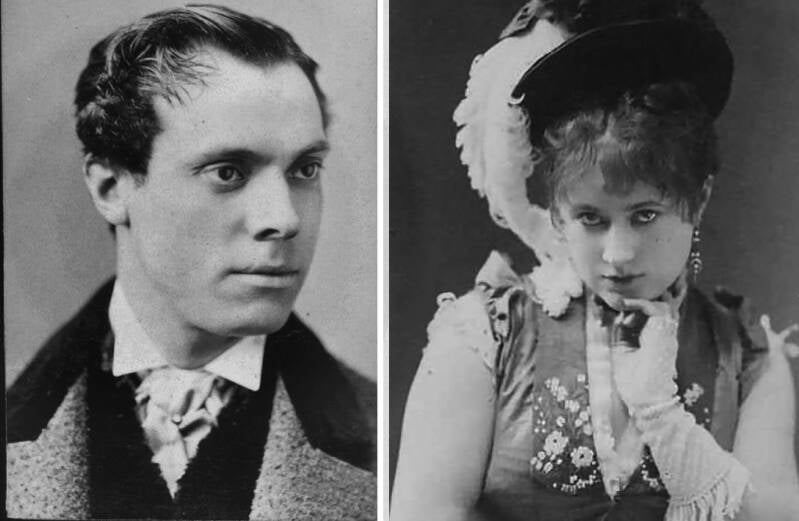
Horace and Alice Dunning Lingard., an American husband and wife acting pair who toured New Zealand in 1876.
It was interesting to note that in the advertising for the various productions at the Theatre Royal, and at other venues during this period, that the manager of the event (De Lias) and the scenic artist (Thornton) were “topping the bill” together—such was the importance of having a well-known artist like Neville Thornton credited for the scenery. Or was it that the canny De Lias used such flattery to keep the mercurial Neville Thornton on board?
It might not have been enough, for Neville decided it was time to take charge of his own destiny when in June of 1877 it was announced, in his own paid advertisement in the Auckland Star, that operating as the Comedy Company he had taken over Dornwell’s Albert Hall in Darby Street, off Queen Street in downtown Auckland, fitting it out with “new and beautiful scenery” and “providing varied entertainment three evenings weekly” featuring “drama, farce, burlesque, scientific phenomena plus feats of legerdemain”.
He stated: “Prices will be within reach of almost everyone wishing to enjoy an evening of harmless and rational amusement”. The advertisement also announced the engagement of a Professor Heinke who would perform “the Arabian Box Mystery and other feats of legerdemain and tricks of science”. “Mr and Mrs Thornton” and “Miss Amy Thornton” were also to feature in the performances with other theatrical talents.
The Auckland Star reviewed the opening night: “The Albert Hall, Darby Street, was opened last evening by Mr Thornton and his company of artists and performers. There was a fair audience, considering the number of counter attractions. We learn that Mr Thornton intends dedicating the Hall to Thespis at least three evenings a week. The opening performances were of a very pleasing character, and calculated to win general approval.”
Professor Heinke’s Arabian Box trick was apparently so successful that a repeat performance was arranged for the next night.
On 18 June the Thorntons appeared to have switched venues to the Choral Hall in Symonds Street, probably in order to host a larger audience, and were going all out in their advertising of an entertainment extravaganza under the “distinguished patronage of Sir George Grey, the attorney general, Chief Judge of the Native Land Court, the mayor of Auckland and the captain and officers of the HMS Sappho”. The Choral Hall was one of the largest buildings in nineteenth-century Auckland, seating 1100 people.
It was pretty much an all Thornton affair providing “sparkling and laughable burlesque”, with Mr, Mrs and Miss Thornton all playing the major parts, but included the good professor Heinke and his Arabian box trick (which he had apparently once performed in front of the Prince of Wales). This time he would be carefully observed by the New Zealand Attorney General and the Chief Judge of the Native Land Court, Francis Fenton.
The “Arabian box trick” involved inviting a strong man from the audience to lift a small wooden box, which the man did easily. He would then declare that he had used his magic to make the man “weaker than a woman”. When the strongman tried again, he could not move the box. Then the professor would invite his wife, Madame Heinke, to lift the box, which she did without effort. This was in an age when electricity was not fully understood (unless you were a scientist like Professor Heinke) who would signal an assistant under the stage to turn on a current of electricity resulting in an electro-magnetic force locking the box to the floor, making it impossible to lift.
On 21 July, 1877, the New Zealand Herald noted that the Theatre Royal was to be “reopened by Mr Thornton”. Neville had negotiated a short sub-lease of the Theatre Royal from his old nemesis, R. J. De Lias—but this did not turn out so well.
On 30 July the New Zealand Herald reported: “An action for damages has been instituted against Mr R. J. De Lias, the lessee of the Theatre Royal, at the instance of Mr Thornton and other members of the dramatic company. The damages are laid at £100. It appears that the company rented the theatre at the rate of £25 per week, and commenced a series of performances there last Saturday night, and they played three nights. In consequence, it is understood, of the rent not being paid nightly, Mr De Lias’ agent locked up the theatre, preventing the company from performing. At this stage, of course, little is known of the merit of the case, but it will no doubt excite some interest in theatrical circles if it is brought into court.”
De Lias reasserted his tenure at the Theatre—and even more so when, just a few months later, he bought the Theatre Royal for the sum of £7050. That amount would be worth $1.4 million today.
On 6 August, Neville wrote a letter to the Auckland Star explaining the sudden closure of the Theatre Royal during his company’s short-term lease of the premises as “no fault of the professionals but through differences with Mr De Lias”.
At this time Neville was working on scenery and stage decorations at the Academy of Music in Shortland Street. However, running into obstacles in Auckland may have prompted Neville to get out of town for a while.
The Taranaki Herald was excited to announce on 5 September, 1877, that: “Mr Thornton, the scenic artist, who was here some two or three years ago, may be expected shortly from Auckland.” The newspaper said it had received a letter from Mr Thornton, with an accompanying portrait of Miss Amy Thornton who “appears to have grown to be a fine young woman”.
A further report said: “Mr Thornton is arriving in New Plymouth by steamer to assist the Garrick Club in a number of dramatic performances”. The report also noted that “Mr Thornton’s family will follow in about a fortnight and in the meantime he is to be also engaged in repainting the scenery at the Odd Fellows Hall”.
Sarah and Amy arrived by steamer on 20 September, no doubt with five-year-old May and two-year-old Daisy in tow.
At the Odd Fellows Hall in New Plymouth in early November, Neville staged a “grand opening” of the “popular production ‘Don Caesar de Bazan’” with amateur actors from the Garrick Club, “supported by Mr and Mrs Thornton and Miss Amy Thornton”.
The Thorntons remained in Taranaki for several weeks, staging the first-ever dramatic performance in the town of Inglewood on 13 October and giving further performances with the Garrick amateurs at the Odd Fellows Hall including a fundraiser “in aid of the Indian famine” in which Amy topped the bill on most occasions.
On 26 November the Thorntons had headed south. Neville was back on the West Coast of the South Island working on scenery for a newly-built public hall in Greymouth.
The girls must have stayed behind while Neville started the job but on 14 December the Grey River Argus was pleased to inform the public: “Miss Amy Thornton, the talented young actress, who has always been a favourite on the Coast, arrived here by the ‘SS Wallace’ yesterday, after an absence of some years. She joins her father, Mr Neville Thornton, who has been engaged for some weeks in decorating the Public Hall, where he will shortly open with a small but clever and versatile company.”
On 21 December, 1877, the Greymouth Public Hall opened for business featuring “new and splendid scenery by Mr Neville Thornton” and starring “Miss Amy Thornton, the well-known and favourite juvenile actress supported by Mr and Mrs Thornton”.
By 1877 Amy, who had virtually grown up on the stage, was making a name for herself as an actress and singer of great promise in her own right. Over the ensuing 20-30 years she became a well-known theatrical star in New Zealand, touring regularly with her own companies under the name of “Miss Amy Vaughan”, always in the company of Daisy and May, and almost always supported by her father Neville with his celebrated skills as a scenic artist.
To give a reviewed perspective at this point—in 1877 Neville was 43, Sarah was 23 and Amy had just turned 16. As soon as his later children to Sarah could walk they too began appearing in his shows. After Sarah’s death he toured as a solo father with, no doubt, Amy acting as a mother figure to her much younger half-sisters.
Amy was once described by a newspaper reviewer: “Miss Aimee is a finished actress, her figure charming, a model of female beauty, piquant and graceful in every movement. She possesses a grand voice, reaching the upper register with ease.”
The much younger girls, May and Daisy, were also billed as Neville Thornton’s “pretty and talented little daughters” and later, as they matured, as gifted performers in their own right. The youngest daughter Daisy’s theatrical star may have shone the brighter of the two after May married our grandfather, herbal botanist George Henry Clapham in 1893, settling down in Auckland to provide him, eventually, with eight children.
Given that the youngest daughter Daisy was born in 1875, she would have been a child when her name began appearing regularly in the advertisements promoting the numerous Thornton family performances. She was billed alongside her big sister May as early as 1880 when May would have been aged seven and Daisy just five years old.
During this period the mother Sarah performed alongside Neville and the three young girls until her fall from grace and accidental death in the mid-1880s.
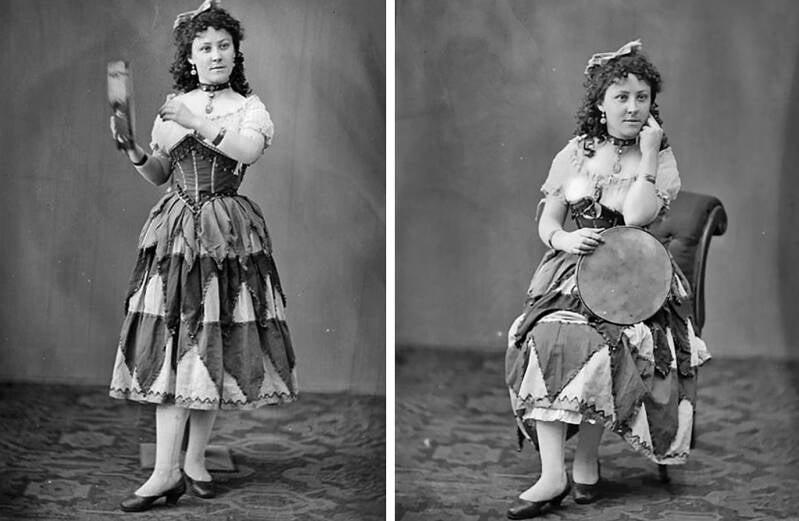
I came across these posed images of Amy Thornton, aka ‘Miss Amy Vaughan' on a website archiving the plate glass portrait photographs of late 19th century Nelson-based photography business, Isaacs and Clark. Amy would have been 13 or 14 years old when these were taken.
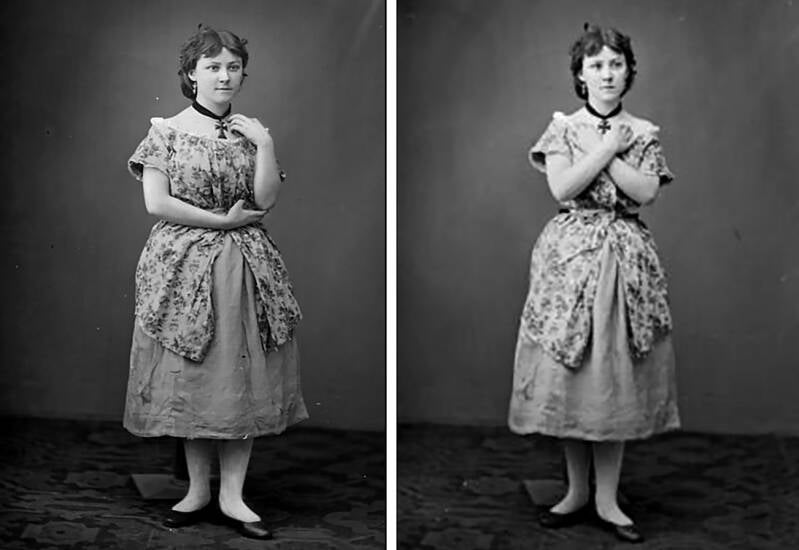
In the top photos the costume suggests Amy may be playing a character like a ‘gypsy’ dancer. Amy’s unusually short skirt, ballet-style flats, and dramatic pose in the bottom images suggest she is in character, possibly playing a peasant girl or a tragic heroine. Her short hair could be part of the character for this part but also allowed her to use a variety of wigs to assume various roles.
The troupe heads south
But let’s return to where we left off in this Thornton saga timeline, where from November 1877 to the middle of 1878 the Thornton family were in Greymouth. They appeared to have full charge of the Public Hall and staged a number of performances there, possibly in lieu of payment for Neville’s work on the scenery.
They took the show on the road to theatres in Kumara and Hokitika in January before returning to Greymouth where a complimentary benefit for Amy and Sarah was held featuring the Raphael Gymnastic Troupe, and our old friend Professor Heinke.
In May, news was released that a new theatre was being built attached to the Odd Fellows Hall in Nelson to accommodate an audience of 600. Reports said the painting of the scenery had been placed in the hands of Neville Thornton, a “gentleman whose ability in his profession is far from unknown in the town”.
On 13 July that year, the Colonist newspaper reported on the construction of the new establishment, the Theatre Royal, where Neville Thornton “has been busily engaged upon the scenery which is all but completed”.
The theatre's opening on 19 July gives us an insight into Neville’s talents as a showman (and possibly a conman) when the Auckland Star commented: “Neville Thornton, scene painter and actor is starring at Nelson, and on the occasion of the opening of the Odd Fellows Hall, he read an address, which was accepted as his own, and, according to the Nelson Evening Mail, was loudly cheered. The address, which he termed a prologue, was, with the exception of some dozen lines, the poem which gained the prize at the opening of the Theatre Royal in Auckland two years ago. Mr Thornton, with the air of a victor, bowed his acknowledgments to the audience without reference to the author of the lines in their original form, and the people of Nelson went away with the impression that a great poet had appeared before them.”
Neville soon had his feet under the table and was staging his own productions at the new Nelson theatre including “the magnificent, spectacular, operatic drama ‘Don Caesar de Bazan’” which he promoted for several weeks before its 21 August opening. It was not without its problems, as the Nelson Evening Mail saw fit to mention: “The Theatre Royal was but moderately attended on the occasion of Mr Thornton’s dramatic entertainment last night. The difficulties to be surmounted in putting such a piece as Don Caesar de Bazan on the stage must have been very great indeed, nevertheless Mr Thornton may be congratulated on the amount of success he achieved.”
The following week Neville donated a benefit performance to a family who had recently lost their home and possessions in a fire. This was followed by a performance starring the always-popular Raphael family of gymnasts.
Other productions included the “splendid drama of ‘The Colleen Bawn’” starring all the Thorntons and featuring “a magnificent water cave, the triumph of scenic art”; and a “Grand Fashionable Night” in benefit of Miss Amy Thornton “under the patronage of many of the most influential ladies of Nelson”.
Amy’s benefit on 16 November prompted some thoughtful but chastening criticism of the enthusiastic Thornton performers: “There was a capital house at the Theatre Royal last night, when Miss Amy Thornton took her benefit, but the attempt to produce a portion of one of Shakespeare’s plays was scarcely a success. When Mr Thornton announced that he was about to put the trial scene from The Merchant of Venice on the stage, it was generally thought that he was a little too ambitious, and last night proved that he had over-estimated the abilities of his company. The other two pieces were more within their scope, and the acting in them was highly amusing. When they do not try to fly too high, the efforts of this company to please their audiences are invariably successful.”
The Thorntons bid farewell to Nelson and in December of 1878 the Theatre Royal in Wellington credited Neville for “entirely new scenery” for a season of ‘Across The Continent’ starring the “talented and favourite artists Mr and Mrs F. M. Bates”, well-known professional actors of the era. Amy got work in her own right playing acting parts in the Bates’ Theatre Royal productions, including ‘East Lynne’, the stage adaption of a Victorian-era best-selling novel.
A newspaper report a week before Christmas of 1878 showed Neville and Amy appearing in a final show at the Theatre Royal in Wellington and three days later at the “grand re-opening” of the Odd Fellows Hall in Wanganui, under the management of the lessee, comedian E. D. Haygarth, where Neville was the scenic artist and Amy played a lead role in a “laughable farce” called ‘Nursery Chickweed’.
The Thorntons remained with the Haygarth Dramatic Company through to the middle of January 1879 and then returned to Wellington.
On 31 March, 1879, the Evening Post in Wellington reported: “The Theatre Royal was re-opened on Saturday evening, under the management of Mr Neville Thornton, when a new drama, entitled ‘The Mariner’s Compass’, from the pen of Mr Thornton himself, was produced. Mr Thornton stated that this was his first essay in dramatic composition, and we cannot congratulate him on the success of his maiden literary effort. The play was of a dreary length, the dialogue was very common-place, while the plot was neither original nor well worked out. The principal characters were very fairly sustained by Miss Amy Thornton, Mr Tom Burton, Mr N. H. Thornton, etc. Some very good songs were contributed by Mr J. Travers and Mr H. Oakley, and one of the features of the performance was the appearance of Miss May Thornton, a little child of five years, who acted with considerable intelligence.”
This was one of the earliest reviews of a performance by May Thornton who was just six years old.
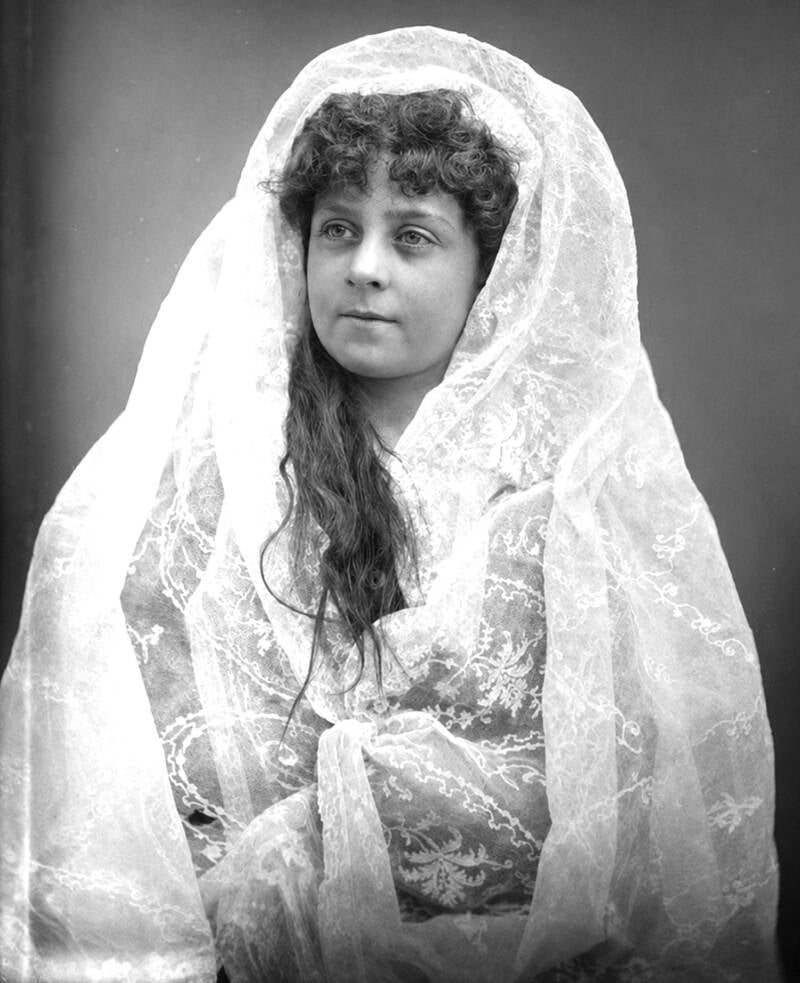
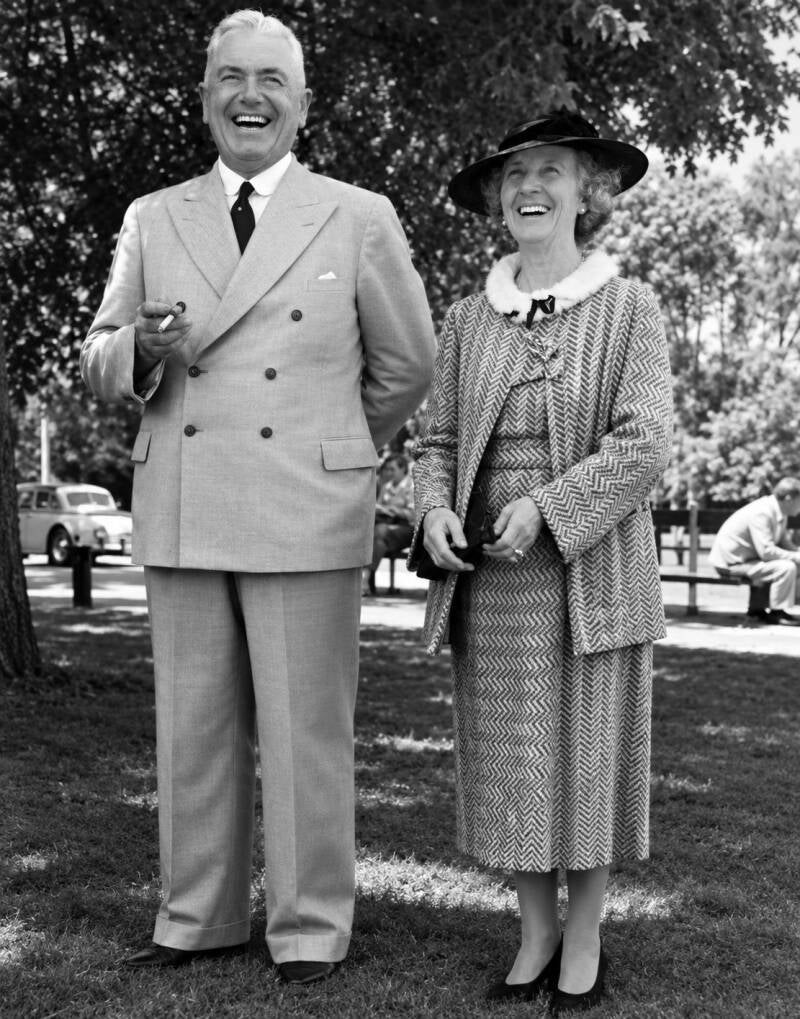
A rare image of May Thornton as a young girl and later in life with her husband George Clapham.
In the Evening Post review it was stated that ‘The Mariner’s Compass’ was an original play written by Neville himself and his very first “essay in dramatic composition”. This claim would later came back to bite him and perhaps to test his credibility.
However, as a testimony to Neville’s growing celebrity, on 3 April a benefit performance for “Miss Amy Thornton, the youthful comedienne” enjoyed the patronage and the presence of the premier Sir George Grey and several members of his cabinet.
With “The Mariner’s Compass” getting mixed reviews in the press, things went quiet on the Thornton front for several months. Times might have been tight for the Thorntons, for Amy appeared to be supporting an American magic act headed by a “Signor Ewini” on a tour of Marlborough: “Miss Amy Thornton appeared in the Lyceum Hall on Wednesday evening, and quite justified our expectations, but we regret to say that she was but indifferently supported by the company, otherwise what is really a pretty piece would have met with better encouragement. They are to appear at Picton night.”
The Nelson Evening Mail must have noticed that the amazing Miss Amy was punching under her weight by commenting: “Signor Ewini and Miss Amy Thornton gave an entertainment at the Theatre Royal last night, when the audience was but very small. In the farce Miss Amy Thornton acted well, as she always does. By the way, we are glad to learn from our Wellington files that this young lady has secured a good engagement in that city for the Christmas.”
The information was correct, with Amy secured for a Christmas Pantomime, to be produced at the Academy of Music. While Amy had been away with the magician, it appeared that Neville had been “busily engaged in the production of some grand pantomimic scenery”.
Amy seemed to be getting what work was on offer and in the new year she was working with an amateur group at a benefit performance of ‘The Lady of Lyons’ at the Theatre Royal, and in February a benefit for Amy was held, “assisted by the leading amateurs of the city and under the patronage of his worship the mayor”.
Amy seemed to have endeared herself to the people of Wellington, the New Zealand Times commenting: “The many friends of Miss Amy Thornton, the well-known and deservedly popular actress, who has made this city her home, will be pleased to learn that she is to take a benefit at the Academy of Music on Monday night. Miss Thornton is so thoroughly identified with the Wellington stage that the bare announcement of the fact should be sufficient to secure her a bumper house.”
For Neville, however, things must not have been going too well, for on 15 March of 1880, he filed for bankruptcy stating he was unable to meet his engagements with his creditors. His liabilities were put down as £129 (approximately $25,000 today) and his assets at £57 ($5400).
Ironically, Amy soldiered on at the Academy of Music in a production called ‘Happy Land’. A scheduled meeting of Neville’s creditors on 24 March was abandoned for lack of attendance by the creditors. There was no further mention of his insolvency in the papers and it appeared he was not declared bankrupt. Could it be that Neville was so admired in Wellington that his debts were somehow forgiven?
For the next thing we knew was that the Thorntons were on board the ‘SS Ringarooma’ which departed from Wellington for ports north on 1 May, 1880, and on 5 May the Hawke’s Bay Herald had the news: “Mr Thornton, the scenic artist and actor, with his talented daughter Miss Amy Thornton, have arrived in Napier. Mr Thornton, we understand, intends making a somewhat lengthy stay in this district, and purposes giving entertainments in Napier, Waipawa, and Waipukurau.”
The Herald had more detail the next day: “Mr Neville Thornton, the well-known scenic artist, has been commissioned by the proprietors of the Theatre Royal to paint some scenery for the stage. The present act drop will be replaced by a splendid painting, representing a feudal fortress of the Middle Ages, surrounded by woods and gardens. A stately drawing-room interior and Gothic chamber are among the items of new scenery included in Mr Thornton’s agreement. As soon as the drop-scene is completed Mr Thornton intends to bring out a drama entitled, ‘Borealis, or the Frozen Zone’, in which Miss Amy Thornton, who it will be remembered was in Napier with the Lindgards and J. H. Emmet, will make her reappearance as the heroine of the piece, supported by Mr and Mrs Thornton, her little sister May, and several of our leading amateurs.”
So, in May of 1880, after having declared himself insolvent two months earlier, Neville was now in Napier with the whole family billed as the “Thornton Dot Troupe”—Amy, or ‘Aimee’ as she was billed in Napier; “Little May”, Daisy who would have been five, and Mrs Thornton, who was given the name Miss Sara Neville in the billings. By June, “Miss Aimee Thornton”—the real star of the troupe—was topping the bill in most of the advertisements and posters for the Thornton entertainments at the Theatre Royal.
Neville must have been working hard to recoup his finances in Hawke’s Bay, creating new scenery at halls in Taradale and Waipawa while still completing the promised scenery for the Theatre Royal in Napier.
In Southern Hawke’s Bay there were complimentary benefit performances on consecutive nights at the Odd Fellows Hall in Waipawa and the Town Hall in Waipukurau with the whole family playing starring roles, including the enigmatic Miss Sara Neville and the five-year-old “La Petite Daisy”. By early November an offer by Neville to paint new scenery for the Waipukurau Hall was accepted.
It appeared that Neville’s modus operandi was to work on the creation of scenery for small-town theatres and then provide “grand opening night” entertainments once completed, with himself and his female entourage adding professional glamour to performances staged with the assistance of local amateurs. Neville, it would seem, staged these benefit performances as part of his contract to defray the expenses to the community for creating the scenic backdrops he had provided.
For example, on the opening night performance to celebrate the new scenery at the Waipawa Odd Fellows Hall on 23 October, 1880, front seats were two shillings and sixpence and back seats one shilling. In the 1880s, a shilling (1/20th of one pound) was a significant amount, often representing a substantial portion of a daily wage for a labourer. So from a full house at a venue like the Waipawa Hall Neville could potentially gross around £22, or $4500 at today’s value.

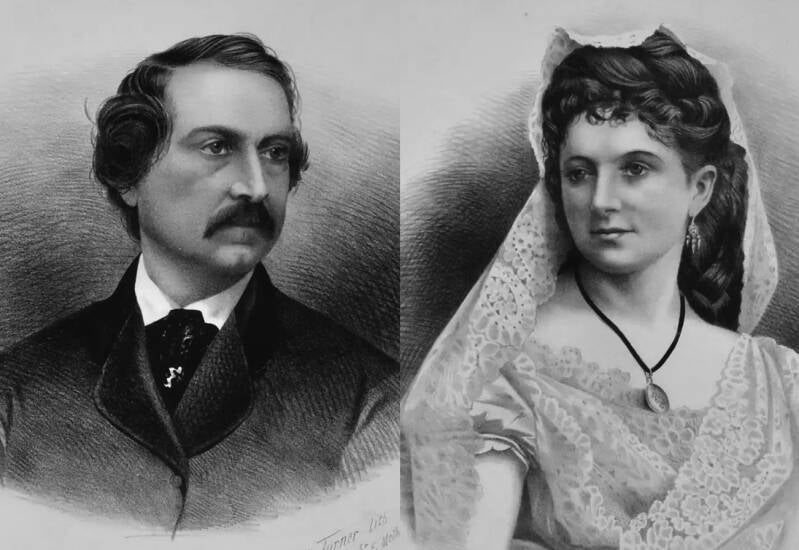
Left: The Opera House in the small Southern Hawke’s Bay town of Waipawa. Right: American actors Francis and Eliza Bates toured New Zealand in the late 1870s.
The Hawke's Bay connection
The Thorntons made Napier their home for several months, putting on their shows and supporting local amateur actors, getting mentioned in the newspapers regularly. In August they staged ‘The Colleen Bawn’, again supported by locals from the Napier Amateur Dramatic Club, including one Mr G. W. Hodgson, and later that month there was a benefit performance for the Napier Fire Brigade.
It was during and after the Fire Brigade benefit that Neville got into a bitter dispute with the opinionated local amateur theatre identity, Mr G. W. Hodgson, described by one newspaper as “a local histrionic genius”.
In early October of 1880 it was reported: “Mr Neville Thornton has been getting into very hot water at Napier. On September 20 a performance was given at the Theatre Royal in aid of the funds of the Fire Brigade, when ‘The Two Orphans’ was to have been played. The local Fire Brigade marched in procession to the theatre, and a large audience assembled, but only to be disappointed in respect to the entertainment, as Mr Thornton refused to go on with his part in the performance. An impromptu programme was then arranged, but after a selection had been played by the band, Mr Thornton mounted from the stalls to the stage, and endeavoured, amid groans and hisses, to justify his conduct. His ground of complaint seemed to be that Mr Hodgson, a local amateur, who seems to have been manager of this and previous entertainments at the Theatre, selected to play ‘The Two Orphans’ against Mr Thornton’s strongly expressed dissent, and notwithstanding that it had to be extensively cut—mutilated, in fact—in order to bring it within the playing strength of the company. He also complained that be was not consulted before the piece was selected. Mr Thornton was not allowed to finish his speech, but was forcibly ejected from the theatre by some of the audience. Mr Hodgson, in reply, stated that Mr Thornton had no right to expect to be consulted about the piece to be played, as he was only engaged to assist in the performance. A miscellaneous entertainment was given in lieu of the ‘The Two Orphans’ and passed off tolerably well.”
The public altercation on the stage of the Theatre Royal got front-page coverage in the local press and a flurry of correspondence between the belligerents followed.
Neville wrote to the Hawke’s Bay Herald on 4 October, 1880: “Sir: Will you kindly allow me to insert the following explanation of the affair between myself and Mr G. W. Hodgson. As regards Mr Hodgson, he has not contradicted anything contained in my explanatory letter. Any man with a spark of manliness in his composition would have allowed me to have been heard on the night of the entertainment, and not have allowed the persons behind the curtain to act like a pack of yelping curs. He seems to know more about my business than I do myself. Knowing that the ‘Two Orphans’ would be a failure if produced, and not to change the piece after the dictatorial manner he has assumed, Mr Hodgson determined upon making me the unfortunate scapegoat.”
The Hawke’s Bay Herald had a reporter at the Theatre who gave an almost verbatim report of the incident: “Mr Thornton who had been sitting in the reserved stalls, mounted the stage amid hisses and groans and other remarks of disapprobation. Thornton: ‘Ladies and gentlemen. (Groans.) I hope you will give me fair play. (Hisses.) I am a perfect stranger among you—(groans)—and expect to be treated in English fashion and if you allow me fair play and I will show you how unfairly and cowardly I have been treated in regard to this performance. It is not very likely that I would rashly incur the loss of the goodwill and respect of the whole community unless I had some provocation. I have been in the profession for 18 years, and have never been treated before with such unfairness and contempt as I have to-day at the hands of Mr Hodgson. (Hisses, groans, and general uproar.) I have always tried to keep in favor with the public.’ (Interjection from the crowd: ‘Yes, and filled your pockets. What about the amateurs!’) Thornton: ‘I told Mr Hodgson I strongly objected to the ‘Two Orphans’ being produced, as nine ladies were required and only three were obtainable.’ (Groans and hisses.) Hodgson: ‘Oh, you are not going to terrify me, and I’ll produce the piece on any account.’ Thornton: ‘I told him it was all very well for him to carry on as he did; he played for his amusement, and I for my living. (Interjection: “Up with the curtain.”) Hodgson said he did not care, that the piece would be produced under any circumstance.”’
The Waipawa Mail, reporting on the drama, commented: “Mr Thornton left the stage amid a perfect uproar. Such a scene is quite a novelty in Napier and we hope that it remains the same. As regards the performance, for an impromptu affair, it was gone through in very creditable style.”
In a subsequent letter in the Herald, Neville alluded to how a storekeeper named Heron, who was employed by Mr Hodgson, had cut off his credit at the shop where his family was buying essentials. He claimed that Sarah was turned away when she went to the store for potatoes.
Neville said when he accosted Heron about the halt on his credit at the store, he put it to the storekeeper: “Come on man, tell the truth. Have you not been influenced by Hodgson?” To which Heron replied: “Well, yes. I think you have quarreled with your best friend.” Heron was quoted in the Hawke’s Bay Herald the next day denying such a conversation took place.
The following day, Heron wrote a letter “in reply to Mr Thornton’s attack on me, that it is quite true, I did refuse to supply him potatoes—I am a baker not a grocer. But I must pronounce it false to assert I was influenced by Mr Hodgson. And I find in my books that Thornton still takes bread from me on credit.”
In reply to a statement made by Mr Thornton that the income he had received during his stay in Napier “barely covered housekeeping expenses”, Hodgson published figures showing that “Mr Thornton had derived a clear profit of £122 (around $25,000 today) from the various entertainments he had staged”.
This veiled attack on his financial integrity prompted Neville to go public with his costs—which incidentally gave us a closer view of the business complexities of a scenic artist of the time. (Note: £1 in 1880 would have had the purchasing power of about $200 today.)
He wrote in the Hawke’s Bay Herald: “Mr Hodgson seems to know more about my business than I do myself. Amongst other things he states that I received £30 for scenery at Taradale. My contract was for £16 (a little difference, you see, in one item) for carpenter’s work, iron work, ropes, pulleys, and painting, in addition to which I had to go out two nights and assist at two performances to enable the amateurs to meet the outlay. I have paid the ladies £6 5s for their assistance. He says also that the only performance that I have played for other than ourselves was the Fire Brigade benefit. How about the two hospital benefits? My gross receipts for playing amount to £132 16s. My expenses, independent of housekeeping, clothing, etc, amount to £86, which I make up as follows: Passages from Wellington (paid here), £12 10s; hotel expenses before taking cottage, nearly five weeks before playing, £20; colors etc (N. Williams) £6; rent theatre, £4; labor assistance, £8; timber, etc (Mr Holt’s account), £4; printing and advertising five entertainments, £18; ladies’ assistance, £6 5s; express hire, check-taking, pianist, £3 10s; refreshments at performances, sundries, etc., £3; total, £85 11s, leaving a balance of £47 5s for nearly five months for myself, wife and daughter. The £22 rent of Theatre I have allowed for, having only paid £4; the rest was in lieu of payment for scene painting. The cash balance of the contract was swallowed up in assistance, colours, etc.”
It is worth noting that on 9 October, Hodgson, making the most of the free publicity, was staging his own benefit performance assisted by the local amateurs in which Hodgson took a lead role. The Hawke’s Bay Herald described the entertainment as “somewhat dull”. It was also of note that the performance made use of a scenic drop described in the reviews as “a splendid work of art which reflects great credit on Mr Thornton who produced it”.
On 13 December of 1880 the Thornton family was back in Waipawa for two benefit performances, staging a “sparkling line-up of burlesque and comedy”. The shows were billed “to defray the expenditure incurred in procuring the much-needed scenic effects”.
Neville’s reputation back in Napier must have been somewhat tarnished after the Hodgson affair with the Hawke’s Bay Herald making a news item in relation to a public notice placed by the committee of the Waipawa Odd Fellows Hall commenting “it should do Mr Thornton an appreciable amount of good”.
The public notice read: “We have much pleasure in publicly conveying to you the best thanks for the very excellent and highly satisfactory manner in which you have performed your contract for furnishing the stage of the hall with appropriate scenery and fittings. The Committee unanimously agreed that the present scenic effects supplied by you are second to none when compared with those of any of the provincial theatres or halls in the colony, and they feel bound, in justice to yourself, as the artist who produced them, to give expression to that opinion. The Committee also desires to thank you for the enjoyable entertainments given by your talented family for the benefit of hall funds.”
In early November Neville had moved on to the neighbouring southern Hawke’s Bay village of Waipukurau where the local town hall committee there had accepted his offer to repaint the stage scenery. On the 15th the family was back in Napier performing at the Theatre Royal in support of Madame Franzini “the champion side-saddle cyclist of the world”.
Madame Franzini travelled widely on the colonial theatrical circuit from the 1870s to 1890s. A reviewer in a New Zealand newspaper pointed out that: “We need hardly say that she rides on one side, and therefore only uses one foot with which to propel the lever.” Another review described her act: “The feats she executes are astonishing, especially when we consider her weight and the dexterity required to manipulate the machine in the performance of difficult and fantastic evolutions. The best item in the programme was her circling through a maze of lighted bottles without touching one of them.”
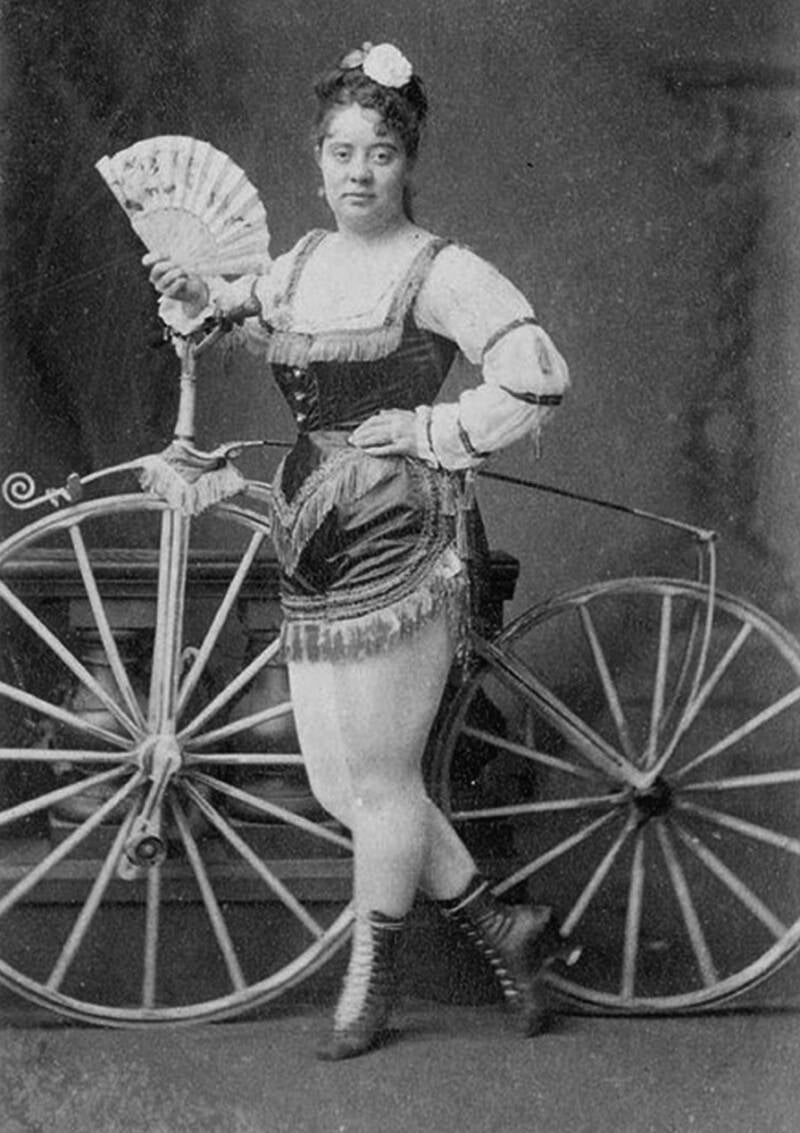
Madame Franzini travelled the theatrical circuit in Australia and New Zealand performing cycling stunts riding side-saddle on stage.
Back to Auckland and Amy gets hitched
The Thorntons’ tenure as residents of Napier must have been getting thinner by the moment when the Hawke’s Bay Herald saw fit to comment in a review of Madame Franzini’s dexterous performance: “It is to be regretted that a number of members of the larrikin fraternity made a disgraceful exhibition of rowdyism in the appearance of the Thornton family. Why they should import personal feeling into an entertainment in which the Thorntons are merely acting as engaged artistes is beyond comprehension.”
The Thorntons accompanied Madame Franzini, and her support act the “great Dutch comedian” Mr A. Hayes, on a tour of southern Hawke’s Bay, with Miss Amy Thornton, featuring as “the favourite song and dance artiste”.
In early December Neville completed his artistic work at the Waipukurau Town Hall and, as per usual, was presenting a number of entertainments to defray the cost of the work.
However, on 20 December a “preliminary announcement” in the Poverty Bay Herald previewed the imminent arrival of The Thornton Dot Troupe who would be providing “unrivaled entertainments” at the Gisborne Masonic Hall and other venues.
As 1880 became 1881 the travelling Thorntons turned up in Gisborne for the first time staging initial performances at the village halls in the rural settlements of Ormond and Makaraka ahead of a New Year’s Day show at the Masonic Hall, which apparently was not that well attended. Members of the Amateur Dramatic Club assisted in a benefit for the troupe at the instigation of the town’s mayor, Captain Winter. We also learned that a Mr McFarlane had engaged Neville for new stage decorations at his soon to be reopened local hall.
The Thornton Dot Troupe remained in Gisborne until late March of 1881 and in April they moved north to the Bay of Plenty where “Miss Amy Thornton” took the top billing with “assistance from Miss Sarah Neville and the Little Dots May and Daisy”.
The opening night in Tauranga was well received but the Bay of Plenty Times reported that: “We are sorry to learn that immediately after the performance of The Dot Troupe last night, Miss Aimee Thornton was seized with an alarming fit of an epileptic nature, the result of over exertion. The suffering lady was conveyed to her accommodation as soon as she recovered consciousness.”
The next day the Times made a correction: “In our last issue a paragraph was inadvertently inserted stating that Miss Aimee Thornton had been seized with a fit of an epileptic nature. We are glad to learn that the attack was merely a fainting fit from which Miss Thornton speedily recovered and that the young lady has never at any time suffered from anything more serious. Miss Thornton appeared on Tuesday evening and was in excellent health and spirits.”
As he had done in Napier, Neville entrenched himself in the local theatrical scene with the Tauranga Dramatic Club in June putting on a benefit performance for the Thorntons assisted by local amateur actors which started with a “torch-light procession through the town by the brass band”.
Amy must have had more than singing and dancing on her mind when the family was in Gisborne back in March—for on 1 June, 1881, the intended marriage of Amy to a Mr Charles Mogridge was announced in a number of newspapers. If we go back a few weeks, we will see that there was a Mr C. Mogridge playing a part in a performance assisted by “lady and gentleman amateurs of Gisborne” at McFarlane’s Hall. Charles Mogridge, a telegraphist originally from Napier, was heading the local telegraph office in Gisborne at this time.
The marriage was reported in the drama columns of newspapers throughout New Zealand reinforcing the understanding that Amy had become something of a celebrity by this time. The marriage took place in Napier on 5 May, 1881.
The Westport Times carried the “gossip”: “Many of our readers who remember Miss Amy Thornton as a little girl in Westport, will be interested to know that she was married on Thursday last week at Napier to Mr Charles S. Mogridge.”
The New Zealand Times noted: “Miss Amy Thornton, well-known to Blenheim audiences has recently taken unto herself a husband and with him the name of Mogridge.”
The Marlborough Express saw fit to erroneously add: “Not a pretty name for a playbill but probably the young lady has now retired from the profession.”
The Lyttelton Times was more sarcastic: “Miss Amy Thornton has been married to a gentleman possessing the sweetly euphonious name of Mogridge.”
From the date of her marriage to Mogridge, Amy largely disappeared from the theatrical reports with her name not heard of in the newspapers again until around 1885, a couple of years after the sudden death of her husband in 1883.
In the meantime, the Bay of Plenty Times ran a story on 21 June on preparations for a new show called ‘The Octoroon’, “a striking illustration of the terrible evils resulting from slavery in the United States” and stated that Neville Thornton had made it known that he intended to make Tauranga his residence.
After the opening night of ‘The Octoroon’, the reviews were not positive, even the Lyttelton Times saw fit to note: “The Thornton Family, assisted by a number of amateurs, produced The Octoroon at Tauranga but it was not a success, many of the amateurs being very indistinct in their utterances.”
Neville’s resolve to put down roots in the Bay must have been less than sincere, for on 16 July, 1881, the New Zealand Herald noted that Neville was back in Auckland where he had been working on scenery for the past three weeks for a grand production of the comic opera ‘Les Cloches de Corneville’ at the Lorne Street Hall, to be staged by Pollard’s Lilliputian Opera Company, a touring Australian company. This must have been a major theatrical attraction at the time going by the newspaper reviews.
Whether or not Neville followed the Pollard company after it left Auckland to tour New Zealand is not clear, but he was hardly heard of again until October, in connection to a new “Bijou Theatre”, a recent addition to the former Remuera Congregational Church Hall, where: “The scenery has been painted by that favourite scenic artist, Mr Neville Thornton, who has given every satisfaction in the execution of the commission.”
It appeared things didn’t always turn out in Neville’s favour, for at the very end of 1881, in the company of Mr Duke (father of Miss Gertrude Duke, the actress), he visited the Observer newspaper to “explain certain matters in connection with the performance given in aid of the North Shore Regatta Fund by the Amateur Dramatic Society”.
Neville stated that at the time the entertainment was first proposed, Mr Robertson, the secretary or manager of the Dramatic Society, asked him to go over to the North Shore and paint a garden scene at the Devonport Hall. Having been well paid by the Society previously, he agreed to do it for nothing, merely stipulating that his expenses should be paid so that he might not be out of pocket, at the end of the day amounting to 30 shillings.
The Observer reported: “Mr Robertson, however, after putting the scene painter off several times, told him there were no funds available to pay the account, as the entertainment had been a financial failure, and suggested he approach the Regatta Fund Committee which also declined to pay the amount owing. The actress Gertrude Duke was equally ‘chiseled’.”
By the end of January 1882, Neville was working on scenery for the newly-built Abbott’s Auckland Opera House. On 14 February he appeared in the Auckland District Court as an expert witness—and possibly as an early supporter of women’s rights—to give evidence in a case where an opera company had terminated the contract of a Mr and Mrs Thompson (her stage name was Miss Carrie Godfrey). Mr Thompson was a member of the orchestra and she was a leading singer. The company decided the heavily pregnant Mrs Thompson was not in a fit condition to sing.
Neville gave evidence on behalf of the Thompsons stating that he had been connected with the stage for the last twenty years and that the practice in such cases as that of Mrs Thompson was to allow the lady to play up till the day of her confinement, altering the cast and run of the pieces to suit circumstances. He knew of more than a dozen instances of this. “The ladies generally returned to their duties three or four days after their accouchement”, adding that husbands and wives received their salaries separately.
The lawyer for the defendant stated that he was prepared to call witnesses to show that Mrs Thompson’s state was such that it was “indecent for her to appear any longer”. However the judge said “this class of evidence would not avail so long as the lady’s competency to sing and play was not questioned”. A judgment was entered for the plaintiff for £20 and costs.
On 13 March, 1882, the Hawke’s Bay Herald announced a first-night performance at the Theatre Royal of Harriet Beecher Stowe’s ‘Uncle Tom’s Cabin’ staged by R. B. Lewis’s Mastodon Star Minstrels and Star Dramatic Company. Little May Thornton and Miss Sarah Neville featured in the cast of characters. Neville was not mentioned in connection with the show.
Could it be that May and Daisy were visiting with their mother Sarah in Napier, perhaps helping Amy with her new baby? Amy gave birth to her daughter, May Neville Winsor Mogridge, in Napier in February of 1882. The Mogridges were a family of some substance in Hawke’s Bay at the time, with Charles senior a local business identity.
The Hawke’s Bay Herald reviewed the performance of ‘Uncle Tom’s Cabin’ mentioning: “Little Eva was taken by Miss May Thornton, a child of about eight summers, in good style, considering her tender years. Her voice could be distinctly heard at all points of the house, and her fresh and innocent face, coupled with the child-like grace of the character won for her hearty applause.” The review also said: “Miss Neville had little to do as Eliza Harris, but she acquitted herself successfully.”
Miss Sarah Neville, as she was billed, and May Thornton appeared again at the Theatre Royal in Napier on 18 March in another grand production, ‘The Slave’s Revenge’, billed as a sensational drama in four acts.
On 5 May, 1882, Neville was reported in the New Zealand Herald as working on scenery at the new Opera House in Auckland that was fast approaching completion: “The scenic artist working late and early to accomplish his task in time.”
The Auckland Star stated that Neville had been working on the scenery ever since the signing of the contract for the large new theatre being built by Mr H. N. Abbott. The Star also gives us an insight into Neville’s actual skill as an artist, stating: “One peculiarity of Mr Thornton’s painting is that while the distance effect is all that can be desired, the minute detail he puts into his work will enable it to bear the closest inspection, without the aphorism occurring to the mind of the spectator that distance lends enchantment to the view.”
On May 24, 1882, the new Abbott’s Auckland Opera House finally opened for business with a formal opening where, “shortly before 8 o’clock, the stage bell rang out and the curtain unfurled slowly disclosing the act-drop painted by Mr Neville Thornton. A call was made for the artist and he duly responded. After expressing his acknowledgments for the flattering recognition that had been made of this latest effort of his brush, he said that if any credit were to be attributed to that production he felt bound to share it with his brother artist, Mr Henry Holmes, by whom he had been assisted.”

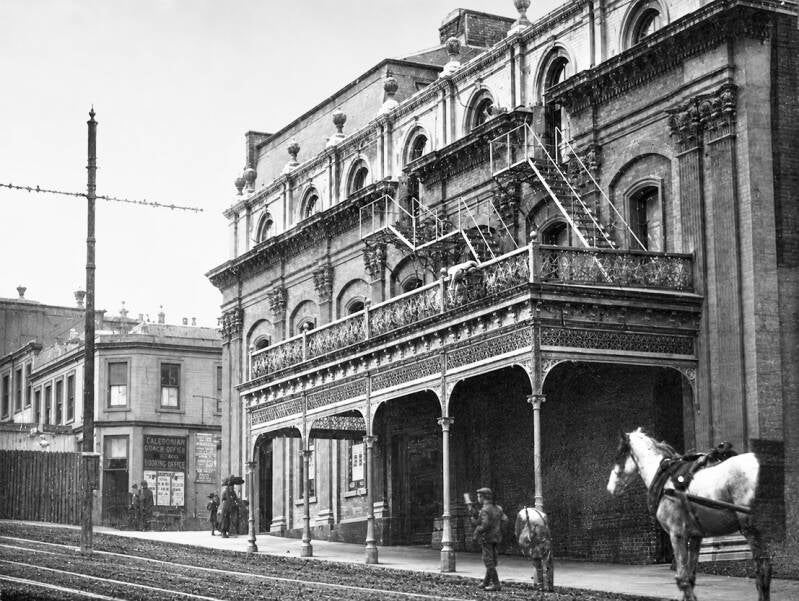
Abbott's Opera House, later to be known as Fuller's Opera House occupied the corner of Elliot and Wellesley Streets in Auckland. Built in 1882 by Henry N. Abbott. Originally designed for opera, the venue was eased by John Fuller & Sons, who transformed it into the heart of the largest vaudeville circuit across Australasia. it served as a primary hub for Vaudeville, musical comedies, and touring theatre troupes. It was completely destroyed by a massive fire on December 3, 1926. Following the blaze, the Fuller family commissioned and built the iconic St. James Theatre to replace it, while the original Opera House site on the corner of Wellesley and Elliot Streets was acquired by Smith & Caughey to expand their department store complex.
Back on the road and the beginning of Sarah's downfall
With the Auckland Opera House contract successfully completed Neville responded to a call for assistance and rushed by steamer to Gisborne to help with a rebuild of McFarlane’s Hall. Earlier that year, on February 5, 1882, the popular Gisborne hall had been destroyed when a block of buildings in the main town area caught fire.
The New Zealand Herald noted: “Mr Neville Thornton, the scenic artist, who is at present at work on the stock scenery of the Auckland Opera House, is to proceed immediately to Gisborne to paint the scenery for the new hall there, which has been built on the site of the one burnt down at the great fire at Gisborne. Mr Thornton decorated the original hall, and the proprietor was desirous that he should also be entrusted with the same work as respects the present one.”
The Poverty Bay Standard reported on 27 June, 1882: “Mr Neville Thornton, the well-known scenic artist—who it will be remembered by Gisborne folks as having executed the very pretty and artistic scenery and decorations for McFarlane’s Hall, burnt down some months back—has been re-engaged by the proprietor to decorate the new hall. Mr Thornton has seized on the opportunity, with shows at the Opera House at Auckland not requiring any great amount of his attention, to come down and pay another visit, and prove the versatility of his brush. We congratulate Mr McFarlane in being able to secure the services of Mr Thornton, and commend him for his enterprise.”
While in Gisborne he was offered more work by the business partners Arthur Parnell and Henry Boylan who were in the process of building another new hall there, and, after a quick return to Auckland to settle his affairs, he was back in Gisborne in September, this time with the family.
It was announced in the Poverty Bay Herald: “The well-known scenic artist Mr Neville Thornton arrived on the ‘SS Mahinapua’ from Auckland yesterday, accompanied by that promising little actress his youngest daughter (Daisy). Mr Thornton hopes, after the arrival of Mrs Thornton and the rest of his family from Auckland, to get up a series of burlesque and bouffe pieces, which should prove a happy inauguration of the Parnell and Boylan’s Bijou Theatre. He has received orders from the proprietors to execute a complete set of rural, domestic, palatial, and other scenery of all descriptions. His productions are always favorably received by the public, and we wish him every success with the good-natured audience which will greet the opening of the Masonic Hall.”
From this report it could be deduced that Neville and Sarah were married, although they were not always living in the same place due to Neville’s work commitments. The Poverty Herald’s shipping news reported “a Mrs Thornton and child”, that would be May, arriving in Gisborne on 6 October, 1882.
Note: It is of interest that this author’s sister, Christine McCulloch (Clapham), remembers her grandmother May in the later years of her life describing coming to Gisborne for the first time and being winched off a ship moored in Poverty Bay in a wicker basket to be taken ashore by lighter.
In Gisborne, Neville was involved in a real-life drama while working on new scenery for Parnell and Boylan’s Masonic Hall when he foiled an attempt by an unknown arsonist to burn the hall down by setting a lighted candle hidden beneath the stage atop a pile of rubbish; a common method of committing an arson. The hall opened on 23 September with a performance by the local Amateur Dramatic Society with Neville receiving “much applause and high encomiums for his taste and skill as a scenic artist”.
It appears the Thorntons spent some months in Gisborne producing shows with Sarah and his daughters, assisted by the local amateurs. In April of 1883 Neville staged what he billed as his own dramatic version of “the well-known novel ‘The Mariner’s Compass’”, as a benefit performance for the local fire brigade in the newly-opened Masonic Hall.
It appears Neville got in some sort of trouble over the copyright of “The Mariner’s Compass”, when in April of 1883 the Poverty Bay Herald published this letter from a company of solicitors addressed to the Fire Brigade: “We are instructed by Mr Gillon, the New Zealand agent for Mr Henry Leslie, author of the play called the ‘Mariner’s Compass’, performed by you on two occasions in Gisborne, to inform you that unless the sums of £4 (being the fee for the two nights) and £5, the costs and expanses to which he (Mr Gillon) has been put, at once proceedings will be instituted against you, and also against Mr Neville Thornton, and every one of the amateurs who took part in the performance, each of whom has rendered himself liable to a penalty of £2 for each representation.”
Neville responded with his own letter published in the Poverty Bay Herald. “In reference to the demand made by Mr Gillon for royalty and costs, regarding Mariners’ Compass, I may briefly state that when I dramatised the above play I was not aware there was any other version in existence.”
After this turn of events Parnell and Boylan allowed a benefit show to aid the Thorntons, a play called ‘The Ticket of Leave Man’ in which Neville played a leading role.
While in Gisborne the Thornton family received some shocking news. The Poverty Bay Herald reported the death in Napier of Mr Charles Samuel Mogridge, Amy’s husband, on 9 June, 1883, “after a lingering and painful illness, at the early age of 26”.
Mogridge had been ill since he had answered a call for regional volunteer rifle companies to assist the government’s Armed Constabulary in Taranaki in November of 1881 for what has become known as the invasion of Parihaka. The Hawke’s Bay Herald commented: “Parihaka was a ‘bloodless victory,’ but it has since cost at least one life.”
Parihaka is a historical Māori community in Taranaki famous for its nineteenth-century campaign of non-violent resistance against land confiscation. On 5 November 1881, 1600 government troops invaded the peaceful settlement, arresting leaders and destroying buildings—a tragic and defining event in New Zealand history for which the Crown officially apologised in June 2019.
Charles’ lingering illness had caused much concern in his home town where he was apparently a very popular man. After his death, one mourner later eulogised: “In private life he endeared himself to all who enjoyed his acquaintance and was always first to hold out the hand of help to anyone, let it be stranger or friend, in any time of need.”
The Napier Amateur Dramatic group, of which Charles was a member, put on a benefit performance for him which attracted a full house at the Theatre Royal, just weeks before his death. The benefit made a profit of £57 which was handed over to his wife when the benefit’s accounts were settled two weeks after Charles’ died.
The Hawke’s Bay Herald also reported that the amount of £200 from a policy on the life of the late C. S. Mogridge in the Government Life Insurance office was paid over to Mrs Mogridge, daughter of Mr Neville Thornton of Gisborne, within a fortnight of the claim being made.
One thing about Neville Thornton that I have so far failed to mention is that he fancied himself as a writer and a poet.
He penned this clever eulogy which was published in the New Zealand Observer in July of 1883:
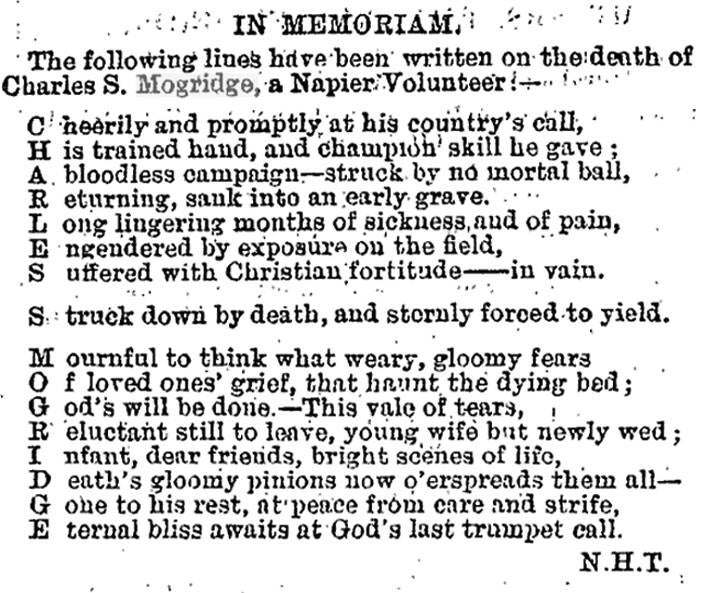
The Thorntons’ sojourn in Gisborne eventually came to an end and they returned to Auckland as the New Zealand Herald reported in October of 1883: “Mr Neville Thornton, the well-known scenic artist and theatre decorator, has returned to Auckland from Gisborne, and is again attached to the Opera House”.
His latest tenure coincided with the arrival from Australia of the well-known American actors Mr and Mrs Polk (Joseph and Julia), a husband and wife comedy act that toured New Zealand from 1883 to 1889.
Neville and the family were back living in Auckland and he was attached to the Opera House during most of 1884. We do not know what had become of Amy and her new baby during the time she was mourning the death of her husband a year earlier.
It was during 1884 that the Thorntons started making news headlines for more than their theatrical activities. There had been hints earlier that Sarah Thornton’s health and behaviour were deteriorating with newspapers noting she was unable to appear as billed in one of the troupe’s performances due to being “indisposed”.
In July of 1884 a man by the name of Augustus Collins was found “in a bed in the house of Neville Thornton”. One of his daughters said she came home at around 11pm from the Opera House and found the man asleep in her father’s bed. The man claimed he was drunk and was charged under the Vagrancy Act and spent 14 days in prison.
This incident might have had no connection but it was from around this time that Sarah started appearing repeatedly before the Magistrates Court in what can only be termed a shocking fall from grace.
We had no hint before this suggesting Sarah had a drinking problem but in August of 1884 she was charged with violently assaulting her husband and accused of mistreating the children. Excessive drinking was cited as the cause.
The New Zealand Herald reported Neville Thornton stating in Court that his wife had been addicted to drink for several years and had often behaved violently to her children. The Herald reported the prosecution stating: “At one time she stuck a fork into one of the children and assaulted the witness Mr Thornton when he tried to shield the eldest of her two children.”
Neville reportedly told the Court that his wife had been showing symptoms of an unsound mind but “when brought before two medical men they considered they could not find reason enough to commit her to the asylum”.
The Auckland Star reported the police stating: “It is a matter of regret that the prisoner (Sarah) is placed in her present position. Neville Thornton said he has constantly delayed taking proceedings against his wife, which is exceedingly painful to him. He said he was assaulted by his wife while endeavouring to shelter his child when she kicked him in a ‘dangerous part’. He said he wished her to be bound over to keep the peace ‘or something dreadful might happen.”
The judge agreed it was a “most painful case” and fined Sarah 20 pounds in default of imprisonment.
It is interesting to note that May (then aged just 11), the one who was allegedly stuck with a fork, was to be observed three months later, in October of 1884, starring as ‘Juliet’ in a family rendition of ‘Romeo and Juliet’ at the Opera House. This was also the first time we heard anything of Amy in a while, as it was reported that she and her sister Daisy also appeared in the performance.
For much of the early months of 1885, Neville and his daughters, including the recently widowed Amy, were back on the West Coast of the South Island giving performances in theatres there as Thornton’s Dot Troupe. The family appeared to be estranged from Sarah, who remained on her own in Auckland. Where Sarah was living at this time is unknown—but what she was getting up to was graphically reported in the Auckland newspapers.
Between 1885 and 1887 Sarah appeared repeatedly before the Auckland Magistrate’s Court on charges of habitual drunkenness. Convictions in February and July 1885 were followed by increasingly severe sentences during 1886 and 1887, including several terms of imprisonment with hard labour in Mount Eden Gaol.
In July of 1887, Neville was still on the road with May and Daisy. Amy had departed for Australia on what could be termed her overseas experience, performing in theatres and halls around Sydney. (More of Amy’s time in Australia to come.)
Meanwhile in Auckland, Sarah was convicted again and sentenced to yet another month in prison. By this time it seems the court had lost any sympathy for Sarah Thornton when the Auckland Star tersely reported on 11 February: “Sarah Thornton, on a fourth conviction for being a habitual drunkard was sentenced to three months’ imprisonment with hard labour.”
Imprisonment and hard labour did not seem to provide any form of deterrent, as not long after her release on 9 September, 1887, she was imprisoned again for a further month behind bars.
In the 1880s, there were no purpose-built women’s prisons in New Zealand. Instead, female prisoners sentenced to hard labour were held in cramped dedicated female wings within larger male prisons. Women’s “hard labour” usually involved punishing domestic tasks such as washing clothes (often for the whole prison), sewing, repairing uniforms and cleaning.
Comparing Sarah’s court appearances with the family’s theatrical engagements between 1885 and 1887 it can be assumed that she was living alone in Auckland, apparently separated from Neville and largely unsupported by her children.
Where she lived and how she got by with an obvious addiction to alcohol adds to the mystery of this woman and once again begs the question—just who was she? Did she have family of her own to help her? If not, how did she survive on the streets of Auckland in the 1880s?
In New Zealand in the 1880s people primarily consumed alcohol in private homes, hotels and in “grog shanties”. Unlicensed or informal binge drinking spots were common. Some women frequented these places.
That Sarah must have fallen in with men who encouraged her to drink, and possibly took advantage of her, can be seen in what happens next.


Mount Eden jail in the 1880s where Sarah Thornton served several sentences. At left is the female division of the jail in the late 19th century when locked up in the same prisons as men.
Sarah's shocking death but the show must go on
On 7 October, 1887, the same day Neville and the girls were starring in a lively performance at the Theatre Royal in Napier, Sarah was released from her latest stint in Mt Eden Jail.
The following afternoon she, along with three men, set out in a 13-foot sailing dinghy bound for Riverhead at the top of the Waitemata Harbour. Along the way one man disembarked at Hobsonville. Shortly after leaving the Hobsonville wharf, around 6pm, the boat was struck by a squall and capsized. Sarah and one of the remaining two men drowned. She was 33 years old.
A newspaper report at the time stated: “The parties are all well-known residents of Auckland. The woman Thornton had just been liberated from gaol and with the men left Auckland in a sailing vessel. It is stated they had a supply of liquor on board and the fatal ending of the trip is attributed to the anxiety to save a bottle of gin from sinking.”
The papers reported that the deceased Sarah Thornton was understood to be the wife of Neville Thornton, scenic artist, who at the time of the drowning was with his “little daughters” May (14) and Daisy (12) in Napier.
The New Zealand Herald claimed there were three men on the dinghy when it left the Queens Street Wharf with Sarah. The Press Association reports that Alexander Lynch, Sarah Thornton, Nicholas Hand—and a coloured man named James Williams—set sail for Riverhead. It claims that Williams was put ashore at Hobsonville wharf and it was not long after leaving the wharf that the boat capsized after a sudden jibe. A United Press Association report stated that “a negro named Williams made an unsuccessful effort to rescue those in the water by swimming out from the shore”.
The Waikato Times stated that the man who survived the incident was Alexander Lynch and claimed that he and Sarah Thornton were “rather notorious characters”. It said that the trio were going on a gum digging expedition. Lynch was described in some reports as a single man of about 53 years of age who lived at Riverhead. The Auckland Star saw fit to comment that Lynch was “well acquainted with the internal arrangements of Mount Eden gaol”.
United Press Association gave a full account of the tragedy on October 11, 1887, under multiple descending headlines:
Boating Fatality.
A Terrible Struggle For Life.
Two Persons Drowned.
“A melancholy boat accident took place on Saturday night at Hobsonville on the upper reach of the harbour, Two men, Alex Lynch and Nicholas Hand, with a woman named Sarah Thornton, had just left Hobsonville wharf, when the boat capsized.
“Lynch and Hand, who were both good swimmers got the woman to grasp the upturned boat and by their united efforts righted it. They then got into the boat but it had no sooner done so that she again upset. A second endeavor to right her was successful, and Sarah Thornton was placed in the boat, which immediately turned over for the third time.
“The men then decided to make for the shore, about 60 yards distance, and started swimming towards it, supporting the woman between them. When nearly half the distance to the shore had been traversed, Lynch suddenly gave the woman a shove towards Hand, and throwing up his hands, disappeared. Hand, who was much exhausted, struggled on with the woman for some distance further, but she slipped from his grasp and sank at once. He then struck out for the shore, which he just managed to reach quite prostrated. A negro named Williams made an unsuccessful effort to rescue the others by swimming from the shore.
“Two young men named McLeod also put off in a boat, but only in time to recover the woman’s body. The parties are all well-known residents of Auckland. The woman Thornton had just been liberated from gaol and with the men left Auckland on a sailing vessel on Saturday afternoon intending to go to Riverhead.
“It was stated they had a supply of liquor on board, and the fatal ending of the trip is attributed to the anxiety to save a bottle of gin from sinking. Sarah Thornton’s body was brought to Auckland and an inquest was held this afternoon. Lynch’s body is not yet recovered.”
The subsequent inquest held on 10 October thoroughly examined all the detail mentioned above. The main witness, the survivor Nicholas Hand, said they had a bottle of gin on board but had only had two nips each before the incident happened. He said they were not drunk and were capable of managing the boat.
The jury, without retiring, returned a verdict of accidental drowning. Sarah was buried on 11 October 1887 and interred at the Waikumete Cemetery in Auckland (Anglican Division C, Row 3, Plot 41.) The body of Alexander Lynch was eventually found washed up on a beach near Hobsonville on 25 October.
No news could be found in the archives of a funeral for Sarah or of Neville’s reaction to his wife’s death. Neville, it would appear, continued on with his work at the Theatre Royal in Napier and later continued to travel around the country with his children. Advertisements attest to shows in places like New Plymouth, Thames and Auckland.
Throughout 1889 and 1890 it appeared to be business as usual with Neville undertaking scenic projects in towns throughout New Zealand. For a time he was contracted to travel around the country with Mr Christie Murray—a prominent late-19th-century British playwright and actor.
The Auckland Star had the news: “The well-known scenic artist, who has been connected with the Opera House for some years past, has been engaged, by Mr Christie Murray to proceed South. Mr Murray was so delighted with the beautiful scenery painted by Mr Thornton for his production of ‘Chums’ in Auckland that he wishes that gentleman to paint the scenery for the production of the play in Christchurch and Dunedin. Mr Thornton will be absent some two or three weeks. It says much for his artistic ability that such a capable judge as Mr Christie Murray should think so highly of his work”.
Neville’s stardom was certainly rising. Everywhere he went he was lauded with comments like “new and magnificent scenery especially painted by Neville Thornton” and “dazzling splendor from the brush of the well-known and gifted artist”.
A search of newspaper archives during this period reveals hundreds of articles or advertisements in which Neville Thornton is featured and his work praised.
While Neville continued to earn acclaim as one of the colony’s foremost scenic artists, the real theatrical phenomenon of the late 1880s was increasingly his daughter Amy Vaughan. By 1890 she was no longer simply appearing in productions; she was creating, managing and touring them on a scale rarely achieved by a colonial actress.
Her sister May was appearing less and less in the family’s theatrical performances and on 14 July, 1893, aged 20, her marriage to George Henry Clapham, the eldest son of Herbert Clapham of Wellington, was announced in the newspapers.
Throughout the late 1890s Neville’s name continued to appear connecting to scenic painting projects around the country. November of 1890 found him painting scenery for the new Municipal Theatre in Wanganui. It seems that Wanganui had become his home during the early 1900s where he continued with his scenic artistry there, and also in Taranaki and the Wairarapa.
He also found time to write a series of patriotic songs regarding the Second Boer War in South Africa, some of which he had published, and are published for the first time at the end of this story.
One thing we have learned about Neville Thornton is that he didn’t walk away from a fight. In late 1901, the Cosgrove Dramatic Company, after playing nearly a week at Wanganui, announced their intention of extending their season for three nights, apparently as a bluff to put anxious creditors off the scent as they furtively attempted to skip town leaving behind a lot of unsettled accounts and many irate creditors.
Word got out and a number of creditors accosted the defaulting gentlemen of the company at the railway station. Neville was amongst the creditors and tried to prevent the Cosgrove’s boarding the train.
One of the Cosgrove employees interfered and a fight broke out on the platform between he and Neville. As the train whistle blew, a tug-of-war resulted between the company attempting to get on the train and the creditors trying to stop them.
As the train pulled out of the station one of the Cosgrove brothers leaned out of his carriage window gleefully shouting: “Goodbye boys.” An officer of the court armed with warrants was dispatched to overtake the company either at Palmerston North or Wellington. The money owing, together with costs, amounted to £50 ($2000 value today.)
In October of 1903 this short news item appeared in the Wanganui Herald: “Mr Neville Thornton, who has been appointed editor and manager of the new Stratford paper, was a passenger by mail train on Saturday. We understand that the paper will be conducted on independent lines.”
Whether or not this was our Neville Thornton could not be verified as there is no further mention of it. A year earlier he had spent time in Stratford working on scenery at the local town hall. Around this time Neville’s health was deteriorating.
Now residing full-time in Wanganui, he wore his French Legion of Honour medal at a parade commemorating the visit to the town by the Governor-General Lord Ranfurly in 1903. It is reported that he suffered what is described as a paralytic stroke in 1905. By this time he was 70 years old and married for the third time to an Elizabeth Crawford, who was 34.
Amy's rising star and the mystery of sister Annie
If we back up a couple of years, Amy Thornton had been making an even bigger name for herself during and after her trip to Australia. She had returned and fully embraced the stage name “Miss Amy Vaughan.” In June 1888, aged 28, she was the leading lady and director of her own theatrical enterprise, the Jubilee Minstrel, Variety and Burlesque Company.
This was a bold move as despite the high participation of women, the nineteenth-century New Zealand theatre industry was predominantly managed and owned by men, so Amy could be seen to have been something of a pioneer.
The New Zealand Herald reported: “A new season is to be inaugurated at the Opera House on Monday evening next. Miss Amy Vaughan, better known as Miss Aimee Thornton—the eldest daughter of Mr Neville Thornton, the scenic artist—and who has just returned from a professional tour through Victoria, New South Wales, South Australia, etc., and is very highly spoken of by the Australian press, purposes opening the Opera House. Her sisters, Miss May and Miss Daisy, will form part of the company, which has been carefully selected. Several new faces will make their first bow to an Auckland audience on the opening night.”
Prior to the inaugural performance at the Opera House, the New Zealand Herald wrote: “Miss Vaughan, who is better known as Miss Aimee Thornton, is one of the most versatile of colonial actresses, and the fact that she is directress of the company should be a guarantee of the success of the entertainment.”
The Lyttelton Times featured the following item in its ‘Dramatic Gossip’ column on 9 July, 1888: “Aucklanders are being treated to a variety show, known as the Jubilee Minstrel, Variety, and Burlesque Company. The opening performance was given on 27 June at the Opera House, and, according to the New Zealand Herald, the Company gave a really clever and novel entertainment. The Company consists of Miss Amy Vaughan, Miss Annie Vaughan, Mr T. Hudson, Mr Newell, Mr Collyer, Miss Hughes, Mr Hilton, and the De Lacy brothers (clog dancers).”
After the season at the Auckland Opera House, September 1888 saw Amy and her team on the road with the Cap and Jacket Company. They appeared first at the Waitara Town Hall in Taranaki in a one-night show featuring ‘Little Daisy’ (now aged 13) and scenery by Neville, before moving on to Alexandra Hall in New Plymouth and then to Wanganui’s Princess Theatre for a number of performances.
After Wanganui, the troupe—apparently without Neville—headed to the Theatre Royal in Wellington for four nights. A storm of newspaper publicity followed wherever Amy took her company.
In October 1888, the New Zealand Herald reported: “The Cap and Jacket Company has received very favourable notices in the press of the towns they have visited” and added that “Miss Amy Vaughan, who is well-known in this city, is supported by her sister, Miss Annie Vaughan.”
It is with this announcement that a new mystery involving the Thornton family appears. As the company continued its tour—to Masterton and then across to Blenheim, Nelson, Westport, and Dunedin—the “sisters Amy and Annie Vaughan” were referred to in a number of reviews.
The sudden appearance of Annie Vaughan, a sister to Amy, came as quite a shock to this writer. I questioned my older sister, who has a longer view of our family history, and this was also the first time she had heard anything about Amy having another sister, apart from her younger half-sisters, May and Daisy.
I went back through the archives and found a few clippings I had missed earlier. The most telling appeared in late March 1885, when the Kumara Times carried an advertisement promoting a two-night performance at the Theatre Royal in Kumara on the West Coast. It listed Annie as one of Neville’s daughters: “Thornton’s Dot Troupe, dramatic performance by Mr Neville Thornton, the well-known scenic artiste—and his daughters—Aimee, Annie, May and Daisy.”
It can be assumed that Neville, the wordsmith, wrote the advertising copy and therefore that it was he who identified Annie as his “daughter”.
The mystery deepens. Going back a further ten years, the Taranaki Herald in February and March 1875 promoted a week-long season of ‘Ten Nights in a Bar-Room’ (an adaptation of the 1854 temperance novel by American author Timothy Shay Arthur) and listed Miss Annie Thornton in the role of Mary Morgan, with other roles played by ‘La Petite Amy’, Neville and Mrs Thornton.
In a review of the play the Taranaki Herald noted: “Miss Annie Thornton, as Mary Morgan (the little daughter of the drunkard), was really excellent and her plaintive voice, as she implores her father to come home from the tavern, caused many amongst the audience to shed tears.”
In the novel Mary Morgan is an eight year old. If, potentially, Neville had produced a child while in Hokitika around 1866-67, that child would have been eight or nine years old in 1875. Annie was not mentioned in the troupe’s advertising again until March of 1885 when the Thornton Dot Troupe were on the West Coast and then was not mentioned again until Amy was working in Sydney from 1886 to 1888.
The first mention of Amy Vaughan in an Australian newspaper was on 10 December, 1886, where she was appearing at the top of the bill at the Alhambra Music Hall in Sydney, a popular venue managed at the time by Edwin ‘Teddy’ Shipp, a prominent figure in late 19th-century Australian variety theatre, most often managing his own minstrel troupes.
From there it appeared that Amy became a favourite of the Sydney theatre scene, billing regularly in dozens of events at a variety of venues, often with the Coghill Brothers Burlesque Company, a troupe known for producing minstrel shows and burlesques, touring Australia in the late 19th century.
On New Year’s Eve of 1887, the Fitzroy City Press reviewed a show performed by the Jubilee Minstrel and Burlesque Company at the Rae Street Temperance Hall: “It opened with a pianoforte solo by Miss Fernadez on whom the instrumental duties of the evening devolved. The next item, a duet by the Misses Amy and Annie Vaughan was very good, the voices blending well and the music rendered with taste.”
The Campertown Chronicle on 30 March 1888 reviewed a performance of the Valentine Minstrel and Burlesque Company at the Mechanics Hall in Sydney, and added to the puzzle: “The corner positions were occupied by members of the fair sex, Miss Amy Vaughan and Miss Thornton.” This would suggest that prior to assuming the same stage name as Amy, she was known as Annie Thornton.
Amy would have been 27 in 1888 and Annie, if she had been born in Hokitika in 1866, would have been about 22.
Amy, accompanied by Annie, returned to New Zealand in June 1888. They toured the country with Amy’s new Jubilee Minstrel, Variety and Burlesque Company, where they were often billed as the “sisters Amy and Annie Vaughan”. In the company’s minstrel sketches, Amy played “Tambo” and Annie played “Bones,” together known as the “corner men.” Before continuing with the mystery of Annie, it is worth explaining what these roles involved.
“Tambo and Bones” were stock characters from nineteenth-century American minstrel shows. “Tambo” played the tambourine and “Bones” played bone castanets. They exchanged jokes, comic banter and songs with the show’s host, known as the “interlocutor.”
The two characters were usually portrayed as comic fools and provided much of the humour, music and dancing in the performance. It appears that these routines formed the basis of the Vaughan sisters’ act.
Note: Minstrel shows were extremely popular in their day, relying on racist stereotypes of Black Americans and were commonly performed by white actors in blackface. Today they are widely regarded as a racist and embarrassing chapter in entertainment history.
Returning to the timeline, in September of 1888 the Jubilee Company, with Annie Vaughan now entrenched in the troupe, set off on a months-long tour of the country before settling at the Theatre Royal in Wellington for a season as Miss Amy Vaughan’s Cap and Jacket Company. The phrase “Cap and Jacket” in the context of minstrels refers to the traditional, vivid costumes used to capture the audience’s attention during comedic acts. The Company then sailed across the Cook Strait for performances in Marlborough, the West Coast, Dunedin, Ashburton, Lyttelton and Christchurch.
In July of 1889 Amy and her troupe were back in Auckland where the Auckland Star reported on a variety concert at the City Hall mentioning for the first time an appearance by ‘Miss May Vaughan’, “a little mite of only six years of age who was very loudly applauded and encored for her surprisingly good rendering of several comic songs”.
This would have been May Mogridge, who was born in 1882, Amy’s daughter with Charles Mogridge, her first husband who died not long after May’s birth. So, by 1889 ‘Little Miss May Vaughan’ was already part of the troupe and following the family tradition of the theatre.
In September of 1889 a performance at the Volunteer Hall in Hamilton featuring ‘The Vaughan Sisters’ adds a clue to the mystery of Annie describing her as “the sparkling comedienne and vocalist, late of Sydney and Melbourne”.
Something a little odd happened at the performance in Hamilton and introduces a new character to the plot that blends two historical family narratives.
At the bottom of the bill the manager of the production is named as “H. Clapham”. H. Clapham in this context could only have been Herbert Clapham, May Thornton’s (now Clapham) father-in-law and my own great-grandfather.
Under the management of H. Clapham the show moved on to Tauranga. After a quick tour of Northland the company returned to Auckland. From there on the troupe was called Miss Amy Vaughan’s Amazon Company, with performances from 28 January to 2 February, 1890, at the Academy of Music in Lorne Street, Auckland, where Herbert Clapham was again the manager of the show.
It is worth inserting this review by the Auckland Star which gives rare detail of one of the Amazon Company’s shows.
“Amongst the numerous evening amusements which are announced during the present week, none offers a more attractive and enjoyable night’s pleasure and fun than the Amy Vaughan Variety Company at the Academy of. Music. The Company is a good one, comprising capable artists in sentimental and comic songs, burlesque, comedietta, comic singing, and indeed in every department of a first-class variety show. The prices of admission are low to suit the multitude, and a shilling is well spent in listening to the programme of music, mirth and melody. Miss Amy Vaughan as Tambo and Miss Annie Vaughan as Bones kept the audience alive with their witty sayings. The following programme was gone through: Overture by the Company; Comic song, ‘Just to Pay my Respects to McGuinness,’ Mr Liston; ‘I’ll Await my Love,’ Miss May Travers, which was sweetly rendered and an encore demanded; Miss Amy Vaughan caused much amusement with the song ‘Wouldn’t You Like to Go ?’; Mr Fenton sang ‘All Very Fine and Large’, which was well rendered; ‘The Song That Reached my Heart’ by Miss Besant seemed to reach the hearts of all present, and had to be responded to. Comic song, ‘Whist, Whist,’ by Miss Annie Vaughan, was also well rendered, after which the first part was brought to a finish with a grand march finale. The second part of the programme was gone through with much spirit. Mr Liston’s singing of ‘His Funeral Takes Place To-morrow ‘was very funny indeed, while little Daisy Thornton’s jockey hornpipe fairly brought down the house. Annie Vaughan sang ‘Light in the Window,’ for which she was loudly applauded, and in response to an encore sang ‘Two Little Heads,’ after which Miss Amy Vaughan, in her coquettish manner, sang ‘Frolicsome Flossy’ and ‘I’m So Shy,’ after which the whole was brought to’ a close with a sparkling burlesque. The Company appear again this evening, on which occasion we hope to see a crowded house.
In February of 1890 the Auckland Star noted that Miss Amy Vaughan and her Amazon Variety Company had left by the steamer ‘SS Southern Cross’ for Gisborne to play a short season. Advance advertising in the Poverty Bay Herald announced the arrival of the “Vaughan Sisters’ Australian Amazon Burlesque Company”. Little Daisy was travelling with the troupe and Herbert Clapham was still named as business manager and travelled to Gisborne with the Company.
One wonders where Neville was at this time. His youngest daughter Daisy, a 15-year-old, seemed to be on the road and in the care of her older half-sister Amy and Herbert Clapham seemed to be in charge of their well-being.
Could it be that Herbert, a rather mercurial entrepreneur—who was better known around New Zealand as a headline-making medical botanist who claimed he could cure tuberculosis and other illnesses—was taking advantage of the success of his daughter-in-law May’s famous half-sister?
The arrival on the scene, albeit for a short time, of Herbert Clapham needs some further detail for it potentially adds a touch of Machiavellian intrigue to this family saga and Herbert’s background needs to be more deeply explored. I have since written an account of Herbert Clapham in another book to follow on from this one.
The Amazons sailed back to Auckland from Gisborne in March. In April of 1890 it was announced that Amy had taken over the management of the Auckland City Hall for Saturday evenings over the winter months under the banner of ‘People’s Popular Concerts’.
It appeared that Amy, as a businesswoman, had seen a gap in the competitive Auckland theatre market, and was offering “a series of popular entertainments at a low price of admission”.
Seats in the dress circle cost one shilling; the body of the hall cost sixpence. For the first time in a while, it was mentioned that Neville Thornton would be painting the scenery. Herbert Clapham no longer appeared to be involved.
The New Zealand Herald wrote: “The People’s Concert Company gave an excellent show in the City Hall, on Saturday night, at popular prices, to a fair audience. The entertainment was of the minstrel and variety type. Most of the items were encored. The second portion of the programme included trapeze, clog-dancing, etc.”
In October, 1890, the Observer wrote: “The People’s Popular Concerts at the City Hall are growing in popularity, and every Saturday evening sees a larger and more appreciative audience.” The programme of last Saturday evening contained nineteen items, including two side-splitting farces. The songs presented by Miss Amy Vaughan, who is now stage manageress, call for special commendation, and on each occasion she was accorded a well-deserved encore. The other performers, including Miss Annie Vaughan, were all at their best, especially the nigger servant in the last farce. The programme for the coming Saturday evening is said to be meritorious and must be seen to be appreciated.”
Amy’s business plan to compete against the Opera House and other larger theatrical establishments in Auckland appeared to be working. In November the Observer noted: “Amy Vaughan’s ever popular little show is still bowling merrily along and growing distinctly in favour, as may be seen by the fact that, though numerous counter attractions are presented on Saturday evenings, the City Hall still claims a good share of patronage.”
The Auckland Star saw fit to comment: “The People’s Popular Concerts have now become such an established institution, and are so really popular, that it is almost unnecessary to draw attention to them. Miss Amy Vaughan and her Company have established themselves in public favour as the providers of a really good variety entertainment”.
As Christmas of 1890 drew near an advertisement in the Auckland Star read: “Wanted at once, 50 Girls, from 10 to 12 years, for Pantomime. Apply Amy Vaughan, City Hall, Tomorrow afternoon, between 4 and 6 o’clock.”
The People’s Popular Concerts got rave reviews through Christmas and into the New Year of 1891 and in March there was a new flurry of media excitement when New Zealand Herald broke the news that Amy and her company were to occupy the prestigious Auckland Opera House for all of Easter week.
The Auckland Star followed up: “Amy Vaughan’s Amazon Burlesque Company opens at the Opera House on Easter Monday with an entirely new entertainment, introducing a regatta scene, in which all the rowing clubs of Auckland will be represented. An appropriate scene has been painted by Mr N. Thornton. Some new comic business will be contributed by Max Rinkle and Tom Makanini, new songs and dances by the Vaughan Sisters, and a laughable farce ‘The Belle of the Kitchen’ by the Company. At popular prices the Company should draw large houses?”
Hiring the large Abbott’s Auckland Opera House at Easter was a clever business model which Amy continued for several years. It must have been that the Opera House’s own schedule took an Easter break each year, a gap in which Amy was able to fill the 1300 available seats there for several nights, adding a valuable injection of funds into a business that relied solely on “bums on seats”.
In April, Amy announced she had leased the City Hall again for a second winter season of People’s Concerts. The concerts were again incredibly successful and continued through to December of 1891 with Amy now firmly established as an astute businesswoman as well as a talented variety performer.
On 21 December, 1891, a farewell benefit performance of ‘Black Eyed Susan’ and a “gorgeous Christmas pantomime” was announced at the Opera House for Amy and her company “prior to her departure for the south”.
On Boxing Day evening the company arrived in Gisborne by steamer at the start of an extensive summer tour of New Zealand, staging the well received shows from the City Hall season, ‘Little Monte Christo’ and ‘Black Eyed Susan’, with further concerts planned for Napier, Wellington, Christchurch and Dunedin. In Napier, Neville Thornton joined the troupe as the scenic artist.
One person who should also be mentioned from this time was Mr A. E. Woolcott, the hard-working advance agent for Amy’s company whose job it was to travel ahead of the team to each new location, organising the venues and arranging the advertising. Such was the fame of Amy Vaughan at this time that a visit to town by Woolcott made news in itself.
As the troupe travelled south, newspapers along the way heralded the arrival of Amy Thornton’s Burlesque Pantomime.
The Lyttelton Times gave an insight into the make-up of the Company and the entertainment on offer: “In connection with the Amy Vaughan Burlesque Pantomime Company’s season here, which opens in the Theatre Royal on Wednesday next. ‘Little Monte Christo’, a newly-written burlesque which has lately had a very long run in Auckland, where it was staged for the first time, will be produced. It was written especially for Miss Amy Vaughan by Mr Travers Vale. Mr Vale will be remembered as the dramatizer of ‘The Mystery of a Hansom Cab’, which has had such a run in the London and Australian theatres. The music in the burlesque was composed by the company’s musical director Mr E. J. Burke, who has won the most flattering opinions from the best of musicians. Miss Amy Vaughan, who is well-known through New Zealand as a burlesque actress, is touring the Company through the colonies. She has been, at great expense, engaging talent from the leading Australian theatres to stage her pieces. An Auckland paper, regarding talent engaged, mentions that Miss Amy Vaughan may consider herself fortunate in having acquired the services of Mr Max Rinkle as clown to her pantomimes. Max has been performing as a clown for the last twenty years, and is one of the best that has visited New Zealand. He has arranged the harlequinade for Miss Vaughan, and will introduce some of his own original tricks. Besides playing clown, Max plays some of the principal parts in the burlesques. Harry Cowan, who has made a name for himself in New Zealand as a comedian, is also with the Company. Neville Thornton is the scenic artist.”
Amy was at the top of her game with the Times providing a glowing account of Amy’s theatrical resumé: “Miss Amy Vaughan, is a daughter of Mr Neville Thornton, who has gained a high reputation as a scenic artist. She went on the stage in very early life, and had achieved fame as a juvenile actress when twelve years old. At fifteen she played the arduous part of Pauline in ‘The Lady of Lyons’, it is said, most creditably for so young an actress. She has played with Miss Lingard, Miss Alice Dunning, Mrs Bates, J. E. Emmett, and the late W. H. Hoskins and J. Hyde. Of recent years she has acquired great celebrity as a variety artist, and as such will appear before the public of Christchurch next week.”
Agent A. E. Woolcott was given a pat on the back by the theatre writer at the Observer: “Mr Woolcott, who has been piloting Miss Amy Vaughan’s Burlesque Co through New Zealand, is to be highly complimented on the excellent way in which he has acquitted the duties entrusted to him.”
The company travelled in the South Island putting on performances almost nightly in the major cities and towns through January and into the new year. On 11 February, 1892, it was announced by the Wellington Evening Post that the Company had arrived in Port Nicholson on the ‘SS Penguin’ having been forced to curtail their plans to play in Timaru “owing to the floods”.
The company performed a three week season in Wellington with a new nautical burlesque, ‘Little Bill and His Ship Amazon’ headlining, which the Evening Post pointed out was “an old friend with a new name, being a reproduction of ‘Black Eyed Susan’”. Neville was in Wellington as scenic artist. Amy’s daughter, ‘Little May Mogridge’ was also in the cast.
Over the next few weeks the company worked its way back north with visits to small towns like Woodville, Pahiatua, Waipawa, Waipukurau, Marton, Waitara, Hawera, Patea and also Napier, Wanganui and New Plymouth. With packed houses reported at every stop, Amy must have been running a buoyant business at this time.
In early April the company was back in Auckland but the Auckland Star reported they were not ready to unpack their bags just yet: “Miss Amy Vaughan’s Amazon Company returned to Auckland on Saturday, after a very successful colonial tour. They now go up the Waikato line as far as Te Aroha, playing at various places en route, and will return to open at the Academy of Music on the Saturday before Easter. The company have improved by their travelling and frequent performances, and will no doubt have a warm welcome from their old friends.”
However, reports from the Auckland Magistrates Court might suggest that things did not always run without a hitch for the travelling Thorntons.
On 8 April, in the Resident Magistrates Court in Auckland, Amy was ordered, in absentia, to pay a New Plymouth hotel keeper £9 1s 6d, the balance of an account remaining unpaid for 17 days board and residence for six adults and one juvenile.
Amy was absent because on that very same day she was in another courtroom where her former stage manager, the esteemed Mr Travers Vale, was suing her for salary and expense payments he believed were his due. Details from the proceedings give an insight into how Amy operated her business and are worth including in the story for this reason.
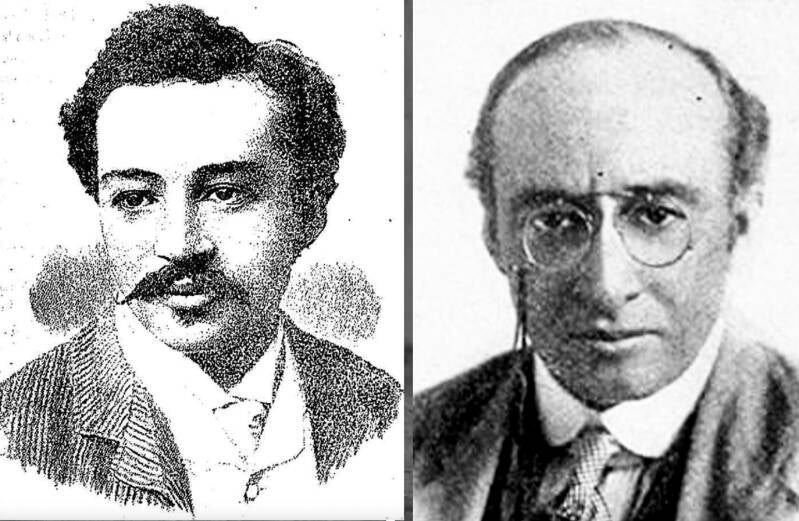
A sketch of Travers Vale while he was in New Zealand in the 1890s as Amy Vaughan’s manager (left) and in 1915 when he was a film director.
Travers Vale said he had accepted an engagement with Miss Vaughan at the beginning of May, 1891, accepting the position of stage manager at the rate of three pounds six shillings per week. (One New Zealand pound in 1891 would have been the equivalent in spending power of around $50 today.)
Travers Vale was born Solomon Flohm, an English-born theatre impresario, playwright, and actor. Raised primarily in Australia, he worked as a playwright and theatre manager there and in New Zealand prior to a successful career in film, directing more than 70 silent movies between 1910 and 1926.
In the middle of May of 1891, as Amy Vaughan’s manager, he arranged the production of a burlesque called ‘Little Monte Christo’ at the City Hall for which he was paid. The piece was subsequently produced at the Opera House, but he was not paid on that occasion. He said he had outlaid the sum of eight shillings for posting bills for the show and incurred other expenses in his capacity as stage manager, for which he had not been repaid.
When the company left Auckland on 24 December on its southern tour, it was under his management. He was engaged at the rate of £3 10s per week for the trip, with all his expenses paid.
However, on the way back north, at the town of Waipawa, he was dismissed from the company and the company clown Harry Cowan was appointed manager in his place. Nine weeks of the 12-week tour had then elapsed. He said Miss Vaughan refused to pay his passage back to Auckland, and he said he was left stranded in Waipawa.
He said he was claiming the fare from Waipawa to Auckland as well as three weeks’ pay for the remainder of the tour, a total of £18 19s 2d.
Annie Vaughan, the person who made payment arrangements with Vale, said she found fault with Vale for abusing her behind her back as well as casting “bad reflections” upon Amy Vaughan’s character.Annie told the court that all the amounts due to Vale for salary had been paid and there was nothing owed to him. In the end the judge ruled in favour of the defendant, with the disgruntled Vale having to pay court costs of £6 1s.
Back in Auckland, the company took up residence at the Academy of Music in Lorne Street with a first performance on 16 April, 1892, starting off a successful season of Saturday night shows through to July.
Then, from 15 July, 1892, the company was back at the City Hall for another winter season of ‘People’s Popular Entertainment’ which continued through to September.
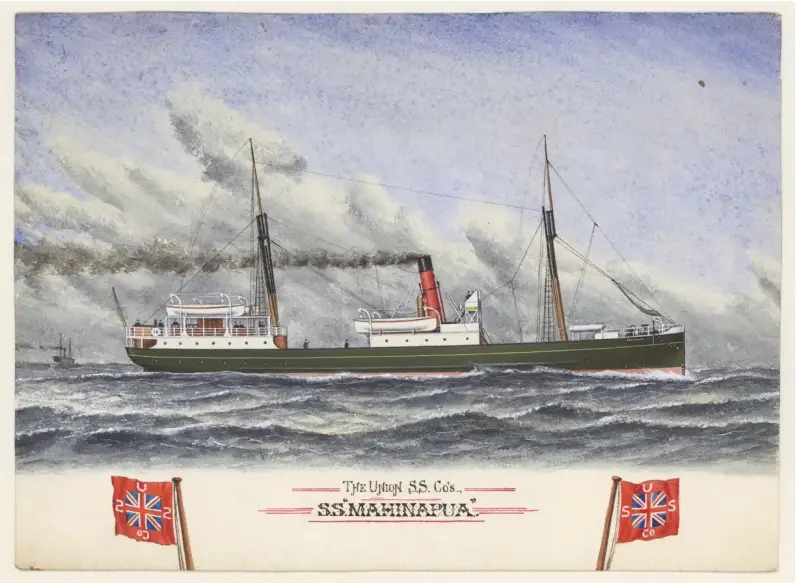
The SS Mahinapua was a historic steel steamship operated by the Union Steam Ship Company of New Zealand specifically designed to navigate the shallow, rough bar harbours of the West Coast. This was the means of transport for Amy and her troupe in the 1890s.
The troupe sails south and Annie disappears
On 15 September the Auckland Star reported the Amy Vaughan Company, consisting of 12 passengers in all, was on board the ‘SS Mahinapua’ heading for New Plymouth and other ports south. Once again the company was back on the road, heading to Wellington for another season at the Theatre Royal and a whirlwind tour of other theatres and halls in the lower North Island. Then it was across the Cook Strait for an extended tour of the South Island’s main centres, finishing in Greymouth six months after departing from Auckland.
Note: While I used the term “on the road” to suggest touring, there was not much road travel involved in the early 1890s in New Zealand. Travel was an arduous undertaking, particularly for a large troupe of performers and their equipment, relying on a mix of coastal shipping, newly-developing rail networks and horse-drawn carriages for inland journeys. Coastal transport between towns with ports was dominated by steamships, which had largely replaced sailing vessels for passengers and freight. The first motor cars were not seen in New Zealand until 1898 and the upgrading of its road network for motor vehicles did not start until the early 1900s.
It is pertinent to note that publicity from September 1892 referred to the troupe as “Cowan and Vaughan’s Amazon Minstrels”. Harry Cowan was billed as “the King of Minstrelsy” and also company manager. It would appear that Harry (the clown who took over as manager after Travers Vale was sacked the year before) had been given some sort of stake in the company at this point.
The company returned from Greymouth to Wellington in early March of 1893 where the newspapers reported that Miss Amy Vaughan, “the clever burlesque actress and vocalist, and the other members of her company”, had been engaged by Cadzow’s Musical Comedy Company for a season that would open at the Exchange Hall.
W. B. Cadzow was a notable Australian lyric tenor and stage performer active in New Zealand and Australia during the late 19th and early 20th centuries. He was most often mentioned in the company of ‘Madame Cadzow’ who was recognised as a leading pianist of the 1890s.
It would appear that Amy’s company had hired itself out to the Cadzow Company for several weeks. A gossip article in the Observer on 15 April alluded to Mr Cadzow “snapping up” performers including “Amy Vaughan and her troupe”.
The Cadzow deal seemed to last until around June of 1893 when it was announced that: “Miss Amy Vaughan, who has conducted successful concert seasons in Auckland for the last three winters, means to do the same in Wellington this year, and for that purpose has secured the Bijou Theatre, formerly the Exchange Hall. Her Amazons Company, which includes three or four new artists from Melbourne, will make its first appearance next Saturday night.”
Now based in Wellington, Amy started another grueling season of weekly concerts, with the New Zealand Times on 1 July, 1893, commenting: “Miss Amy Vaughan, a hard-working and deservedly popular artist, is trying management at the Exchange Hall. She is a plucky little woman, and I hope she will succeed. The inimitable Harry Cowan is a member of the company, and fresh talent is being brought over from Australia.”
It is of note that, while performing in their own productions, Amy and Annie were often employed as “local talent for hire” by international touring companies.
Of concerning interest is that from August of 1893, Annie Thornton’s name seemed to fade from all newspaper reports and announcements regarding Amy’s company, in fact from the theatrical scene altogether.
She was last reported performing a supporting role, along with Amy, in a touring production at the Wellington Opera House on 12 August of the William Gill musical ‘My Sweetheart’ by a company led by the internationally-famous American actress Miss Minnie Palmer, who was undertaking a tour of the colonies and was currently giving performances in Wellington.
This was the last time Annie Vaughan was heard of.
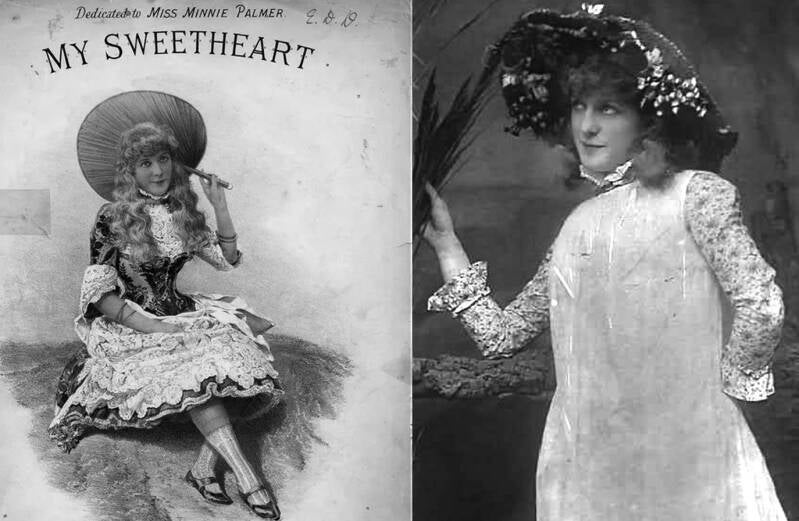
American actress Minnie Palmer performed her famous play ‘My Sweetheart’ at the Wellington Opera House in 1893 supported by Amy and Annie Vaughan.
Could it be that Annie was recruited by the Palmer Company to tour with them full-time? If she was in fact Amy’s sister, she would have been about 27 at the time. There was no mention of Annie’s name in New Zealand or Australia again after the Evening Post review of ‘My Sweetheart’ on 12 August, 1893. Did Annie want to pursue a career of her own? Was there some sort of falling out between the sisters?
The first hint that something was not quite right came in newspaper reports just 12 days later when Amy was reportedly unable to appear in one of the Palmer Company performances.
The newspapers made note of this: “Owing to sudden indisposition, Miss Amy Vaughan, who had been cast for Gladys Farwell, was unable to appear. Her place taken at a moment’s notice by Miss Maud Bursleigh, a member of the orchestra, who “winged” the part of Gladys. The young lady struggled heroically with the disadvantages with which she was beset.”
When the Wellington season came to an end, Amy and the troupe—notably without Annie—headed back north for scheduled shows in Wanganui and Hawke’s Bay, and numerous small towns along the way through September and October.
In Woodville on 10 October, 1893, Amy was listed in a cast described as “The Talented, Renowned, Original, and Complete Company of Star Artists”, in a production of ‘Uncle Tom’s Cabin’. “Little Miss May Mogridge” was in the cast. The “beautiful and real live scenery” was provided by Neville Thornton, who must have joined his daughters.
After the concert in Woodville the advertisements and reviews came to a halt for several weeks until the Auckland Star on 13 January of 1894 revealed in regard to Amy’s health: “Miss Amy Vaughan is once more in Auckland, and we regret to learn in bad health. As will be seen by an advertisement, her professional friends have kindly tendered her a benefit, which is to take place in the City Hall on Saturday evening next. Miss Vaughan was ever ready to assist in charitable objects during her last season in Auckland, and therefore she should have a crowded House on the occasion of her own benefit.”
The Observer added: “Amy Vaughan was seriously ill at Wellington and has not yet fully recovered.” The New Zealand Herald followed up on 20 January: “This lady has been seriously ill for some considerable time.”
What Amy was suffering from was never identified but one might wonder at the stress that the 33-year-old Amy had been under from the years of running her own company, performing herself most nights while travelling up and down the country by steamship and train.
Being a burlesque star in the 1890s was a paradoxical life of high-profile fame, late nights, intense physical work and often societal scandal. The female performers were trailblazing entertainers who navigated a male-dominated industry, often enjoying financial independence that few women of the Victorian era could imagine, while often being judged as “loose” women by mainstream society.
Amy may have been burnt-out, as they say today, but the disappearance of sister Annie from her orbit may have been at the core of Amy’s “indisposition”. Her theatrical friends realised that Amy was ailing and put on a benefit concert for her which the newspapers reported as a “success with a good attendance”.
Things went quiet on the media front for a few weeks until in March of 1894 it was announced that “Miss Amy Vaughan has fully recovered from her illness” and her Saturday night popular People’s Concerts would be resumed at the City Hall and would continue throughout the winter. The first such concert was held on 14 April with “new artists and a new programme”.
Amy recovers and here comes Harry
The People’s Concert season rolled through the winter of 1894 and came to an end in October when the Auckland Star announced: “Miss Amy Vaughan’s Amazon Company brought their series of weekly entertainments to a close for the season on Saturday night. The Amazons left for Rarotonga and Tahiti by the ‘SS Richmond’ this morning.”
There were no reports of Amy taking the Company with her on a tour of the Pacific. Shipping news archives revealed that just Amy and Daisy Thornton were travelling in the Pacific for some weeks before returning to Auckland on 27 December, 1894.
There were no reports of Amy’s activities in the Pacific Islands. Was this a much-needed rest? Was it time out for Amy to recover from what had been troubling her for several months? Was she seeking the panacea of a warmer climate? In the 1890s, Pacific holidays were exclusive, elite ventures, with wealthy travellers taking winter steamship cruises from Auckland or Sydney to the tropical islands.
On her return, apparently restored and revitalised, Amy’s Amazon Company leased the Auckland City Hall promising “a new season of burlesque and variety” through 1895 and announced an entire change of programme which would include comedian Harry Baxter who was making his debut with the Company. That’s a name we should keep an eye on.
On 6 December, 1895, Amy was tendered a benefit performance and a grand double bill was announced, including items by the Tivoli Comedy Company and on 23 January, 1896, the Auckland Star broke the news that the management of the Tivoli Musical Comedy Company had made arrangements with Miss Amy Vaughan to amalgamate their respective enterprises: “The intention of the new partnership is to perform two or three nights a week, introducing musical comedy, variety and burlesque, from time to time. New casting engagements are to be made in Australia, and a successful season should ensue.”
The owner of the Tivoli Company was the affable Australian Harry Baxter. Historically, Harry was a known character comedian, vocalist, and entertainer in both Australia and New Zealand during the late 19th century. He became even more popular in the 1900s–1930s era, frequently performing in vaudeville shows and in conjunction with silent film screenings, often acting as a singer and announcer. More about Harry Baxter to come.
From January of 1896 the merged companies staged concerts through until April when Amy did her regular trick of hiring the Auckland Opera House for Easter. Amy and Harry then sailed south for a stint at the Criterion Theatre in Wellington, before carrying on to Dunedin until June.
They then returned north to Wanganui where Neville Thornton got what was becoming a rare mention by this time for his “specially painted scenery”. Shows were staged in Fielding and Hawera and New Plymouth. Reviews were by now mentioning the names ‘Amy Vaughan and Harry Baxter’ in the same sentence.
On 1 March, 1897, the New Zealand Herald carried the news: “An interesting ceremony was performed on Friday last, when Miss Amy Vaughan was married to Mr Harry Baxter. Miss Vaughan, who had been before the New Zealand public for so long, received the congratulations of many friends. The ceremony was performed by the Reverend Scott West, the only witnesses present being Mrs Lodge and Mr T. Hocken.”
It might have appeared that Amy and Harry had eloped, or at least opted for a very private ceremony. The Observer reported: “Miss Amy Vaughan, the well-known public entertainer, was on Friday last united in the bonds of matrimony with Mr Harry Baxter. The ceremony was of the quietest description possible.”
Amy had been a single woman (as far as was known) since 1883 when her first husband Charles Mogridge died just two years into their marriage and not long after the birth of their daughter May. With her latest marriage to Australian theatre celebrity Harry Baxter, aged 27 and five years her junior, she entered into both a romantic and a business partnership at a time when the entertainment industry was undergoing huge change. Now aged 36, which in the 1890s was considered the “middle age” of a woman’s life, Amy, after years of going it alone, may have needed someone like Harry to help with the heavy lifting.
Harry was a man of the moment, with an eye to the future. In partnership with a group of like-minded entertainers and entrepreneurs, he was a founder of the Christchurch Kinematograph Syndicate. The Syndicate was part of an early wave of moving picture exhibitors in New Zealand, often showcasing short films alongside vaudeville acts.
A “kinematograph” was a device invented and patented by French inventor Léon Bouly in 1892. Bouly coined the term “kinematograph”, from the Greek for “writing in movement.” From this came the modern word “cinema”. During this early era of silent film, viewers were exposed to a rich variety of sound effects as they watched the flickering silent images projected in theatres and town halls.
Film exhibitors used a wide range of techniques to fill the acoustic spaces around a varied package of short film items, usually acquired from overseas. This created a ripe opportunity for the already established vaudeville and burlesque acts to take advantage of.
The first-ever public kinematograph performance in New Zealand was at the Auckland Opera House on 13 October, 1896, and was announced with sensational fanfare as “the sensation of the day, Edison’s latest marvel, the wonder of the 19th century, direct from America, the rage of London, Paris and New York, moving pictures in life-like action, a truly wonderful development of instantaneous photography which in short baffled description”.
Harry was not slow to see where this was heading and in November of 1897 the New Zealand Times reported: “The Christchurch Kinematograph Company announced a short season of three nights at the Exchange Hall. In addition to the pictures of the Diamond Jubilee procession, the company received by the last San Francisco mail a new assortment of films, some fifty in number, which would be shown here for the first time.”
The line-up of short films included: “The Diamond Jubilee procession, a bull fight, artillery practice, the Henley Regatta, lady acrobats, a descent of the pyramids, a skating act and a marvelous ten-minute picture, ‘Faust Up To Date’—a weird and magical transformation scene from the Comedy Theatre of Paris”.
Harry was the stage manager of the Syndicate; the overall manager of the enterprise was a Mr Thomas Falvey who, nearly five years later, would marry Amy’s daughter May Mogridge.
While Harry was busily involved in the kinematography business, Amy was busy herself looking after their new baby. The first boy to appear in Neville Thornton’s dynasty, Harry Neville Baxter, was born on 1 October, 1897. Harry was later killed in action in 1917, aged just 19, after enlisting with the Australian Imperial Expeditionary Forces during the early stages of the First World War.
From 1897, the Christchurch Syndicate operated for the next several years travelling the country putting on performances with Harry as the announcer and voice-over man, and Amy in charge of the singing and dancing during the intervals.
Harry got into a spot of bother in December of 1897 when he was taken to court by the Auckland Society for the Protection of Women and Children for allowing a 10-year-old girl, one Dara Mellanta, to perform with the company. He told the court he had not been warned by the police before the action was taken and that in Australia such children were allowed to perform up until 9pm. He was fined one pound.
The Christchurch Kinematograph Syndicate toured New Zealand throughout 1899–1900. In addition to kinematograph films—including topical scenes from the Boer War in South Africa—the evenings offered audiences a varied programme of short films interspersed with variety acts, creating a lively and eclectic form of entertainment.
Harry announced and explained the films as they were played, combining the roles of announcer and singer. One reviewer commented on the scene of a troopship leaving for war accompanied by Harry’s live narration: “The effect of which was enhanced by Mr Baxter’s singing of an appropriate chorus while the picture moved across the screen”.
This from the Observer, 12 July, 1900: “War! War! War! The Christchurch Syndicate announced to the public of Auckland that they intended to exhibit, by means of Edison’s 1900 Model Kinematograph and ‘One Mile of Films’, the latest, best, and clearest, just landed from South Africa, all the principal incidents connected with the war in South Africa. No magic lantern slides, all moving pictures. All genuine pictures. No fakes. Also, full concert programme, which included Mr Harry Baxter, comedian and an old favourite of the Auckland theatre-goers, in up-to-date songs and sketches. Also, Miss Amy Vaughan, another favourite, in new serio-comic songs and dances. Full orchestra. Popular prices.”
The new technology had its drawbacks, with the Auckland Star reporting a month later: “Mr Harry Baxter and Miss Amy Vaughan met with a piece of ill-luck on Monday. According to a wire received, their kinematograph was destroyed at Kaihu on Monday through an explosion.”
The Waikato Argus gave more detail: “A rather exciting incident was reported from Kaihu, Northern Wairoa. The Christchurch Kinematograph Company was giving an exhibition to a well-filled house, when the gas bag burst, and set fire to the Company’s pictures and to the hall. Fortunately the hall was well provided with means of exit, and the people lost no time in getting out through the doors and windows. The hall stood near the railway line and the hose was secured and the water poured on the fire from a tank for supplying the locomotives. The Company saved their machine but lost their pictures, which they valued at £400.”
In January of 1901 a schedule of shows throughout Southland was upset by the death of Queen Victoria, and also extremely bad weather.
The Western Star reported: “Notwithstanding those drawbacks, it spoke well for the reputation of the company that they drew a full house and those who attended were not disappointed. Ten kinematograph pictures were new, clear as day and exceedingly interesting. The comic singing of Mr Harry Baxter, a comedian of rare ability, provoked roars of laughter, while his sentimental songs were also loudly applauded. Miss Amy Vaughan won hearty plaudits, the dancing being very prettily executed. A conjuring exhibition was awarded the hearty approbation of the audience.”
This was one of the last newspaper mentions of Harry and Amy with the Christchurch Kinematograph Company and suggests they may have departed from the Syndicate while in the South Island and joined up with Fuller’s Empire Vaudeville Company.
Fuller’s Vaudeville Company was a dominant Australasian entertainment operation founded by Sir Benjamin and John Fuller, featuring popular variety acts as well as cinema. It evolved from a small New Zealand concert party into a massive enterprise operating theatres across Australasia.
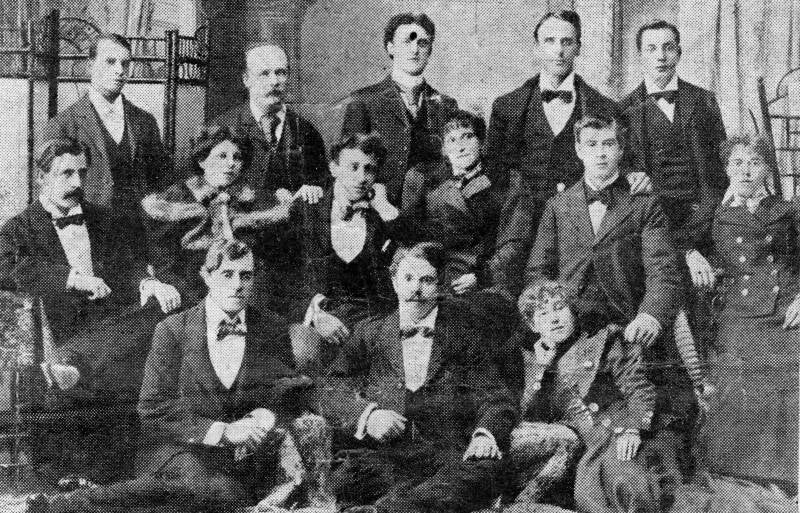
A rare image of Amy Vaughan (middle row fourth from right) was captured in this group photograph of Fuller’s Vaudeville Company circa 1901.
In the Observer of 1 February, 1902, it was learned that Amy, while travelling with the Fuller company, was a heavy loser in a fire at the Oriental Hotel in Wellington: “Among the inmates of the hotel at the time of the fire were Harry Baxter, Amy Vaughan, Myra Thompson, and other members of the Empire Vaudeville Company. Baxter got away with two pairs of trousers, Amy Vaughan with a dressing gown, Myra Thompson with something less.”
Meanwhile, from the Observer, 7 June, 1902, it was learned: “The engagement was announced of Miss May Mogridge, only daughter of Mr Charles Mogridge of Napier, to Mr Thomas Falvey, eldest son of Mrs J. T. Falvey, Christchurch.”
Oddly, the one brief item mentioned only May’s father Charles, who had died 19 years earlier. It did not mention that she was also the daughter of the famous Miss Amy Vaughan.
What became of May and Thomas Falvey—who we remember as manager of the Christchurch Kinematograph Company five years earlier—has been harder to uncover. A Thomas Falvey was mentioned amongst the first volunteers to be accepted for active service in 1914 at the start of the First World War. New Zealand death records showed that Thomas Peter Falvey, husband of May, died aged 57 in 1937.
In August of 1916 the Gisborne Times made note that “the World’s Picture Company Ltd has engaged Mrs T. Falvey as solo pianist for the World’s Pictures evening sessions. Mrs Falvey was the only daughter of Miss Amy Vaughan, the celebrated actress, an old favourite, whose capabilities were so widely known throughout Australasia.”
Newspaper archive mentions of Amy and Harry together grew thinner after the fire at the Oriental Hotel. In February of 1902 Harry joined Dix’s Gaiety Company as a comedian as Amy’s name appeared to fade from the billboards. At this time the baby boy Harry would have been five years old.
By July, Harry senior was the manager of a new outfit called the Globe Dramatic Company touring Southland where Harry acted the lead role and Amy made a reappearance, playing her familiar role as Eliza, in ‘Uncle Tom’s Cabin’. Was starting his own company Harry’s way of getting Amy back on stage at the age of 41?
At this point, while in the deep south of the South Island in late 1902, the renowned Harry Baxter had been “missing in action” by his friends and associates from the theatres and halls of the main cities of New Zealand for several months.
He felt it necessary to write a letter about it in the Otago Witness: “I have been so long away that I am afraid my friends will think I have gone forever. As you know, we started with big blood and thunder dramas but we have now given it up and gone for variety and illusions. We have one big illusion, ‘Noah’s Ark After the Flood’ a direct importation from Maskelyne and Cook’s Egyptian Hall of London. The ark is shown in the first place empty, it is then closed and filled with water. On the doors being opened, countless birds, animals, etc, leave the ark. It is filled with water and once again opened and in place of the water, which has disappeared, is found a beautiful lady, fully attired, reclining on the inside of the ark. Twenty pounds is offered to any person who can define the mechanism of this marvelous illusion. It is a splendid drawcard.”
As if Harry could not get far enough away from the big cities, the Otago Witness on 22 October, 1902, announced: “The Globe Dramatic Company, headed by Harry Baxter and Amy Vaughan, recently hired an oystercutter to convey them to Stewart Island, where they played for several nights.” In November Harry was reportedly back in Dunedin and re-associated with the Fuller’s company.
Something odd occurred in 1903. An advertisement appeared in the Otago Daily Times on 30 May seeking the “whereabouts of Mrs Harry Baxter, actress—forward address Prince of Wales Hotel, Christchurch”. A number of newspapers picked up on the mystifying classified three-liner adding that the “whereabouts of Miss Amy Vaughan were being anxiously inquired for”.
The mystery remains unsolved by this writer, but it could have been that Harry and Amy had quietly slipped out of New Zealand for Australia. Maybe Harry felt it was time to go home. From September of 1903 the couple were reported in New Zealand newspaper items as “appearing with Miller and Hay’s Variety Company in Launceston, Tasmania”.
In their early days in Australia, Amy was a novelty for the Australian newspaper entertainment scribes. The Launceston Examiner of 16 May, 1903, noted in its ‘Music and Drama’ column that “Miss Amy Vaughan, a dashing serio-comic and danseur was to appear at the Empire Theatre on Saturday”.
Amy and Harry were billed together at a concert in the Temperance Hall in Melbourne in July and in March of 1904, Harry was said to have joined the Gaiety Theatre Entertainers. From this point Amy Vaughan’s name appeared to fade completely from all entertainment news.
Harry soldiered on and in 1906 Harry joined the Lynch Family of Bellringers. The Lynch Family Bellringers were a renowned Australian vaudeville musical troupe established in 1867. They gained international fame touring across Australia, New Zealand and Asia, playing popular tunes using handbells, organ chimes, glassophones, bottles and other unique instruments through to the late 1920s.
Harry appeared on and off with various companies through the ensuing 20 years but he seemed to have found a permanent job as the comic raconteur with the Lynch Family, appearing with the renowned bellringers as late as 1926. After that he appeared sporadically supporting a variety of vaudeville acts in Sydney until the death of the “veteran comedian” was noted in the Australian newspapers in June of 1936.
A poster advertising the Lynch Family Bellringers, a popular musical troupe that toured Australasia from the 1870s through the 1920s. Harry Baxter, Amy’s husband, was the troupe’s front man in his later years.
Amy returns to Neville's side
Amy had been missing from the news columns in both Australia and New Zealand for several years, finally emerging in December of 1912 when the Wanganui Herald reported: “Mrs Harry Baxter, who some years ago was well-known throughout New Zealand as Miss Amy Vaughan, a talented member of the theatrical profession, had returned to Wanganui on a visit to her father Mr Neville Thornton.”
Neville had remarried in 1903, to a woman named Elizabeth Crawford. He was 66 and she was 34 at the time. Neville, living in Wanganui, suffered a stroke in 1905. By 1911 he was almost paralysed and reportedly destitute, prompting a public appeal to raise funds to send him to Rotorua for treatment.
The editor of the Whanganui Chronicle wrote: “We beg to bring under the notice of the people of Wanganui the needs of a deserving case in our midst. Mr Neville Thornton, for many years a respected citizen of our town in now lying almost paralyzed and destitute. Mr Thornton’s services to his country in the Crimea and elsewhere are such as should not be forgotten. We respectfully appeal to the people of Wanganui to enable us to raise sufficient funds to send Mr Thornton to Rotorua for a course of treatment there and to furnish him with some, of the comfort necessary to one of his years and infirmities. Donations may be paid either to us or at the office of your paper or to Mr J. Goss Tobacconist. We subjoin a list of donations already given.”
Amy arrived from Australia with just days to spare to give comfort to her ailing father. Neville Hale Thornton died at Wanganui on 26 December, 1912, three days after his birthday.
His death certificate recorded his age as 77, though Neville claimed to have been 16 when he was enlisted at the beginning of the Crimean War, which would have made him approximately 75 at the time of his death. Elizabeth survived him until 1944.
After Neville’s death, Amy remained in New Zealand for a while with the newspapers reporting in February of 1913 that “Mrs Harry Baxter, formerly well-known throughout New Zealand as Miss Amy Vaughan, was visiting Auckland for the first time in 12 years.”
This was just about the last that was heard of Amy Thornton, Miss Amy Vaughan or Mrs Harry Baxter in the New Zealand press until her son Harry Neville Baxter was killed in action on May 3, 1917.
The Wanganui Herald saw fit to note: “Harry Neville Baxter, the grandson of Mr Neville Hale Thornton, was reported as killed in action in France on the 3rd May, 1917, whilst serving with a battery of artillery belonging to the Australian Imperial Expeditionary Forces. The boy was a keen soldier, evidently inherited from his grandfather, Mr Thornton, who served in the Crimea War, where, among other decorations, he received the Cross of the French Legion of Honour.”
From the date of her son’s death Amy’s name does not appear in New Zealand news archives again even though she continued living until 27 August, 1951,“taking her final curtain” at the age of 90.
She passed away having lived for much of her later life in Australia. However records showed that she died in Auckland and was cremated at the Waikumete Cemetery. Her ashes were then taken to Australia where they were interred with Harry’s remains at the Eastern Suburbs Memorial Park, Matraville, City of Randwick, New South Wales. Harry had died 15 years earlier on June 10, 1936, aged 67.
Amy’s light shone bright for most of her younger life. She was a star. She was mentioned as “Amy Vaughan” 2695 times in the New Zealand newspaper historic archives. As “Miss Amy Thornton”, she received a further 372 mentions. “Aimee Thornton” received 49 more mentions.
It was thought that Amy, in her later years, was cared for in Auckland by her half-sister May, or maybe by Daisy. It was of note that she died in Auckland and not Australia. It is a shame that all of May’s children, my uncles and aunties, have long since died and cannot be questioned about the latter years of Miss Amy Vaughan.
Amy’s older half-sister May Thornton, this writer’s paternal grandmother, we know something about. She married George Henry Clapham in 1893. According to her daughter, Aimee Richardson (nee Clapham), the couple eloped: “My mother’s father (Neville Thornton) was living in Wanganui. No one was suitable for his daughters, so mum and dad eloped. They lived with an ex-school mistress near to a Maori marae. Neville was born there. He was very fair with blue eyes, and the Maori people used to come and see him and my mother would help the Maori women with their babies. Neville, during the First World War, was a captain and was presented to the King and Queen of England. He was chosen with a Maori captain, Captain Bennett, and they had both been christened in this little Maori church in Wanganui.”
When I found out that my grandparents had eloped and the reason was that Neville Thornton did not favour the marriage, I wondered if he was, in fact, unhappy with George Clapham being the son and business partner of the mercurial Herbert Clapham—for reasons that will be divulged in the sequel to this story.
Aimee, my aunt, continued: “My father set up a gas business. Gas was just coming in and he set up a shop in Te Kuiti where they had all the necessary things to promote gas for cooking, heating and lighting. I was only very young, I was five, the two older boys, Neville and George went to the First World War from Te Kuiti. Just at that time our family moved to Auckland and dad started the Clapham Botanical Herbal Institute, that he ran until he died.”
Daisy Thornton, the youngest daughter of Neville Thornton and Sarah, appeared to have played a cameo role in the larger drama that was her half-sister Amy’s celebrated life. As ‘Miss Daisy Thornton’ and often teamed up as ‘Miss May and Daisy Thornton’, she did however attract hundreds of press mentions through the last three decades of the 19th century.
The Taranaki Herald in 1888 gave a clue as to her birthplace when noting that the first Cap and Jacket Company performance in New Plymouth was to be attended by the mayor and the borough council on account of one of the performers, Miss Daisy Thornton (then aged 13), being born in that city in 1875. For some weeks she was billed as “the little Taranaki lady”.
As she got older Daisy may have attempted to make a name for herself as an entertainer in her own right—or she may have been “hired out” to other companies. In 1893, aged 18, she appeared with the Annie Brandt Comedy Company in Napier, without any apparent on-stage support from her family.
A newspaper previewed that performance saying: “We understand Miss Annie Brandt has engaged Miss Daisy Thornton, the premier danseuse of New Zealand, who will dance her celebrated ‘Pas de Zephyr’ in the second part of tomorrow’s programme. Miss Daisy will also dance the tambourine and cachuca. Those who witnessed this young lady’s performance in Auckland, were struck by the naive simplicity of the dancer, and the wonderful and artistic manner of her action which took the audience by storm.”
She appeared sporadically in the performances produced by other companies but for most of the late 1890s she was mostly mentioned as a member of the various Amy and Harry Baxter theatrical productions. After Amy’s move to Australia with Harry, her name faded from the theatrical advertisements and variety show reviews.
The New Zealand marriage archives records the marriage in 1896 of Daisy Marguerite Thornton (aged 21) to William Godfrey Nolan. They eventually had four daughters. The oldest, born in the same year as their marriage, was named Daisy May. They had three other daughters, Ivy Myrtle, Pearlie Poppy and Violet Elizabeth.
William died in 1944 aged 70 and was buried at the Waikumete Cemetery in Auckland. However there appears to be no official record of the death of Daisy Nolan.
That is as far as this narration of the lives and times of Neville, Sarah, Amy, May and Daisy, and of course Annie—‘The Amazing, Talented Thorntons’—can proceed.
It’s a story of an energetic family of theatre performers who cut a swathe across the vaudeville entertainment scene in New Zealand at the end of the 19th century and then faded into obscurity.
They were obviously famous in their lifetimes but this is the first time their collective stories had been packaged into a single narrative. It is the writer’s hope that this information will be picked up and added to the pages of New Zealand’s early history.

After her death in Auckland on 27 August, 1951, aged 90, Amy Thornton’s ashes were taken to Australia where they were interred at the grave site of her husband Harry Baxter at the Eastern Suburbs Memorial Park in New South Wales.
Before signing out, this is an appropriate place to add a few pages written by Neville Thornton himself, the only written record that could be found in his memoirs of his life in New Zealand as the father of three talented daughters who were somewhat celebrities in the entertainment scene of the day.
Neville wrote the following account to illustrate how his award of the French Legion of Honour for bravery during the Crimea War went mostly without recognition in New Zealand, but there was this one time when his youthful heroism was celebrated on New Zealand shores. From detail in the story it would have been circa 1890.
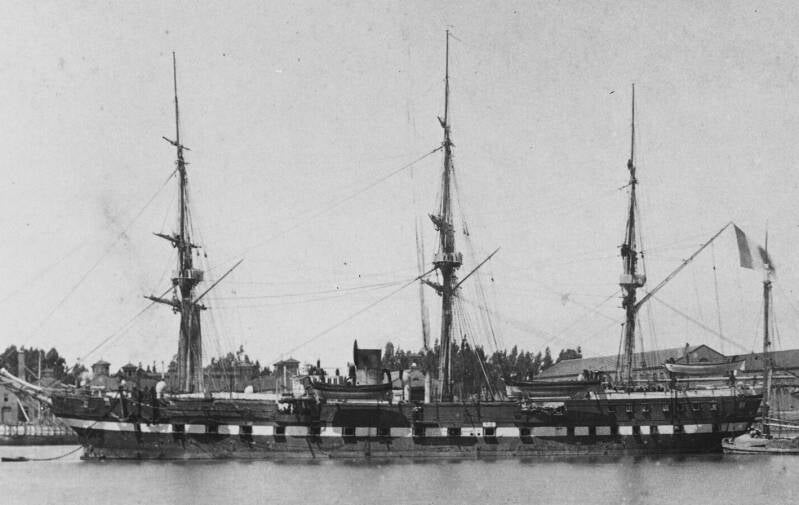
The French navy’s cruiser “Dubourdieu’ served as France’s flagship in the Pacific from 1884 to 1889. Neville and his daughters were hosted on the ship when its officers learned he was a member of the French Legion of Honour.
From the original text written by Neville Thornton
Speaking of my Legion of Honour I must anticipate many years ahead. I will mention the incident here as it may interest some of my New Zealand friends and as it has been the only occasion on which I have ever received official recognition due to my decoration of the Legion of Honour.
One day I was standing at the corner of Victoria and Queen streets, Auckland, looking on at the silly antics of the Salvation Army, a lot of these were dressed up like a party of Christy Minstrels, playing tambourines, banjos, concertinas, big drums, etc and singing, or rather howling, out a lot of hymns set to nigger minstrel and music hall tunes; altogether making a painful and sorry exhibition of fanatical religious ideas.
I overheard two officers belonging to a French war ship lying in port, Le Doubourdieu, passing remarks, saying what a miserable travesty it was of a religious service but that there was possibly some excuse. Laughingly adding, “as they might perhaps be some lunatics out for a holiday, collecting funds for the lunatic asylum” seeing people throwing coins on the blood-and-thunder flag lying on the ground.
I remarked: “Vous avez raison pour vos idees.” (You have reason for your ideas). Immediately I spoke one of the officers said: “Oh, you speak French?” “Yes,” I replied and then the other officer asked me if I could direct them to the to the Star Hotel as they had a friend staying there from Tahiti. I gave them the necessary directions and they thanked me and wished me good day, they then went up Victoria Street on their way to the hotel.
My eldest daughter, Miss Amy Vaughan (her stage name), was at that time in management running the City Hall Saturday Concerts. On the following Saturday evening after meeting the French officers I went up into the lobby of the dress circle, when the usher told me that there were five or six French officers in the dress circle and that during the intermission one or two of them came to him and tried to explain something but that he could not make out what they wanted but he told them that Miss Vaughan’s father spoke French and that he would be up directly.
Shortly after the performance and as the officers were coming out the usher pointed me out to them. They accosted me very politely and said that they were overjoyed to find someone who could speak French and that they were given to understand that my daughter was the manageress and would it be possible for them to be allowed to present her with their compliments personally for the pleasure that she and the other ladies had afforded them, especially “la petite dauseuse”, my daughter Daisy.
I took them round to the stage and introduced them to my daughters and, as they did not speak French, I had to do the interpreting. They were very profuse in their compliments to my daughters, thanked them for their courtesy and took their leave. On the following Saturday evening they attended the performance again, bringing a quantity of bouquets which they threw at intervals to the ladies. They also sent round large box of bonbons beautifully ornamented and addressed to my eldest daughter.
They had ascertained from me that I had been in the French service and that I was a Legionnaire, so that evening after the performance they came round to the back of the stage and the First Lieutenant, on behalf of himself and brother officers, invited myself and daughters to dine on board the ship on the following Tuesday. After some little demur on the part of my girls we accepted the invitation and spent a very pleasant evening while on board, having a concert and dance after the dinner.
It was something novel for my daughters to dine with a lot of French officers but they were so courteous and affable that restraint speedily disappeared. It was very laughable to hear the officers trying to make themselves understood.
While we were at dinner one of the stewards brought me in a note from the Admiral stating that he had been informed that his officers were entertaining at dinner a gentleman who had, in his youth, served in the French Army and who was also a member of the Legion of Honour. If that was the case and I could give satisfactory data, he would be most happy and feel honoured if I would accept an invitation for myself and daughters to dine on board the following Friday as guests of the ship.
I was interviewed by the Admiral and having satisfied him, he said: “I will send the steam launch ashore for you and your daughters at seven o’clock on Friday evening, I have fixed Friday hoping that it will be convenient for you as we sail on Saturday.”
I thanked the Admiral and accepted the invitation, when I told the officers, they were delighted and they told me that I need not confine myself exclusively to my own family but that I was at liberty to bring a friend or two as they intended to make a gala night of it.
On the Friday night of 29th April 1892 the steam launch awaited us at the steps of the Queen Street wharf and when we got alongside Le Doubourdieu I was received at the gangway by the Admiral and officers, with all the etiquette of the service due to me as a Member of the Legion.
The cabin was gaily decorated with flowers, the sternchasers wreathed with garlands. Several officers of La Volta, another French Warship, were invited guests on that occasion and I had availed myself of the permission accorded me by bringing another lady and also Mr E. Bourke, my daughters’ pianist. The officers seemed to be unable to show myself and my daughters enough consideration.
On each of our plates was placed a handsome bouquet and a hand-painted menu; one side representing the ship, the other a French sailor holding a flag and then came a list of the dishes. They were executed by one of the officers expressly for the occasion and my girls still treasure them as mementos of that visit.
We spent a most delightful evening; after the dinner we had a concert, then a dance, the music being supplied alternately by Mr Bourke and one of the officers. Just before breaking up, my daughter May and the young lady sang the Marseillaise accompanied by one of the officers and soon the whole of the crew, some three or four hundred men who were in their hammocks, joined in the refrain.
At last our pleasant evening drew to a close, a hearty farewell was given and we left the ship, reaching the wharf about three o’clock in the morning. I often look back to that evening with feelings of pride and pleasure, my daughters sharing in my sentiments.
Neville Thornton—songwriter and poet
Earlier in this story it was mentioned that Neville Thornton fancied himself, not only as an artist and an actor, but also as a poet and songwriter. He did in fact write a number of songs, some of which he says in his notes were set to music.
At a complimentary benefit performance for Neville when he was severely ill in Wanganui, the Wanganui Chronicle noteed that “Mr Arthur Bennet will sing ‘Trident of the Sea’, written and composed by Neville Thornton, accompaied on the piano by Mr Harry Hawkins”
Most of his songs were patriotic anthems penned at the time Britain was fighting the Second Boer War. New Zealand played a significant role in the Second Boer War marking its first official involvement in an overseas conflict.
For the sake of posterity—and because song copyright lasts for the lifetime of the author plus 50 years from the end of the calendar year they die—I have decided to publish his lyrics in print for the first time in over a century.
The Bugle Call
A Patriotic Song By Neville Thornton
Hark to England’s bugle calling
To her sons beyond the seas
See her brave old flag unfolding
Floating proudly in the breeze.
For she calls her sons to share
In the glories of the hour
And ‘gainst the world in arms prepared
And share her prestige and her power.
Hark to England’s bugle calling
To her sons beyond the seas.
Hear its clarion notes announcing
Wars alarming, broken peace.
When her unwilling sword is drawn
When arrives the crucial test.
When dark clouds obscure the dawn
We will send our bravest and our best.
For she another leaf has gained
In her laurel leaf to set.
And ‘tho blood and tears ’tis stained
Her children’s help, she’ll n’er forget.
Hark to England’s bugle calling
From tropic heat and arctic snows.
To assist the flag maintaining
And guard her realms from foreign foes.
May England’s flag in glory wave
Supreme from rise to set of sun.
If needful from all foes to save
Our cry will be, we come, we come.
___________________________________________________________________
The Storming of the Kopje
By Neville Thornton — Wanganui
At last the summit gained, we pause, but not through fear,
But to regain our breath and then with rifle at the hip.
We charge, a shout, a yell, an ake, and a cheer,
We hold the foe at last within our vengeful grip.
Our gleaming bayonets soon are drenched with gore,
Shed by the churlish foe, who when the hill was won.
The white flag waved, a signal that no more
The fight would rage, but all resistance done.
A pure white field with golden lilies sown
Was Gallia’s flag, when Bourbouns ruled fair France
By many a battle breeze, its folds were blown
When trumpets gave the signal to advance.
And when the foe they met on honour’s field
No craven trick, or cowards they played
Unlike the Boers, who when they had to yield
In cunning guise their treacherous flag displayed.
But why compare dear France’s chivalry
With Boer cunning, treachery and deceit
On we the Vierkleur and the Fleur-de-lis
In equal terms should ever dare to speak.
In simple faith we gave the terms they craved
Their effort to submit we hastened to accept
Our men by those whose craven lives they’d save
By murderous volley then downwards swept.
But retribution stern they quick by met
Their dastard trick caused but a moment’s pause
For our own men at point of bayonet
Redress at once war’s broken laws.
Note: There is no definitive proof that the South Africans engaged in an organized military
strategy of using white flags to ambush British troops during the Boer Wars.
However, it was a prevalent accusation and a major source of grievance and controversy during the conflicts.
__________________________________________________________________________
An Allegory
By Neville Thornton
I had a dream, t’was on a starry night,
I saw two forms, a maid and matron staid.
The one, a stately dame encased in armour bright,
A Victrix queen in every step she made.
And in her hand, fit symbol of her power,
A glittering trident grasped with forceful grace,
And by her side, of aspect stern and dour,
A lion stalked, the mightiest of his race.
A triple cross emblazoned on her shield,
A metal forged, by living hearts and true.
A scarf, the best that British looms could yield,
It’s colours scarlet, white and blue.
And in her train from every clime and creed,
In serried ranks, mailed myriads marched,
Their queen to help in case of urgent need,
From icy wastes afar, and plains sunparched.
No bondmen they, but loyal hearts and free,
With loud acclaim, they sang a grand refrain,
Like rolling thunder heard from sea to sea,
“All hail! Britannia, mistress of the main”.
Thus spoke the maid, with voice of silvery ring,
From loyal friends beyond the rolling sea,
“This golden casket, as a gift I bring
Enclosed, a bond of love from them to thee”.
And now the maid, enrobed in shimmering white,
Wore on her breast New Zealands’ floral wealth,
The scarlet rata, and Mountain lily bright,
Fair nature’s tribute to beauty, grace and health.
And thus the maid, replete with every grace,
Drew from the casket, on fair parchment writ,
This loving message from the kindred race:
“The bonds of love are now more closely knit
And now war clouds are gathering fast,
On every sea, we’ll a stubborn phalanx keep,
To show the world our prestige and our past,
That Old England still, is mistress of the deep.”
____________________________________________________________________________
Finis Coronat Opus
By Neville Thornton
Ring out glad bells, let banners wave
From every mast and stately fane,
To welcome back the bold and brave
Who’ve made us victors once again!
Ring out joy bells from every clime,
’Neath Austral heat, Canadian snow,
From Ganges, Murray, coaly Tyne,
Wherever waters ebb and flow!
Wherever England’s Saxon tongue
And England’s power is held supreme,
There let joy bells be gaily rung,
By city, village, mount, and stream!
Let Briton, Scot, and Irish show
The cloud has passed, and England’s might
Has shown a lesson to her foe,
While fighting for her fame and right!
Her off-spring, too, have bravely shown
That they can fight as well as she,
And reap proud laurels all their own,
No matter where, on land or sea!
The wily Boer, the rebel horde,
In stubborn strife their fate have met,
On kopjes, veldt, by river ford,
At point of lance and bayonet!
Brave hearts were they, who at the call
Of Mother England armed for strife,
Went death to meet, from Mauser ball,
Leaving mother, sister, home and wife!
Upon the sun-parched veldt they lie;
They gave their lives for honour’s cause,
That England’s meteor flag might fly,
Emblem of just and wholesome laws!
Then toll ye bells from every tower;
Let martial minute guns proclaim,
That England in her victrix hour,
Her gallant sons inters again!
And from King Edward’s Empire round,
Upon a day set forth apart,
Let requiem’s solemn notes re-sound,
Sung by an Empire’s mournful heart!
In fancy, on their graves we’ll lay
Zealandia’s flag—fit soldier’s pall,
Then let them rest till Judgment Day,
In care of Him, the Lord of all!
____________________________________________________________________________
L’entente Cordiale
Dedicated to the Crimean Veterans, my old comrades
by Neville Thornton, formerly of the French Chasseurs in the Crimea.
Midst the grey dim vistas of many a vanished year
I stood awe-struck by many a fitful transient glance.
Methought I saw and faintly seemed to hear
Rumblings of cannon, and glint of sword and lance.
Tattered, grim, and gaunt, stalwart guardsmen, they
With dauntless courage, each shattered corps re-formed
While British bayonets held the foe at bay,
While spectral Casseurs bravely the Russian outposts stormed.
On each ensanguined plain the gallant dead
Like sheaves in autumn, cut by the grisly reaper, Death,
Friend and foe alike, shared their gory bed.
The hideous picture drawn, I never shall forget;
The thin red line, by British soldiers kept,
A living wall, slender, yet steadfast, staunch and true;
In vain the Russians, as the heights they swept
In dire defeat and loss; they then withdrew.
I saw again the valiant British charge
Of matchless cavalry, ’gainst Russian horse and gun;
The deeds of chivalry, praised by the world at large,
Bedecked with laurels and honours fairly won.
On Malakoff’s bristling ramparts I saw De Brancion fall,
My peerless captain, victor in many a stubborn fight.
Tho’ by foes outnumbered, they put to headlong flight.
Sunk at their moorings, the Russian navy lay,
By allied guns attacked and deadly screaming shell,
By loud explosions heard from day to day
The hapless city, tho’ in widespread ruin, still nobly fell.
But I awoke, and in serried ranks, they heard Death’s Bugle Call
The phantom regiments marched, began with noiseless tread,
Their shadowy campaign lost, lost beyond control,
And they with muffled drums then joined the vanished army of the dead.
____________________________________________________________________________
The Trident of the Sea
(Copyright and words by Neville Thornton)
In every port, on every sea, a meteor flag is seen,
It’s dear old title, “Union Jack,” claims Britain as it’s queen.
Its glorious folds from countless ships stream out so fair and free,
A signal proud that England holds the Trident of the Sea.
Its triple prongs are bright and sharp, its shaft is British oak,
And serves alike her shores to guard, her sons from foreign yoke.
Chorus:
The decks are cleared, a signal flies, we’re ready for the fray!
From every mast Old England’s flag is hoisted there to stay!
And if a snarling foe should dare the three-pronged arm to seize,
He’ll find that England still can wield
The Trident of the Seas!
On every sea our stately ships a watchful patrol keep,
To shield from harm her commerce vast upon the trackless deep.
Should cause arise her foes will find Old England to the fore,
In stubborn fight assert her right as she has done before.
And if the foe is three to one, she’ll meet them with a smile,
And quickly make them recollect Trafalgar and the Nile!
Repeat chorus.
And on their decks our sturdy lads will fight with might and main,
Old England’s record still to keep, her prestige to maintain.
For they will fight, but never yield, Old England’s fame to keep,
Her title good, ’gainst every odds, the mistress of the deep.
In serried lines her ships they lie grave caution to the world,
No insult to her flag she’ll brook, when Union Jack’s unfurled!
Repeat chorus.
In England’s sea-girt isle we find the Viking blood still flows,
The bulldog breed it still exists, the fighting instinct shows.
Wherever keel can safely float, a British ship is there,
To treat it’s flag with disrespect, let foreign foes beware!
Her flag is free beneath it’s folds, all men a shelter find,
Mild is her rule, no tyrant she, her laws are just and kind.
Repeat chorus.
____________________________________________________________________________
Note: Breaking away from his patriotic bellicosity, this loving lyric
would have been written for his granddaughter Ivy Myrtle, the second born of his
daughter Daisy’s four girls to Thomas Nolan, all given flowery names—
Daisy May, Ivy Myrtle, Pearlie Poppy and Violet Elizabeth
A Little Belle of Wanganui
To Ivy: My little granddaughter
(By Neville Thornton—Town Hall, Stratford)
A wayward little puss is she
Around my heart, she’s thrown a spell
A tiny treasure she’s to me
My love for her, ah who can tell.
No rival for her love I fear
For in her heart I sit enshrined
My love augments from year to year
We’re Oak and Ivy intertwined.
And o’er my swiftly lessening years
A gleam of sunshine she imparts
She shares alike my hopes and fears
To me she is my queen of hearts.
I would not give for wealth untold
Her winning ways, her sparkling eyes
And when her arms my neck enfold
It seems a glimpse of Paradise.
At night when in her cosy nest
In happy childhood’s sleep she lies
Her little arms crossed o’er her breast
A picture fit for beauty’s prize.