Herbert the Hustler
By Gray Clapham

Herbert Clapham was my great-grandfather on my father's side. He did not feature in any New Zealand history books, but in his lifetime he was a well-known and influential character of his era; in many ways infamous and, at times, sensational. He was a hyperactive mix of woollen-industry entrepreneur, quasi-medical guru, snake-oil salesman, con man and—well ahead of his time—a pioneering entrepreneur in the promotion of wellbeing and healthy lifestyles. He was instrumental in starting a woollen mill in Timaru that today is known as Alliance Textiles. He made headlines by claiming he could cure tuberculosis and other serious diseases of the day. With no medical qualifications, he established private hospitals that he called 'sanatoriums'. He took this concept all the way to Hollywood where he set up a 'health spa', where his clients included movie stars of the 1920s. He was also the founder of the Healtheries health food company.But let us start at the beginning and follow Herbert's timeline through newspaper reports spanning the middle of the nineteenth century to his untimely death in 1931 at the age of eighty-three when, on his way home from work, he was knocked down by a motorcar while crossing Queen Street in Auckland. But even that is debatable, for there is another story that he lived to be 100.
Herbert Clapham was born in Wakefield, West Yorkshire, on 8 May 1848. His father was Captain John Clapham (1810–1871) and his mother was Harriet Dunhill (1807–1882). He was one of seven siblings.
Herbert’s early life in England is difficult to research, but it might be assumed that he was involved in the textile manufacturing industry for which Yorkshire was renowned. He married a woman from a family of woollen mill workers.
Later, in New Zealand in the early 1890s, he claimed in newspapers that he had lived in Leeds, where he trained as a medical botanist under the mentorship of his uncle, John Clapham. This is a bit unusual in that his father’s name was John Clapham. Records show that his father was a ship’s captain, master of the vessel The Friendship, based at Hull Harbour, Yorkshire. The captain had nine siblings, including three brothers, Herbert’s uncles, named George, William and Haigh. However, during his life in New Zealand, everything Herbert said in the newspapers had to be treated with a degree of circumspection.
Some time in the early 1870s, Herbert, aged about 25, immigrated to New Zealand with his wife Matilda, aged 28, and their two small children.
The youngest was a baby, James Burnley Clapham, who appears to have been born on 15 March 1873 in England but died in Timaru, New Zealand, on 6 October 1874. If this is correct, it would mean they sailed to New Zealand from England sometime between those dates. The older child was my grandfather, George Henry Clapham, who had been born in England in 1872.
Matilda’s maiden name was Burnley. Her family were from Batley in Yorkshire. They were skilled in the art of weaving wool.
What Herbert did during his first years in New Zealand, apparently based in Timaru, is unclear. But from 1882 his name started appearing in the local newspapers.
On 22 August 1882, some nine or ten years after his arrival, the South Canterbury Times reported that Herbert Clapham had been "home" to England, visiting the cloth-weaving districts with a view to importing machinery for a factory he intended to build. His plans for a woollen mill were apparently thwarted when he learned that a "large and influential" company had already formulated plans to establish a tweed-weaving business in Timaru.
The report said, “Mr Clapham left the importation of his machinery in abeyance and instead had returned to Timaru to open the Timaru Clothing Factory."
“Mr Clapham will import Scottish and West of England tweeds at an extremely low rate with which he intends to make all types of clothing on his premises. The special feature of the new industry is that a customer may be measured for a suit or any garment and have them made to order within a few hours.”
Herbert’s trip to England and his return to Timaru can be verified by New Zealand shipping records showing that Herbert Clapham arrived in Port Chalmers from London by steerage with Sarah E. Burnley on 25 April 1882 aboard the square-rigged migrant sailing barque Sarah Bell, which sailed from London on 2 March.
Sarah, according to MyHeritage records, was his wife Matilda’s sister. It would appear that he had persuaded his sister-in-law, an expert in weaving cloth, to come to New Zealand to assist him with his new venture.
Archived census records from 1861, sighted through MyHeritage, show that the Burnleys of Batley, living at 45 Cobden Street, were very much involved in the woollen industry in Yorkshire. The mother, Hannah, and her eldest daughter are listed as “woollen powerloom weavers”; Matilda is listed as a “woollen winder”. Sarah was only ten at the time of the census but would no doubt have gone into the woollen business after finishing school.
On 22 August 1882, the new Timaru Clothing Factory was announced in the South Canterbury Times: “Timaru Clothing Factory. Main North Road opposite Smith’s Coal Yard. Support the new industry. Herbert Clapham, proprietor.”
It can be seen from his first forays into advertising that Herbert was a clever copywriter with a gift for the gab. He conveyed all this detail in his classified advertisements: “On my recent visit to the Mother Country, I was induced by my friends (who are large manufacturers of woollen goods), on my return to New Zealand, to start a factory, having for its object the means of supplying all kinds of men’s, youths’, and boys’ clothing made to measure at the prices usually charged by other large factories to their wholesale clients. For example, should a man, youth or boy require a suit of clothes, he can come to my factory, select the material, have his measure taken, and in, say, 48 hours afterwards receive his clothes, on payment of the price charged by storekeepers in Timaru and elsewhere, being fully 30 per cent, or six shillings in the pound, cheaper. Thus, a suit of clothes made by tailors and charged, say, £5, my price would be £3 10s. The prices I intend charging will be so low that I feel sure no ready-made clothing shop will be able to compete.”
Business must have boomed at first, with Herbert placing newspaper advertisements seeking machinists and tailors. In December 1882 he went into print to boast that he had secured the services of “Professor Buller, the eminent cutter, who stands unrivalled in both England and the Colonies.” He added that “the most fastidious need not hesitate a moment.”
He also claimed that a new shipment of cloth had arrived from the West of England and Scotland, making his woollen goods the largest and most complete in South Canterbury.
However, in June of the following year, 1883, a notice appeared in the Timaru Herald advising: “In consequence of the Journeymen Tailors’ lock-out, they have purchased the tailoring business of Mr Herbert Clapham, and formed themselves into a Company, such to be called The Timaru Co-Operative Tailoring Company. The company will carry on the business in the old premises of Mr H. Clapham.”
Herbert was still very much involved in the co-operative. Was this some clever move to get around a strike by tailors who that year were actively organising against poor working conditions and low pay?
He placed a notice in the South Canterbury Times: “Herbert Clapham, in thanking his numerous patrons for past favours, desires to intimate that having received a first-class assortment of new materials, and in consequence of the recent strike among the tailors in Timaru, he has turned his extensive establishment into a co-operative company, who are prepared to execute all orders in a style that will defy comparison with any other firm in the Colony. Fit, workmanship, and material guaranteed, and the price charged will bring the best order-work within the reach of all classes of the community. The best workmen only employed on the premises.”
He also stated that the business would trade under the name Herbert Clapham and Co. At the same time he announced a new business—the Timaru Ham, Bacon and Lard Company—and advertised that he was a buyer of such products.
The Herbert Clapham Timaru Clothing Company continued to trade on, but it appears Herbert had larger ideas on his mind as he left New Zealand for England again on a very important mission. He had persuaded leading local businessmen to invest in his plans for a woollen mill. It appears from the news archives that the city fathers of Timaru had been discussing the idea of such an enterprise for several years but had never made any practical progress.
In 1884 news broke of a new industry for the town of Timaru. The Temuka Leader in December of that year wrote: “It is not generally known that a new company for the purpose of establishing a woollen factory has been floated in Timaru and that tenders have been called for the erection of buildings for it, and that Mr Herbert Clapham has gone to England to procure the necessary plant.”
It is of note that around this time, on 20 September 1884, Matilda gave birth to a son, John James Herbert Clapham.
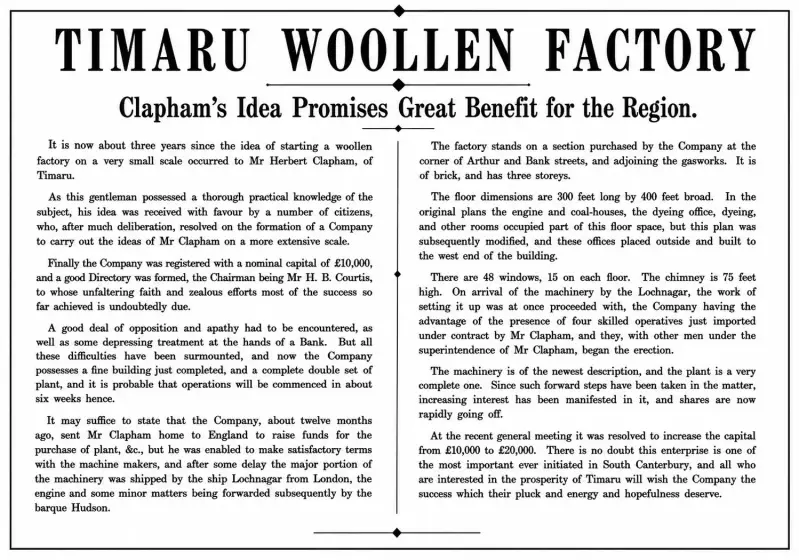
Herbert was away from New Zealand for nine months and, on his return, the Lyttelton Times picked up the story in its 30 December 1885 edition: “It is now about three years since the idea of starting a woollen factory on a very small scale occurred to Mr Herbert Clapham, of Timaru. As this gentleman possessed a thorough practical knowledge of the subject, his idea was received with favour by a number of citizens, who, after much deliberation, resolved on the formation of a Company to carry out the ideas of Mr Clapham on a more extensive scale.”
It added: “Finally the Company is registered with a nominal capital of £10,000 ($2.5 million at today’s value) and a good directory has been formed. It may suffice to state that the Company, about twelve months ago, sent Mr Clapham home to England where he was enabled to make satisfactory terms with the machine makers, and after some delay the major portion of the machinery has been shipped by the ship 'Lochnagar' from London, the engine and some minor matters being forwarded subsequently by the barque Hudson.”
The report went on: “On arrival of the machinery by the Lochnagar, the work of setting it up will at once proceed with, the Company having the advantage of the presence of four skilled operatives just imported under contract by Mr Clapham, and they, with other men under the superintendence of Mr Clapham, begin the erection. At the recent general meeting of the Company it was resolved to increase the capital to £20,000. There is no doubt this enterprise is one of the most important ever initiated in South Canterbury, and all who are interested in the prosperity of Timaru will wish the Company the success which their pluck, energy and hopefulness deserve.”
The Temuka Leader conveyed the region’s optimism for the new venture: “And now, perhaps, the most important matter connected with the woollen factory is whether it will prove a success or not. Of course it is a speculation on which a great deal depends, but one thing is in favour of the presumption that it will be a success and that is that every woollen factory in the colony is in a flourishing condition.”
The Christchurch Star in January 1886 reported: “Mr Herbert Clapham, who initiated the Timaru Woollen Factory, and recently visited England in the Company’s interest, has been appointed manager of the concern.”
The Timaru Woollen Factory Company was opened in May 1886 with much fanfare, and the Timaru Herald reported: “Yesterday will long be remembered by all well-wishers of local industries in Timaru as the day on which the Timaru Woollen Factory Company’s new buildings were formally opened, and their industry recognised as one of the principal in South Canterbury. It is now about two and a half years since the company was first formed, and there is no denying that the shareholders of it have met with signal success so far. The opening of the Timaru Woollen Factory certainly marks a new era in the history of Timaru.”
Let us pause a moment and reflect that this major investment in the future of a town and the region of South Canterbury had been brought to fruition by the machinations of a man who later in life made a dubious living claiming that he could cure tuberculosis and just about any other incurable disease of the day.
But that was all in the future and, reporting on the opening of the factory, the Temuka Leader gave Herbert most of the glory: “The machinery is working splendidly, and reflects the greatest credit on the manager of the factory, Mr Herbert Clapham.”
However, it was only a matter of months until the local newspapers, in September 1886, broke the news: “The Timaru Woollen Mill is in difficulties. It has temporarily suspended work on account of the position in which the directors find themselves, and because they can not see their way to pay the next fortnight’s wages.”
That same month, Herbert Clapham, the manager of the enterprise, was declared bankrupt.
The Timaru Herald carried the notice: “The District Court of Timaru and Oamaru. In the matter of The Bankruptcy Act 1883 and the bankruptcy of Herbert Clapham of Timaru, Woollen Manufacturer. Notice is hereby given that the matter of the said Herbert Clapham having been adjudicated a bankrupt in the said Court, the first general meeting of the creditors will be held at my Office, North Road, Timaru, on Thursday, the 23rd day of September, 1886, dated this 17th day of September, 1886.”
How much of the company’s financial difficulties were due to its manager was never made clear and we can only read between the lines.
The existing shareholders tried desperately, but unsuccessfully, to save their investments, forming a committee to look at forming a new company to repurchase the mill. However, the Timaru Woollen Mill was rescued and given renewed life when a syndicate of businessmen from the North Island purchased the factory. It went on to become a major textile manufacturer in New Zealand before merging to form Alliance Textiles in 1960.
Herbert left Timaru bankrupt, but not broken. We next hear from him in Wanganui in December 1886, where he had been successful in his application for an auctioneer’s licence. His advertisements appeared in the Wanganui Herald through to May 1887, trading as G. H. Clapham and Co., which was “prepared to receive goods of all descriptions for sale and on commission. Periodical sales held throughout the Wellington Provincial District, thereby affording special advantages to our clients for quickly disposing of any jobs or surplus stock submitted to us for sale.”
The advertisements stopped and Herbert’s newspaper trail went cold from May 1887 for a couple of years.

Let us stop there for a minute. Where did Herbert Clapham find the time to travel to all parts of the civilized world? When and where did he do all those years of “anxious study and research”? The records show that Herbert and his wife Matilda had by this time produced a family of four children. George Henry (my grandfather) would have been 18, James Henry had died as a baby, John James Herbert would have been six, and another son, Hector Charles, was just a toddler in 1889.
However, the Sanatorium appears to have done well, advertising its promises constantly through to November 1892: “The Sanatorium is replete with every comfort, while the sanitary arrangements cannot be excelled, and patients receive every possible attention from trained nurses and servants engaged under the direct supervision of Mr Clapham. The success which has attended the Clapham Combination Cure of Consumption is being made known far and wide, and patients are coming from foreign countries to receive treatment. Of course, the details of the Clapham Combination mode of treatment are at present kept secret.”
The promises were endless: “Persons suffering with any nervous disorders or any illness that flesh is heir to will find in Mr Clapham’s Botanico-Electro remedial agency a sure, safe, and speedy cure. In further consideration of the indoor patients of the Nelson Sanatorium, the proprietor places horses and carriages at their disposal to afford them an opportunity for easy outdoor exercise and to view the charming surrounding district of Nelson.”
It did not go as smoothly as Herbert’s copywriting, however, as he found himself defending his claims in the Nelson Magistrates Court on 5 July 1892.
Joseph Mallamo, a fisherman, was the plaintiff in relation to his wife’s unsuccessful treatment by Herbert. Mary Ann Mallamo had an internal tumour for which two doctors agreed that an operation would be too dangerous. Mrs Mallamo, the court report said, “had turned to Mr Clapham who had examined her and prescribed medicines and pills. He had visited her every day for three weeks and she continued under his care for twenty-five weeks.” After a break of three months she then entered another three-month course of treatment.
Mrs Mallamo said she believed that she had been promised a cure for her tumour, but in fact it continued to grow larger. By this time the costs had risen to a level which Mr Mallamo found difficult to pay, and Mr Clapham had threatened to sue him in court for the money owing. This did not eventuate and, in response, Mr Mallamo decided to try to recover the money he had already paid through the court.
Mrs Mallamo gave evidence that the tumour had increased, not decreased, and this was confirmed by the doctors. Herbert’s evidence was to the effect that he had not promised Mrs Mallamo a cure.
The outcome was that Herbert was ordered to repay Mr Mallamo twenty-one pounds five shillings, being the amount actually paid, and costs of eight pounds ten shillings.
In April 1892 Herbert branched out by floating a new company called the Swiss Alpine Soap Company Limited, posting a prospectus seeking capital of £3000 in 3000 shares of £1 each, of which 350 shares were fully paid and issued to Herbert Clapham in payment for all his “plant and appliances”.
The prospectus said the company was being formed for the purpose of taking over Mr Clapham’s Toilet Soap Works, then in operation as a going concern. Mr Clapham was willing to relinquish this industry owing to his profession as a medical botanist necessitating that all his attention be given to the increasing number of patients being treated for consumption and other complaints.
The blurb, typical of Herbert’s compelling writing style, said his toilet soaps were already a “profitable, going concern” and that before long these “superior toilet soaps will be in general use and supersede all the imported soaps now carrying a duty of 25 per cent.”
The prospectus named several prominent Nelsonians as provisional directors of the company. It is, however, of note that no mention of Herbert owning a “toilet soap works” can be found prior to the issuing of the prospectus for the new company and no mention can be found of the Swiss Alpine Soap Company ever getting off the ground and running as a business afterwards, apart from a notice in the Nelson Evening Mail on 25 May advertising a meeting of “all dissatisfied shareholders in Clapham’s Swiss Alpine Soap Company”.
At the same time, Herbert announced that he was available for consultation in Blenheim due to the increasing interest in his treatments. Advertisements for the Nelson Sanatorium continued to appear daily in the newspapers. He also ran advertisements promoting “Turkish and other baths, now open daily at Bridge Street, Nelson”.
The Colonist, a Nelson newspaper, on 9 December 1892, burst the Clapham bubble with the brief notice regarding a meeting of creditors in the estate of H. Clapham.
It appears the herbal botanist had neglected to pay his advertising bills, among others, when the Marlborough Express ran this notice the same week: “Bankruptcy—Herbert Clapham, herbalist, of Nelson, has filed his petition for bankruptcy with liabilities of £1183 14s, and assets of £810. There are two Blenheim creditors; this unfortunate newspaper’s proprietors once more.”
On 25 January 1893 Herbert was declared bankrupt yet again, his wife and youngest son having departed Nelson by steamer a few days before the bankruptcy was declared.
On 26 January notice was given that, in the matter of the bankruptcy of Herbert Clapham of Nelson, Medical Herbalist, he had applied for a discharge, which would be heard on 22 February. The judge did not grant the discharge “on account of his not keeping proper books”.
In March there were notices posted of auctions for the sale of goods in the bankrupt estate of H. Clapham. Under the hammer went every single item of the family’s possessions and household furniture, including ornaments, books, bedding, wall mirrors, bedsteads and chairs, couches, tables and curtains; a piano, a double-barrelled gun; a buggy and three horses “broken to single and double harness”.
On 4 March the Nelson Evening Mail ran an advertisement: “To Let: The well-known premises in Bridge Street recently occupied by Mr H. Clapham consisting of house, shop, Turkish and other baths; a soap factory with complete working plant; three-stall stable and sheds.”
Herbert and his family were left penniless and without any of the comforts and accoutrements of wealth that he must have accumulated while in Nelson.
Strangely, awkwardly worded advertisements had already started appearing in the Manawatu region from 26 January: “Nature’s Remedies. Mr J. Hepworth, Eclectic Medical Herbal Specialist (Twelve years’ practice). The attention of the public of Feilding and district is directed to his Dispensary and Consulting Room, The Square, next the Club Hotel, Palmerston, where the benefit of his advice and medicine may repay a thousand times the effort to get there. Mr Hepworth visits Ashhurst on Wednesdays for the benefit of his patients, and may be consulted at Mr Clapham’s, from 10 to 4, on that day. Note: The Square, Palmerston North.”
These advertisements ran for weeks unchanged. Was this a clever means for Herbert to operate while bankrupt?
If Herbert was operating secretively, a large and incredibly verbosely worded advertisement in the Wairarapa Daily Times on 16 May 1893 announced loud and clear that Herbert Clapham was back in action—and on a mission.
“Theatre Royal Masterton: Clapham’s Health Mission. Wairarapa season commencing Monday. Mr Clapham from the Nelson Sanatorium, and Hydro-Electropathic and Botanic Institute, has now the honour to announce to the people of Masterton and District, that, after considerable difficulty he has been successful in organising a Mission to help the Needy Sick, and for that purpose will give Lecture Entertainments in your town, of a pleasing character, introducing Music, Song and Drama by a select and powerful company of 15 talented artists, in their Grand Drawing-Room Entertainments. Sketches specially written for the occasion, staged up to date, with all the latest mechanical effects, and scenery specially painted for the tour. The whole forming the most brilliant organised entertainments that have ever visited your district. Pronounced by the Southern Press to be the brightest, happiest, most unique home of home amusement and refined enjoyment. Its great object is to help the Poor Sick to regain health, free of cost to the individual. The whole of the proceeds (except bare actual expenses) are devoted to a fund for that purpose. Come one! Come all! and help me in this great cause of Suffering Humanity, as it is easy for the many to help the few. Popular prices will be charged. Reserved Seats: Three Shillings.”
Offering a bit of editorial support, the Daily Times news pages gave the advertising blurb credibility and also revealed that Herbert was taking advantage of the theatrical success of his daughter-in-law May’s family, the Thorntons.
“A little information concerning Mr Herbert Clapham and his Health Mission will, we are sure, interest our readers, as a preface to the visit of that gentleman to Masterton at the beginning of next week. Mr Clapham is the successful founder of the Nelson Hydro-Electropathic and Botanic Institute, associated with which is the Nelson Sanatorium, a handsome and extensive establishment, beautifully furnished and fitted with every appliance and requisite necessary to grapple with disease under Mr Clapham’s system of treatment. The Sanatorium is also surrounded by most charming grounds, tastefully laid out, the whole affording an unequalled recreative retreat for those who surrender themselves to the proprietor’s restorative influence.
“Mr Clapham has latterly opened a branch in Willis Street, Wellington, but he considers that he can do more good to humanity by bringing his treatment for morbid, pulmonary, and constitutional diseases right to the thresholds of sufferers. It is this which is inducing him to come to Masterton, and as a means of introducing his mission and of bringing it prominently under the notice of the public he gives a superior drawing-room entertainment of a most attractive character. Indeed, the following names are a voucher for the excellence of the organisation: Messrs Claude Hennegan, Leonard De Vere, A. Lovell, Augustus Marks, W. Melvin, and the Misses Annie Montrose, May Travers, Amy Vaughan, Daisy Thornton, and Lily Mercer.
“It may be said of Mr Clapham that he possesses numerous testimonials, including a letter from the Rev. Father Mahoney, of Nelson, and that as he stops some weeks in each town visited during his tour, there is ample time to test the genuineness of the cures he effects. Nervous and organic diseases, epilepsy, and consumption are his specialties, we might add.”
News of Clapham’s Mission went nationwide when the New Zealand Mail in early June enthused: “A clever combination of variety artists known as the Clapham Health Mission Company has been showing in Masterton for the past week. The proceeds of the entertainments are stated to be devoted to a fund for assisting the sick poor, and enabling them to take advantage of the special treatment of Mr J. H. Clapham, of the Nelson Sanatorium.”
On 19 June the advertising was toned down a little as Clapham’s Health Mission Entertainment held a “talent competition” at the Bijou Theatre in Wellington with sixpence admission.
On 13 July the proprietors of the Theatre Royal in Masterton took Herbert to court seeking £18 6s owed for theatre hire.
The newspapers followed up: “Some weeks ago a Health Mission Company visited Masterton. Besides entertaining select audiences with high-kicking and funny business, the company dispensed patent medicines galore, which were to cure all manner of diseases. The mission was to have lasted some weeks, but for obvious reasons it was brought to a sudden termination a few days after it commenced. The company left with the ‘best wishes of a number of creditors for their future prosperity’. The sequel to the visit is that judgment has been given in the Masterton Resident Magistrate’s Court against H. Clapham, dispenser, of Wellington, for the rent of theatre and gas, and £1 4s for hire of the piano.”
On 15 July 1893, at a meeting of the Nelson Borough Council, a letter was tabled by Mr F. J. Humphreys stating that he wished to dispel a rumour that he had been cured of consumption at “Mr Clapham’s establishment”, wishing to state that this was not true, for he had not been cured.
On 15 August 1893, in the Nelson District Court, Herbert again applied unsuccessfully to be released from bankruptcy. However, he did have some supporters. The Evening Post reported on 31 August 1893: “Some people at Nelson have petitioned for an amendment of the Medical Practitioners’ Act to enable Herbert Clapham to continue the practice of his profession as a medical botanist.”
On 27 December 1893, a brief public notice appeared in the Hawera and Normanby Star: “A Card: H. Clapham from Nelson Sanatorium. Medical Specialist. Regent Street, Hawera.”
But just two months later, in February 1894, Herbert was back in full flight with this loud and public announcement in the Wanganui Herald: “Mr Clapham, from Nelson Sanatorium, Practising Medical Botanist and Hydro-Electro Therapist, will commence practice at his Institute, corner of Hull Street and Maria Place, Wanganui. Specialist for the Scientific Treatment of Acute and Chronic Nervous, Complicated, Special and Organic Diseases; Rheumatism, Sciatica, Fits, and Consumption. Mr Clapham, who is the founder of Clapham’s Combination Treatment of Morbid, Pulmonary, and Wasting Diseases, has all the latest medical appliances requisite for the successful carrying out of the same. Sufferers from Blood and Skin Diseases, Kidney and Urinary Affections, would do well to consult Mr Clapham.”
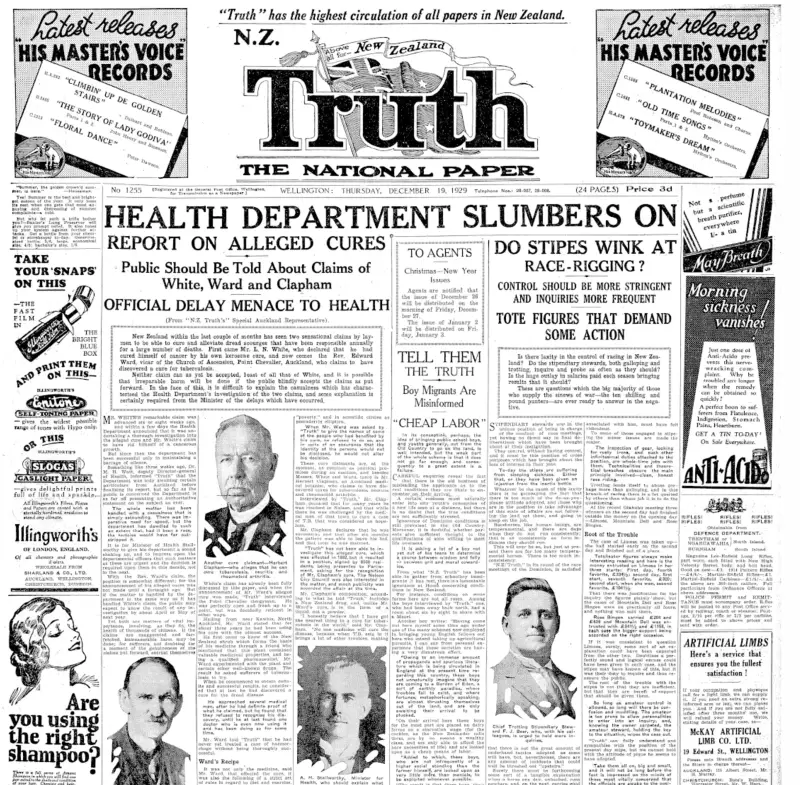
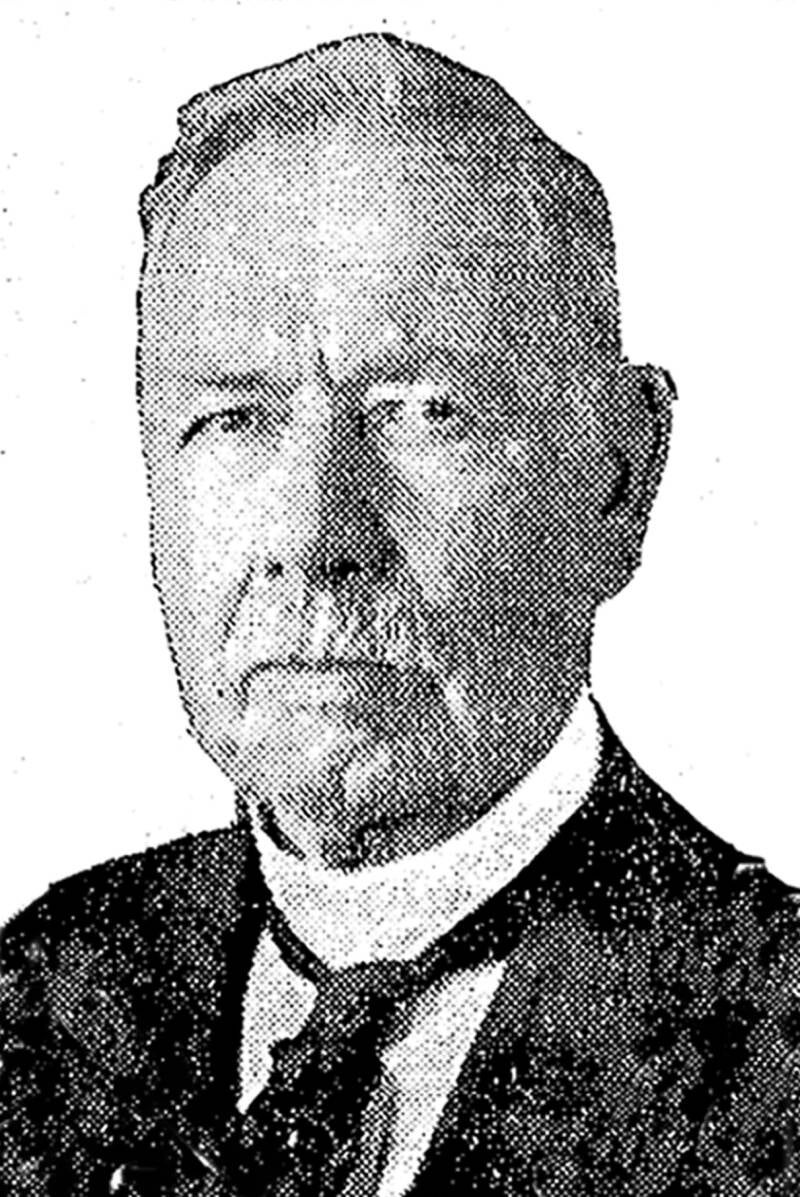
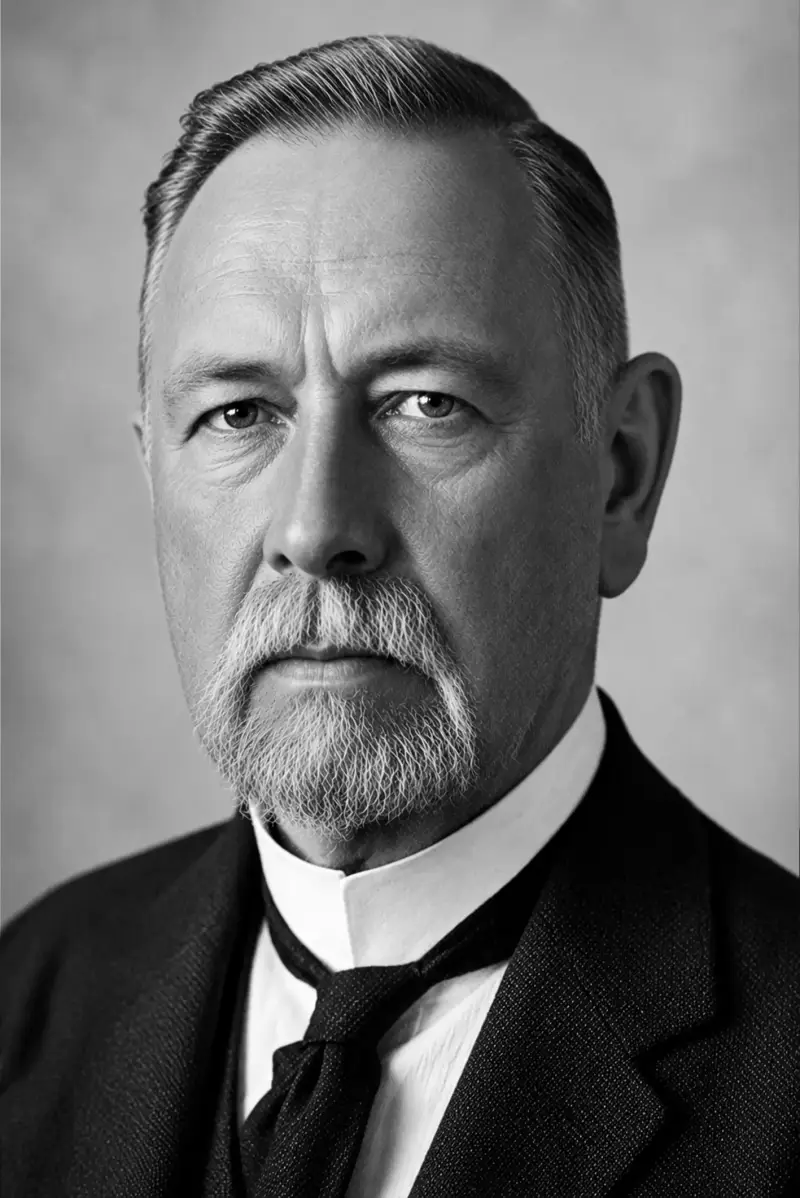
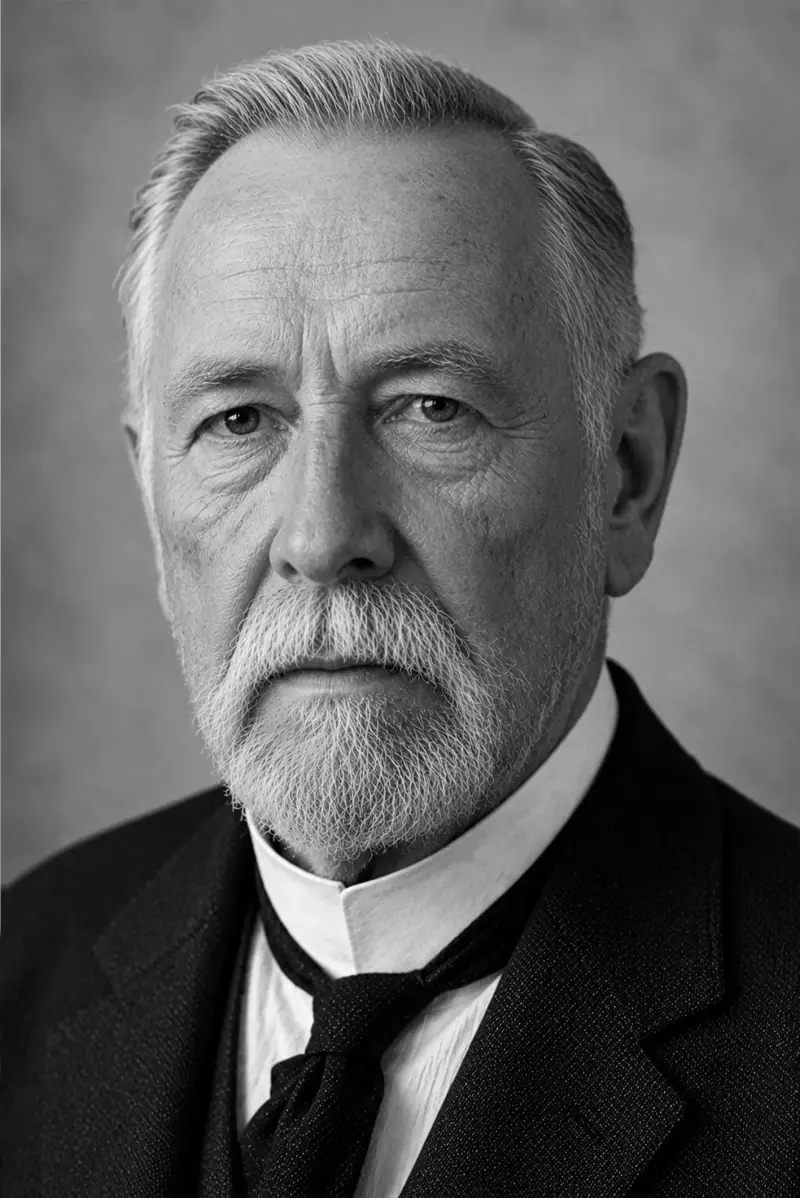
From the only image of Herbert Clapham found on an archived front page image of the Truth newspaper in 1929 , I used AI to create what he may have looked like in middle age and then as an older man.
Herbert could not seem to settle. Two months later, in April, he ran a replica of the advertisement in the Taranaki Herald, this time with his “Institute” based in New Plymouth.
In May, the “Institute” had shifted to Greymouth with the same promises of incredible medical treatments and, this time, offering: “Special accommodation for invalids placed inside the Institute, and such patients will receive every medical comfort and attention from trained nurses and servants, engaged under the direct supervision of Mr Clapham.”
Herbert must have found richer pickings and conditions more to his liking on the West Coast, with his advertisement repeated virtually every day for nearly two years. In July 1896 he shifted base from Greymouth to Hokitika, with his last advertisement appearing in the Kumara Times on 29 December 1896.
After New Year 1897, all advertising ceased. Nothing more was printed about Herbert Clapham’s activities in New Zealand for the next ten years.
Then, in December 1906, his name started appearing again in the New Zealand press archives and it was more of the same, albeit with new credentials.
This time he was promoting himself as: “Herbert Clapham, Consulting Herbal Practitioner from East St Kilda, Melbourne. Late Proprietor and Superintendent of the Bellevue Sanatorium and Hydro-Electropathic and Botanic Institute, the Mount View Botanic Institute of Kew, Melbourne, and formerly of the Nelson Sanatorium, Nelson, New Zealand.”
He placed advertisements in the Manawatu newspapers advising that he had commenced practice in Main Street, Palmerston North.
Before we continue from here, we need to go back a few years and head across the Tasman to trace Herbert’s activities in Australia during the previous decade—and there we find him.
He was missing in action for around four years. Then, in March 1901, the Ballarat Star, a newspaper based in central Victoria, found Herbert Clapham practising as the Medical Superintendent of the Bellevue Consumptive Sanatorium in the small town of Moama on the banks of the Murray River, directly across from the larger town of Echuca.
The Bellevue Sanatorium was of Herbert’s own design and he was going about his usual quasi-medical modus operandi, placing advertisements making outrageous medical claims that newspapers then followed up in their news columns.
For example, the Mount Alexander Mail noted in May 1901: “It will be seen from his notice in another column that Mr Herbert Clapham is fully prepared to cure consumption, fits, and complicated diseases.”
But Herbert’s road was not without its bumps and, in August 1901, we find him appearing in the Moama Police Court charged with a breach of the Medical Act of New South Wales.
The Ballarat Star was at the court: “The Moama Police Court was engaged until midnight yesterday in dealing with charges preferred against Herbert Clapham, proprietor of a building called the Bellevue Sanatorium. The accused, who is a herbalist and has been lecturing about the country in aid of the ‘sick poor’, was first charged with a breach of the Medical Act of the State of New South Wales. The police evidence was to the effect that the accused’s name did not appear upon the list of registered practitioners, but that he carried on a building in Moama where people paid for medical treatment. The prosecution arose from the fact that a man named Godfrey had died there and, with the accused being unable to give a certificate of death, an inquest had to be held.
“Dr Eakins gave evidence that the accused had informed him that he was not a duly qualified practitioner. After consideration, the bench decided to dismiss the case, though the chairman said that the accused had been perilously near a contravention of the law.
“A second charge, that Mr Clapham, being a person advertising that he treated patients at a certain house, to wit the Moama Sanatorium, had not printed on all such advertisements his full Christian name and surname, and had not the same upon the said building, was then heard. Voluminous evidence was given, and it was brought out that although the accused had his name on the walls inside the building, it did not appear on the outside. Mr Nathan, defending Mr Clapham, admitted a technical offence, but considered it infinitesimal. The bench considered that the letter of the law had certainly been contravened and it would be compelled to impose the minimum penalty of £20, but at the same time indicated that a memorial addressed to the proper authorities would very probably result in a material reduction of the fine.”
This brush with the authorities appears to have put a handbrake on Herbert’s activities and he seems to have moved on from the Bellevue, where his trail becomes even more convoluted.
In the People’s Weekly, a small newspaper based in the town of Moonta on the coast of the Spencer Gulf west of Adelaide, there is an advertisement in July 1904 announcing: “Mr Herbert Clapham, the eminent Hydro-Electropathic and Consulting Herbal Practitioner from Melbourne and Adelaide, is revisiting Moonta and may be consulted at the Globe Hotel. Mr Clapham will lecture at Victoria Hall, Moonta Mines, on Monday evening on Health. Silver Coin Admission.”
The only reference that can be found to the Botanic Institute of Melbourne and Adelaide appears in the Burra Record of 6 July 1904: “We are requested to call special attention to the advertisement in another column, announcing that Mr Bretnall of Clapham’s Botanic Institute will deliver a lecture at the Burra Institute this Wednesday evening. Also that Mr Bretnall may be consulted at the Kooringa Hotel on the two following days. The Botanic Institute is not an institution having its locale in some of the other States or abroad, but in Adelaide. This fact should weigh with those who desire to have their medicines at first hand from men who by an extensive enterprise give a guarantee of their responsibility. Wherever Mr Bretnall or his partner have lectured and consulted along the north line, a large number of patients have put themselves in their hands for treatment. Both the partners are men who have devoted their lives to the study of natural remedies known as the ‘botanic system’.”
It should be noted that later, in 1906, W. Bretnall, as a member of the Australian Union of Herbalists, was instrumental in establishing the Queensland branch of the union and eventually, as its president, campaigned for herbalists to be recognised as medical practitioners.
In November 1904, Herbert Clapham appears to have found a new way to peddle his services and was billed as the manager of The Grand Rational Sacred Concert in an advertisement in the Adelaide Advertiser, which read: “Under the direction of the Rational Sacred Concert Organisation. Produced with Dramatic, Spectacular, and Mechanical Effects. The most powerful and attractive combined cast of Musical, Vocal and Instrumental Selections comprising over 50 illustrated items, by leading Members of the Dramatic, Musical, and Vaudeville Profession.”
A Sacred Concert was typically a musical performance featuring religious music, often designed to blend religious devotion with concert-hall performance. Rationalist organisations were formed in the early twentieth century by non-religious individuals who promoted science, reason and free thought while critiquing the influence of superstition or religious dogma.
How Herbert’s Sacred Concert fared is not mentioned in the press.
Six months later, in August 1905, Herbert was in Broken Hill advertising himself as “Australia’s most eminent consulting herbal practitioner”, this time giving his credentials as “from the Botanic Institute of Melbourne and Adelaide”.
Herbert appears to have found some traction in the Broken Hill area and was still giving consultations up until November 1905. He also appears to have found a way to blend his promises of medical cures with vaudeville-style entertainment.
The Barrier Miner reported: “A concert and magic lantern entertainment organised by Mr Herbert Clapham was given last night in Heggarty’s Hall, South Broken Hill. The entertainment was very poorly attended. Popular songs were given, and Mr Clapham lectured on ‘Health’. The singers, especially Mrs Holmes’ rendition of ‘The Lily of Laguna’, were worthy of special mention.”
From late 1905 Herbert Clapham’s name abruptly disappeared from the Australian newspaper archives and, a year later, in December 1906, he reappeared on the New Zealand scene, this time in Palmerston North where he had set up consulting rooms.
Once again he began an extensive advertising campaign as he toured the towns of the lower North Island delivering “his famous lecture, The Battle of Life”, and offering consultations in local hotel rooms.
It soon appears that Palmerston North was not the most salubrious address and, by July 1907, he was claiming to represent the “Wellington Botanic Institute” and had taken his show on the road to Auckland. As he toured the northern towns he promoted himself as being from the “Auckland branch of the Clapham Botanic Institute”.
From September 1908 he was based on Queen Street, Onehunga, where he invited: “All discouraged and dissatisfied sufferers, who have been treated without receiving a cure, to call on him. It will cost them nothing for a consultation, and he will be pleased to have a chat and tell you frankly what can be done for you. Mr Clapham cures internal and external ailments without cutting or operations. The afflicted, no matter how, should not neglect to avail themselves of this opportunity to consult and get the advice of one of the world’s most eminent and successful Herbal Practitioners absolutely free. Consumption—Mr Clapham’s success in the treatment of this disease is unparalleled.”
From this base, at the age of sixty, Herbert embarked on yet another round of exhausting schemes to persuade unwell people to part with their money.
In September he travelled to the town of Paeroa where the local newspaper, the Ohinemuri Gazette, obliged him: “We understand that Mr H. Clapham intends giving a health lecture on the ‘Battle of Life’ in the Criterion Theatre on September 16th. The subject is one that Mr Clapham has given a great deal of study to and, being a fluent and entertaining speaker, we have no doubt a large number will take advantage of the chance of hearing him. There will not be any charge made for admission, but a collection will be taken up for some deserving case of distress in the district.”
Herbert advertised regularly in the Gazette, making fortnightly visits to Paeroa through to March 1909, where he worked from a local boarding house, using the old ploy of providing “free consultations”. This allowed him to make his dubious diagnoses and offer his even more dubious cures. He continually made the claim that “Mr Clapham’s success in the treatment of consumption is unparalleled”.
However, Herbert may actually have believed in his claims and may have been seeking the credibility of his peers when he ran a small notice in the New Zealand Herald: “Applications are invited from duly qualified medical men to watch, discuss, or join in my completed Progressive Oxy-Hydro Combination Treatment for Pulmonary or Constitutional Phthisis. H. Clapham. Queen Street, Onehunga.”
Whether any “medical men” responded is not known.
It was in January 1909 that Herbert branched out into another business venture by establishing the Healtheries Manufacturing Company, apparently in partnership with a miller named Hector Bloor. He advertised for sales staff, rented offices in the city, and promoted his first Healtheries product—Grist Ola.
Once more, his copywriting skills came to the fore: “Preserve bodily strength by using ‘Grist Ola,’ New Zealand’s ideal breakfast food. Gives power, energy, and vim. Dainty, delicious and highly nutritive. One pound of Grist Ola contains more real nutriment than three pounds of the best beef, mutton, or superfine white flour. Makes you feel fit for anything. Easily digested, sustaining, all nourishing. A boon to persons advanced in age, invalids, delicate children and all who suffer from indigestion, debility, etc. Grist Ola Porridge recommended for use in every home. 3 lb packet is obtainable from all grocers. Wholesale from the Healtheries Manufacturing Co., Onehunga.”
Herbert must have made friends at the Ohinemuri Gazette, the newspaper in June of 1909 seeing fit to editorialise: “We have received from the Healtheries Manufacturing Company, Onehunga, a sample package of an ideal breakfast food called Grist Ola. It is a specially prepared combination of the finest selected whole grain, blended with a full proportion of the choicest whole wheat berry, of the same high quality as at present used by the British and American Health Food Reform Societies. We have tested Grist Ola and can recommend it as a highly nutritious and wholesome food.”
Herbert must have made friends at the Ohinemuri Gazette, the newspaper in June of 1909 seeing fit to editorialise: “We have received from the Healtheries Manufacturing Company, Onehunga, a sample package of an ideal breakfast food called Grist Ola. It is a specially prepared combination of the finest selected whole grain, blended with a full proportion of the choicest whole wheat berry, of the same high quality as at present used by the British and American Health Food Reform Association. The manufacturers claim that it makes a complete diet in itself alone, capable of sustaining life to healthy, vigorous action and building up the body generally, because it contains the right proportions of actual nutriment. It is easy to digest and the most delicate constitutions can use it freely. Grist Ola is strongly recommended, and can be tested by the highest medical authorities as a perfect food for daily use by all families in every home. It is sold in three pound packages, and may be had from W. J. Adams’ store at the retail price of one shilling per package.”
It must have been costing money to distribute those three-pound packages of Grist Ola around the country, so in August 1909 Herbert advertised in the Auckland newspapers to buy a “ketch or small schooner, about 25 tons”.
Grist Ola was obviously Herbert's take on granola, which had been invented by Dr James Caleb Jackson, who created “granula” at his health spa in Dansville, New York, in 1863. Made of dense Graham flour, the dough was baked, broken apart, baked again, and required soaking in milk overnight before eating. In the 1880s, Dr John Harvey Kellogg developed his own oat-and-wheat-based version of the cereal, initially calling it “granula”. To avoid a lawsuit from Jackson, Kellogg renamed his creation “granola”.
From the middle of 1909 the advertisements for Grist Ola appeared no more.
However, not long after Herbert’s death in 1931, a report in the New Zealand Herald’s Stocks and Shares column reported that a new company, Healtheries Limited, had been registered in Auckland to take over the business of Herbert Clapham and Hector Bloor, millers. Capital: £1,500 in £1 shares.
Then, in November 1911, a familiar advertisement appeared in the King Country Chronicle, which occasioned the newspaper to comment: “As will be seen by advertisement in another column Mr Herbert Clapham has resumed practice in this district as a hydro-electropathic and consulting botanic practitioner. Mr Clapham, who has had a very wide experience both in Australia and New Zealand, may be consulted on all diseases free of charge at his consulting rooms, Rora Street, Te Kuiti.”
The advertisements continued until May 1912, when we catch a glimpse of another side of Herbert’s character. Then aged sixty-four, he was named as co-respondent in a divorce case between Arthur Leopold Raven and Jessie Carr Raven.
The reporting is vague, but it appears that John James Herbert Clapham, son of the co-respondent Herbert Clapham, gave evidence of his father’s conduct with the respondent, as a result of which his father and mother separated.
Herbert’s behaviour in this regard can be backed up by a recorded interview I made with his granddaughter, my Aunt Aimee, not long before her death in 2003.
She told me how Herbert abandoned his wife and children and went off to Hollywood in 1920. He was by this time seventy-two years old.
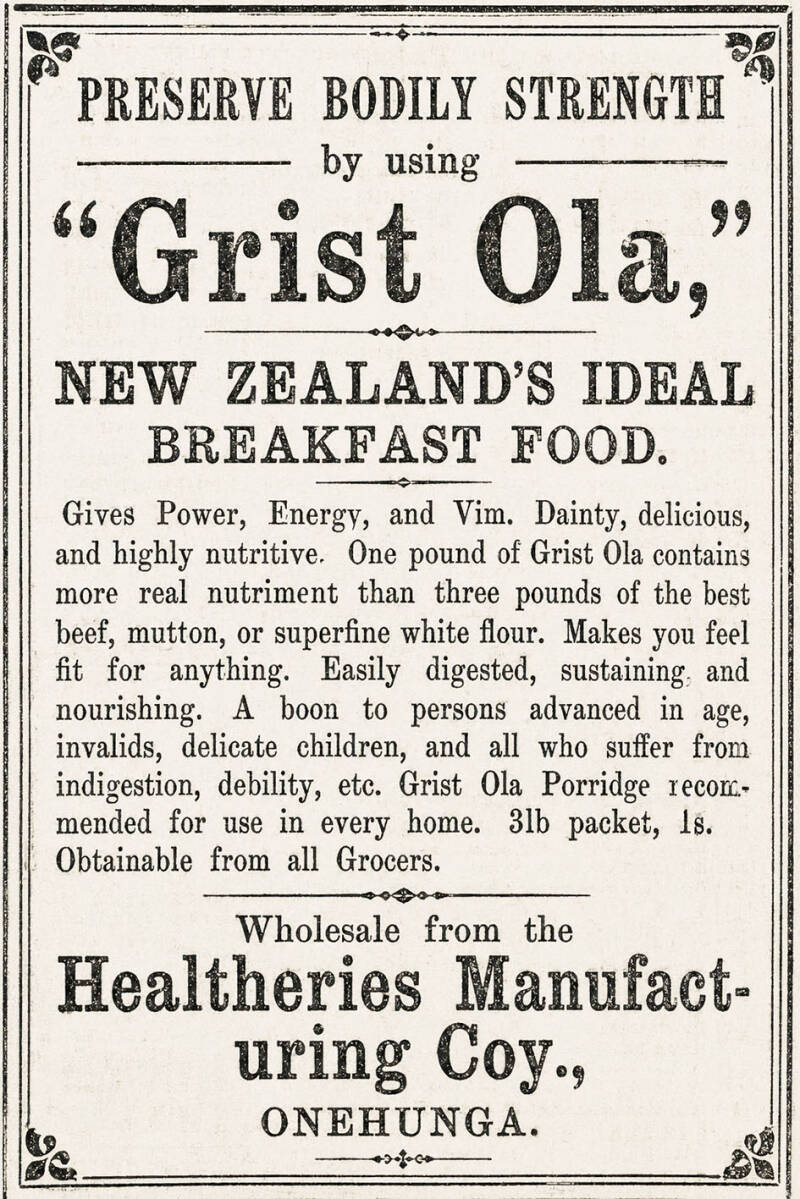
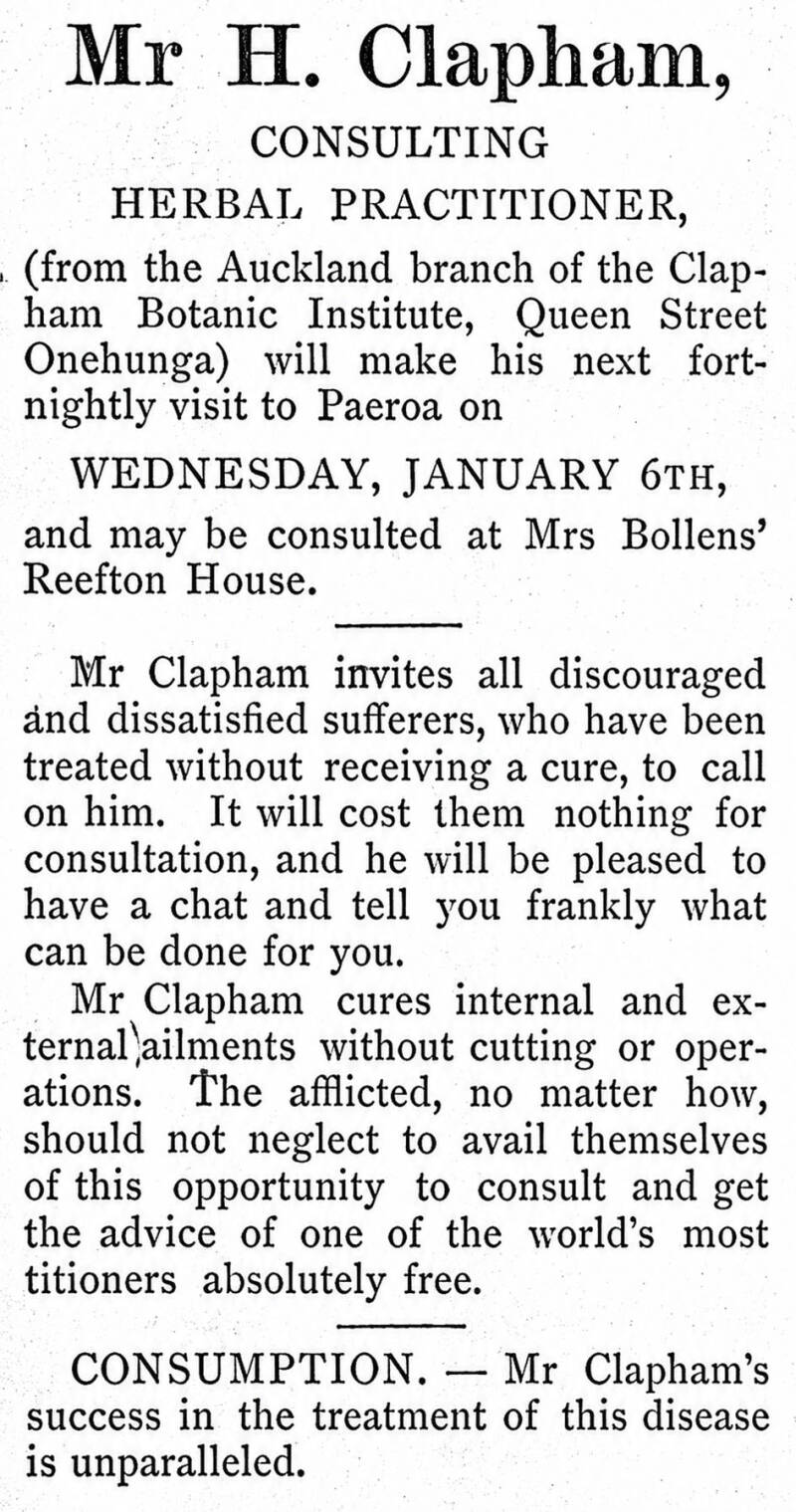
Herbert was a founder of a company called Healtheries while at the same time promoting his ability to cure a number of diseases.
I asked if her grandfather was an adventurer and whether he was attracted to the glamour of what was happening in Hollywood at that time.
Aimee, who had already made it clear to me that she had no time for her grandfather and did not really want to talk about him, answered: “Yes, well no. He was attracted to the glamour of the ladies probably. He was a good-looking man, absolutely immaculate. Always immaculate. He was tall, he didn’t carry excess weight. He was a great advertisement for the way of life he taught, as far as health went. He was very successful in that manner.”
I asked her if Herbert actually deserted his wife Matilda, her grandmother, who was in later life living with her son George’s family in Auckland.
She answered: “Yes, he did. He only came back home when he wanted assistance from Dad. He didn’t live with us. But he would come over on these jaunts and he stayed with us. He didn’t appeal to me. He was a very, what should I say, enterprising man. He took himself off to America and left my grandmother with her two sons. But every time he overspent and got into difficulties he came home to my father, his son, and at that stage was getting on in life, and Dad would have to help him on his way again. That is why I had such a distinct dislike for him. So my dad, instead of finishing his doctorate, went on with the herbal business. It was the Clapham Botanic Herbal Institute. That is what my father ran until he died.”
It is important that I add here that I asked Aimee if Herbert’s health business was a confidence trick of some kind.
She answered emphatically: “Oh no, it was a very good thing.”
But before we attempt to follow Herbert to Hollywood, we learn that in June of 1912 it would appear that Herbert’s marriage to Matilda was definitely on the rocks. The Dominion newspaper reported from the Lower Hutt court: “Matilda Clapham applied for a separation order with maintenance against Herbert Clapham. Applicant stated that she had lived apart from her husband for twenty years, earning her living by nursing. The application was granted for separation, with five shillings per week maintenance.”
It appears that around this time, in 1911, Herbert applied to patent a device for the generation of gas for homes. This ties in with his eldest son George and his family living in Te Kuiti at this time, running a gas appliance business. Aunt Aimee confirmed this in our 2003 discussion: “My father set up a gas business. Gas was just coming in and he set up a shop in Te Kuiti where they had all the necessary things to promote gas for cooking, heating and lighting.”
Aimee was born in Te Kuiti in 1908 and her younger brother Ellis (my father) was born there in 1912. It might appear that Herbert was living with George’s family in Te Kuiti at this time.
If we go back a couple of years, we discover that the Clapham Gas Light Manufacturing and Agency Company started doing business with lots of promise in 1909, visiting Auckland to demonstrate its “very superior light, heat and gas producing plant”.
But in October 1910 the company featured in the papers for another reason: unpaid debts, resulting in it being placed in liquidation in November that year. Among the items for sale by tender was a ‘Clapham Gas Generating Plant’ valued at £200, today’s equivalent of around $44,000. One of the company’s debtors advertised to sell what he was owed by tender, being the overdue balance of £385 ($85,000 today) on a promissory note of £900.
Included in the liquidation was the sale of a boat (a ketch named Waitangi) and, as a result of a later court case regarding its sale, we learn that Herbert was in fact a director of the gas company. This must have been the boat he bought for his Healtheries business.
All through this Herbert continued to “consult” as a “Hydro-Electropathic and Medical Botanic Practitioner, late proprietor and superintendent of the Bellevue and Mount View Sanatoriums of Australia”, mostly advertising in the King Country Chronicle in Te Kuiti until the time of the gas company’s collapse in 1912.
After that he was based in Auckland with premises at 480 Queen Street, operating as the Clapham Botanic Institute and advertising a “100 Years’ Life Elixir” which promised to make people “be young, look young, feel young all the time” for two shillings and sixpence a bottle. This was probably the business he set up with his son George, which operated in Auckland for the next number of years. It was also known as Clapham Botanic Remedies. The business was still operating in Queen Street in 1930.
In August 1913, he was back in the news nationwide, with all the major newspapers reacting to a claim he had made to have discovered and perfected a cure for tuberculosis and had presented a petition to Parliament, signed by no less than 7,110 others, urging the Government to give Herbert its backing.
The newspapers reported: “A somewhat unusual petition was submitted to Parliament this week by Mr Macdonald (Bay of Plenty) on behalf of Herbert Clapham, medical botanist, of Auckland, and 7,110 others. The petitioner states that he, not being a duly qualified medical practitioner, finds his humane efforts clashing with the interests of the medical profession, although he knows himself to be qualified to place the cure of consumption before the world at large for the benefit of suffering humanity. He explains that the processes and method of cure are radically different from the treatment hitherto recognised and employed, and entail an initial expense which is beyond his means. He, therefore, prays that the Government grant a sum sufficient to enable him to disburse the initial outlay or, alternatively, that the Government undertake the treatment of consumptives according to his methods and formulas under his direction and, if successful after a fair and satisfactory test has been made, recompense him by bonus or otherwise. He also requests the Government to grant him immunity from any prosecution to which he may be liable in the contravening of certain Acts in demonstrating his cure.”
In September the Public Petitions Committee made the non-committal recommendation that the petition should be referred to the Government. No news of the outcome of this petition could be found in the news archives.
While the petition was bouncing around Parliament, Herbert was busy organising a benefit concert, by permission of the Mayor of Auckland, to assist the families and dependants of the recent Huntly mining disaster. The “Huntly Disaster” was the 1914 mine explosion in which 43 miners died on 12 September 1914 after an acetylene cap lamp ignited methane gas, leading to a difficult, weeks-long recovery.
In a massive public relations coup, the Prime Minister of the day, Sir Joseph Ward, accepted an invitation to make a speech to open the event and was followed by “an excellent programme of songs, recitations and other items”. The concert wound up with a “lecturette” given by Herbert Clapham titled “The Struggle for Life”.
The event must have been a fundraising success for the Huntly relief fund, and possibly for Herbert Clapham, running for six nights across a number of venues in Auckland, including the Opera House, and winding up at the King George Theatre where it was announced that the benefits had raised a net profit of £120 for the widows and orphans of Huntly.
In December 1915, Herbert was running another benefit performance, this time for the “needy sick and dependants of the White Island Disaster” in the Auckland Town Hall. The White Island disaster of September 1914 involved a catastrophic crater wall collapse that triggered a massive mudflow, obliterating a sulphur mining camp and killing ten workers.
Sometime in 1916 Herbert Clapham packed his bags and sailed to America. He was away from New Zealand for fourteen years. It is difficult to find much detail of what he did in America, but there are family anecdotes that he went to California and peddled his ideas on health and medicine around Hollywood.
Aunt Aimee, in her conversation with me 23 years ago, recalled: “My father was to be a doctor, but our grandfather went to America, and set up this health and beauty establishment in the early days of Hollywood. He called it some sort of sanatorium and they had Roman rings and horizontal bars and Turkish baths, and dietary advice was the main thing. Some of his clients were very famous actors and actresses. I can remember Bette Davis being one.”
Herbert's wife, Matilda Clapham, died in 1921, aged 76. She is buried in the Waikaraka Cemetery in Onehunga (Area 1, Block J, Lot No. 145A).
It is not until Herbert returned to New Zealand in late 1929—aged 82—that we find out a little of his experiences abroad in a public notice in the Bay of Plenty Times: “Clapham’s Botanic Institute, established 1889, takes pleasure in announcing that special arrangements have been made whereby the founder of the Institute, Mr Herbert Clapham, will visit Tauranga on August 2nd, 3rd, and 4th. Sufferers in this district are fortunate in having this unique opportunity of consulting a gentleman so eminent in his profession and whose 50 years’ experience and sympathetic service has resulted in thousands being restored to perfect health when all hope had gone. Mr Herbert Clapham, the Founder of Clapham’s Botanic Institute, has but recently returned from America after an absence of 14 years, during which he was principal in charge of The Mountain Glen Sanatorium, Sierra Madre, California, the most successful institution for the treatment of all chest, throat and lung troubles, rheumatism, arthritis, kidney, liver and stomach troubles, specialising in TB, epilepsy and constitutional diseases.”
In the late 1910s, healthy living was a cornerstone of what was known as the “Progressive Era”, emphasised by the “back to nature” movement. It focused on spending time outdoors, eating whole foods, proper sanitation and personal hygiene.
So it would appear that Herbert, always the entrepreneur, was riding that wave and was astute enough to take himself and his skills to the forefront of the trend. The 1920s marked a major shift in American consumer culture where beauty culture and wellness merged, heavily promoted by movie magazines of the era. While spa treatments began as a “medical cure”, they quickly evolved into a 1920s luxury, especially for the wealthy and rising middle class.
Southern California, including the Hollywood area, was also an early twentieth-century hub for sanitariums due to its dry, warm climate, attracting affluent patients seeking treatment for tuberculosis and mental health issues.
Not long after his return from America, the campaigning newspaper New Zealand Truth, on 19 December 1929, published an investigative story about people who alleged they had discovered cures for tuberculosis, and Herbert Clapham was one of three men named in a lengthy article headlined, “Report On Alleged Cures. Public Should Be Told the Truth About White, Ward and Clapham”.
The story, under a subheading, Office Delay Menace To Health, stated that there had recently been sensational claims by laymen to be able to cure and alleviate tuberculosis and other “dread scourges”: “First came Mr L. N. White, who declared that he had cured himself of cancer by his own kerosene cure, and now comes the Rev. Edward Ward, Vicar of the Church of Ascension, Point Chevalier, Auckland, who claims to have discovered a cure for tuberculosis. Neither claim can as yet be accepted, least of all that of White, and it is possible that irreparable harm will be done if the public blindly accepts the claims as put forward. In the face of this, it is difficult to explain the casualness which has characterised the Health Department’s investigation of the two claims, and some explanation is certainly required from the Prime Minister of the delays which have occurred.”
The investigation focused initially on these two characters but then turned its attention to one Herbert Clapham, an Auckland medical botanist, who in an interview with the Truth reporter defended his claims of being able to cure sufferers of tuberculosis, neuritis, as well as rheumatoid arthritis.
He said that while he was a resident of Nelson he had been challenged by the medical men of that town to cure a case of tuberculosis that was considered hopeless.
The Truth article read: “Mr Clapham declares that he was successful, and that after six months the patient was able to leave his bed and that later he was married. Truth has not been able to investigate this alleged cure, which was effected in 1892, but found that it resulted in a petition, signed by 8000 residents, being presented to Parliament, asking for the recognition of Mr Clapham’s cure. The Nelson City Council was also interested in the matter, and much publicity was accorded the affair at the time. Mr Clapham’s composition, according to what he told Truth, includes a New Zealand drug, and, unlike Mr Ward’s cure, is in the form of a liquid, not a powder.”
Herbert was quoted in the story: “I honestly believe that I have got the nearest thing to a cure for tuberculosis in the world. No one medicine will cure the disease, because when TB sets in it brings a lot of other troubles, making a group of diseases that must be combated. It is essential to get the human machinery working before any good will result, and I have here a full course that, if followed, will have definite results.”
The Truth reporter continued: “Mr Clapham furnished Truth with the names of several of his patients and accompanied this paper’s representative on a visit to them, but the success or otherwise of his treatment is not a matter which this paper can determine. The Department of Health is investigating the claims of Messrs Ward and White, and, since Mr Clapham is in business and is treating patients, it should also thoroughly inquire into his so-called cure. Truth does not doubt the bona fides of these three individuals, but it considers that their claims cannot be accepted until investigated and tested by medical experts. If it is proved that they are genuine cures, then the public should be told so; if the claims are disproved and rejected, then the individuals concerned should be prevented from treating patients or selling their remedies. And if the present legislation does not permit this, then Minister of Health Stallworthy should see that the necessary amendments to the Health Act are made to enable the department to take action.”
The Truth story made no real accusations or allegations that Herbert was a charlatan and it appears there was no governmental inquiry into the claims of White, Ward or Clapham. In fact, the Truth story, in not proving that Herbert was misleading anyone, may have given him a certain amount of credible publicity.
It was seven months after the article that Herbert visited Tauranga in July 1930 and in October he made a similar trip north to Whangārei, promoting himself on these occasions as the founder of Clapham’s Botanic Institute, which was still operating from its address at 480 Queen Street, Auckland. He was living in the home of his son George and family in Kelvin Road, Remuera.
His advertising in the Auckland newspapers was less flamboyant than in the past; he simply posted a four-line classified in the “Wanted Known” sections of the Herald and the Star stating: “Consumption cured. Living testimony proves Herbert Clapham’s nature treatment. Consultations free. Communicate 480 Queen Street.”
If we accept that the New Zealand Herald was unlikely to have made a mistake, Herbert was 83 years old and, by all reports, still a supremely healthy and agile man when he set off as usual for the offices in Queen Street on 15 May 1931.
That evening, at around 9.20 pm, while crossing Upper Queen Street, he was knocked over by a car heading up toward Karangahape Road. The next morning the Herald reported that Herbert Clapham had received injuries to his head and that his condition was “fairly serious”.
The Auckland newspapers made no mention of his subsequent death as a result of the accident — the last report being in the Herald, where his condition was said to be “still fairly serious”. There is no eventual death notice and no obituary to be found.
The register of New Zealand deaths states that a Herbert Clapham died in 1939 and gives his age as 91, which would have been correct at that date. The MyHeritage ancestry website says he died on “15 May”, the date he was knocked down, but it also says the year was 1939. The website Findagrave.com also lists the date of his death as 1939 but has no details of his burial. However these ancestry styled websites are not fool-proof.
What makes it harder to pin-point when Herbert died is that a search of Auckland City burial and cremation records can find no listing at all for Herbert Clapham.
And Aunt Aimee—who at the time of his death was well known as “Miss Aimee Clapham”, a talented contralto singer who performed on stage in Auckland and regularly on the 1YA Concert Radio station broadcasting throughout New Zealand in the 1930s—confused the matter of her grandfather’s death even further when I played back the tape of our interview in 2003 where she stated, without supplying any dates: “Herbert came home on his last trip to America and he was staying with us in Remuera then, in Kelvin Road, living with us there, and he caught the tram into town where Dad was running his business in Upper Queen Street, and he was knocked over by a taxi. He was run over by a taxi and died. He lived to be a hundred. He was just on a hundred when he died, he was either 99 or 101, I can’t remember.”
It has long been a family anecdote that our great-great-grandfather Herbert died crossing Queen Street on his way to work at the age of 100. If that was the case the date of his death would have been between 1947 and 1949, but there is no evidence of this.
So it is here that I leave the story, with Herbert being as much of an enigma in death as in life. He remains a difficult man to judge. Perhaps the fairest conclusion is that he was a product of an age when the boundaries between medicine, entrepreneurship, invention and promotion were far less clearly defined than they are today.
Whatever one makes of Herbert Clapham, he was far more than a simple charlatan or eccentric. He helped establish industries. He promoted ideas about diet and health that were ahead of their time. He founded what ultimately became one of New Zealand’s most enduring health-food brands. He possessed immense energy, considerable intelligence and an extraordinary capacity for self-belief.
He spent his entire life pursuing opportunity, convinced that success lay just around the next corner. At the same time, he repeatedly overreached, made claims that could not always be substantiated, and left a trail of disappointed creditors, failed ventures and family tensions.
What is remarkable is that Herbert never seemed to lose faith in himself. Bankruptcies had not stopped him. Court cases had not stopped him. Public criticism had not stopped him. Failed businesses had not stopped him.
Repeatedly, throughout his life, he simply reinvented himself and started again.