Barefoot in La Brousse
Reporting from the 1993 La Transcaledonienne multisport endurance race.

In the high hills of central New Caledonia a team of kanak mountain runners showed me a clean pair of heels.
In the middle of July in 1993 I found myself in New Caledonia, running along a forested mountain ridge in the company of three barefooted Melanesians. The Melanesians were just three of 474 competitors running across the main divide that day in the second annual Transcaledonienne endurance race.
They had already run 16 kilometres from the start. I had been dropped on the ridge by helicopter, but I was determined to run the final 16km of the first day’s mountain run. Not because I had anything to prove, but because running over this terrain was infectious and exhilarating.
The event began that morning on the west coast of New Caledonia, way out in “la brousse”, or the back-country, about 200km north of Noumea, and was to cross the mountainous width of the island over two days and 68 kilometres.
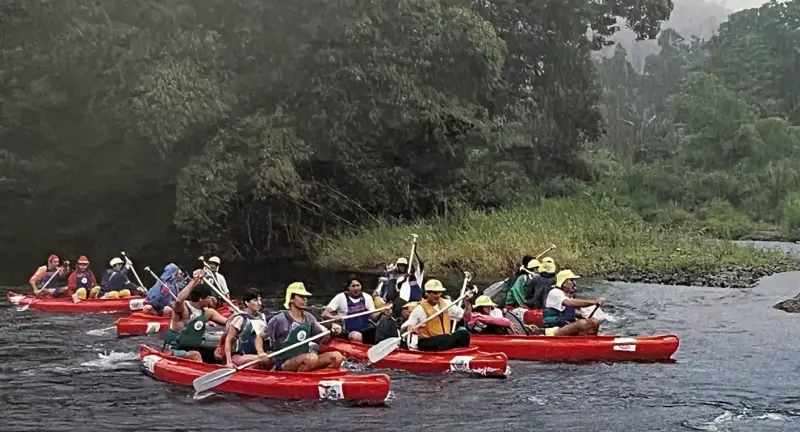
The race is run in teams of three, a ratio of 2:1 of each sex, and they must keep together for the entire race. On the second day teams have the option of running the final 35km or paddling part of the way in three-man plastic canoes. This year’s route followed traditional native walking tracks, revealed to race organisers by local tribes during the planning for the event.
The event was spawned by the running of the 1991 Raid Gauloises in New Caledonia—not to celebrate that event, but rather in protest of it. For during the running of the Raid Gauloises a group of New Caledonians were united by their condemnation of a cigarette company gaining so much publicity from a sports event.
The following year, 1992, they decided to run their own endurance event under the banner of the Association Defi Sante—a group of medical professionals and health care workers united in their concern at the effects of smoking and drinking on general health in New Caledonia. The association’s wide aim is to promote health in sport without the hypocrisy of cigarette company sponsorship. In fact, they are privately doing the work the Government-funded Health Sponsorship Council does in New Zealand with Smokefree and Lifespan.
The event has a budget of nearly 12 million francs, or approximately $NZ210,000. This money is raised by entry fees and sponsorship from major corporations willing to side with the health message of the event.
The association is also concerned at bringing health education to the rural Melanesian today's tribes and at grassroots level is helping to nurture social and cultural sensitivity towards the tribes’ values and customs. The event has a very similar philosophy to New Zealand’s Mountains to Sea race.
The Transcaledonienne passes over tribal lands with an overnight camp in a Melanesian village. I was told that a whiteman would have risked his life to have shown his face in this region only five years ago.
While I ran most of my journey in the company of three silent Melanesians, most of the 158 teams taking part were hyperactive French Caledonians from Noumea. There were all types, many running endurance distances for the first time, with the country’s top athletes competing fiercely at the front. The French seem to have a penchant for things military—and military was the word to describe the running of the race. The army, air force, police and civil defence seemed to be out in full strength in voluntary support of the event, which included compulsory checkpoints and team passports.
The top team won—sponsored by a chewing gum company (an alternative to smoking?) consisting of three members of the team which won the Raid Gauloises back in 1991.
The only disappointment the organisers had, and the reason for my presence there, was a no-show of New Zealand teams for the event.
Event director Jeanne Hosken is keen to see Kiwis take part in the next race (16 and 17 July, 1994), partly because of the high profile the New Zealand team had in the Raid Gauloises, and because she knows New Zealanders will give the local heroes a run for the money.
There is, after all, a national challenge waiting in New Caledonia. Mike Hosken, an ex-patriot Kiwi and a member of the fourth-placed team told me to urge New Zealanders to come over to New Caledonia to “kick French butt”.
The winners this year were three of the same who beat the Kiwis in the Raid Gauloises—and they still crow about that in Noumea. Hosken believes there is a score to settle here, and I agree. There is utu waiting for a New Zealand team of three, somewhere in those foreign hills.
For more information contact Jeanne Hosken, Association Defi Sante, BP 4770, Noumea, New Caledonia.