On the Run with Covid
As a virus-ridden fugitive I hole-up in a paradise
Written for self indulgence and to kill the time in the autumn of 2023

In May of 2024, while on holiday in Australia, I became infected with Covid, and was banished to spent eight days in isolation at Agnes Water on Queensland's Capricorn Coast.
After nine days and five rounds of golf on the Gold Coast, I finally saw the golf tour boys off at Coolangatta Airport on Sunday morning of May 3, 2024, and after being dropped off by the tour bus driver at Robina station, I caught a train to Altandi station in Brisbane
I had messaged my old friend Tony Broadhurst, who had arranged to pick me up to take me to stay at his home with his wife Noelene and our mutual friends Willy and Gillian Coyle from Waiheke Island for the rest of the week, with a vague plan of travelling north to Agnes Water the week later.
Tony was 15 minutes late picking me up at the station and I did experience a brief moment of anxiety realising how difficult it is to travel if you don’t have friends waiting for you at the end of the line. But he finally arrived and we embraced each other as good old friends do, and headed to his house in Marianas Street, Mansfield.
On my arrival, I received a warm welcome from the rest of the crew. We had all been together at the same time the previous year and had so much fun that we decided to do it again this year.
As we sat around the kitchen table I began to regale them with some of the adventures I’d had with my golfing buddies down on the Gold Coast over the past week. Noelene was doing something upstairs preparing rooms for her guests, but then she was suddenly in the adjacent lounge room where she called out to Tony: “Tony, can you help me please."
Tony jokingly said: “Can you wait till Gray finishes his story”, and she replied, “I really need your help now”. Was it my arrival or just a coincidence but within 10 minutes of my turning up Noelene was experiencing all the symptoms of a heart attack. This was dramatically confirmed after we called the ambulance and she was taken urgently to hospital where, in coronary care, she had a full-blown heart seizure and needed full resuscitation.
Thankfully she survived and after just four days in hospital, she was advised she could come home to recover. This was due to happen on Thursday afternoon. During that week Tony juggled his part-time courier job, visiting Noelene, and taking his New Zealand guests out to lunch. On the Wednesday we had all crowded into Tony’s car and gone to Bribie Island for lunch at a fabulous waterside resort with Robert and Karen Weyers. I did have a small concern that I was coming down with a "bit of a cold" and suggested that maybe I should stay behind. But Tony insisted I come.
We visited the Weyer’s impressive riverside apartment before making the hour-long journey north to Bribie, lunching at the sprawling Sandstone Point Hotel. We then piled back in the car, three of us across the back seat and drove back across the Gateway Bridge and home to Mariannas Avenue. That night I made a pasta dinner using sausages and fridge leftovers for us all.
Willy and I had planned a round of golf the next morning, Thursday, with Alan Munce, a friend of Tony’s and an acquaintance of mine from the numerous other times I have visited the Broadhursts in Brisbane.
I woke up on Thursday morning with an unusual headache and a sore throat and with dread I wondered if maybe I had caught Covid somewhere in my earlier travels. Alas, this was confirmed after a Covid test I took while Tony was visiting Noelene in Hospital, who was being discharged and was preparing to return home that afternoon, proved positive.
With dismay, I alerted Tony by text message that I had tested positive for Covid. And that was when my week as a Covid fugitive began. It was obvious that I needed to vacate the house immediately so as not to infect the others and certainly before Noelene came home. As it was, the doctor decided to hold Noelene back at the hospital one more night so I could be dispatched and the house could be seriously cleaned and disinfected.
I did not know what to do immediately; a foggy headache not helping my thought processes. I tried to Google search for somewhere to stay that night, but because of a major sporting event in Brisbane all that week there was absolutely no affordable, or even unaffordable, accommodation available in the city.
I contemplated flying to Auckland that afternoon in an attempt to get home, but that was quickly ruled out given the moral incorrectness of such a move. I decided there was only one thing I could do and that was to rent a car and just get the hell out of town.
The vague escape plan in my Covid-fogged brain was to drive north a few hundred kilometres, find a small country town where I could book into a cheap motel and where I could isolate for potentially seven days.
During the week I had arranged to catch a train north to Miriam Vale where on Sunday my friends Mark and Michelle would pick me up and drive to their place on the coast at Agnes Water. I rang Michelle and told her of the situation. She was my saviour. Her practical advice was that I should find a way to travel to their place where they were prepared for my arrival anyway. Michelle, who has been a nurse for most of her life, took my problem in her stride and insisted that everything would be alright.
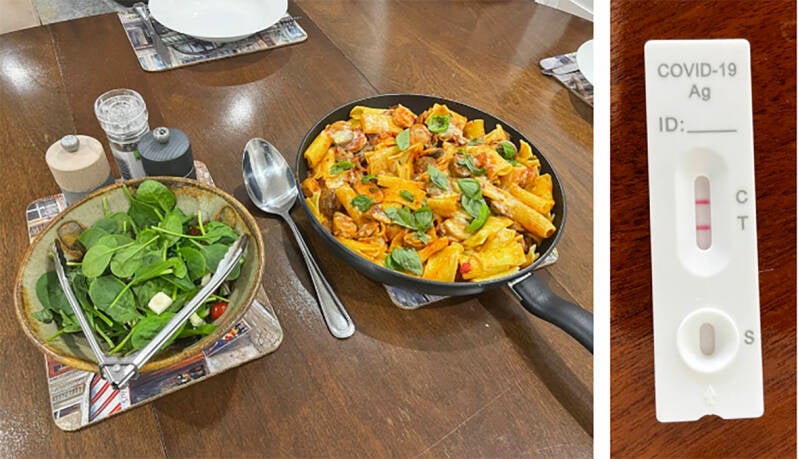
The last supper. That evening I made dinner for us all but the next morning I tested positive for Covid and so began my eight days on the run.
Thank God for good friends and sensible nurses. I had a way out, but I had to move quickly. Tony was sympathetic and apologetic but I understood his priorities and insisted that I had to leave the comfort of his home within the hour. “I’m sorry mate you just have to go” he said.
I rapidly searched for a rental car that could convey me in isolation from Brisbane to Agnes Water, some six hours north. But due to that major sporting event there were no appropriate rental cars available in the Brisbane area. So with time running out for my evacuation, I recklessly bought an online ticket on a Greyhound bus to Maroochydore, a hundred kiometres north on the Sunshine Coast, where I knew from pervious experience I could hire a rental car from the airport there.
Tony came home and, wearing a mask, he took me to the bus depot in the city, where at 2 o’clock that afternoon we said our goodbyes and I was on my way north in ominously rainy weather. As the packed Greyhound coach made its way towards the Sunshine Coast, and ultimately all the way to Cairns, I was overwhelmed with a sense of guilt and criminality. If the good people on the bus had known what I was, a Covid carrier hiding amongst them, they would have halted the bus immediately and called the authorities.
Wearing a surgical mask but trying to pretend I was just a nervous traveller, I tried to get a seat to myself but it was impossible and I ended up next to a young foreign girl who remained busy and distracted with her laptop and iPhone for the whole of the trip and took little notice of the man in the mask next to her.
Fortunately my symptoms weren’t aggressive at that stage and I was able to suppress urges to sneeze or cough for the two hours of that excruciating journey and I remain hopeful that I did not infect that innocent cohort of backpackers heading north for their sun-soaked adventures.
From the Greyhound bus stop in Maroochydore I called an Uber and to Maroochydore Airport where I rented a small hatchback for the next 16 days at the amazingly reasonable cost of just over $500. That’s if you don’t take out any insurance whatsoever. Fugitives have to take risks.
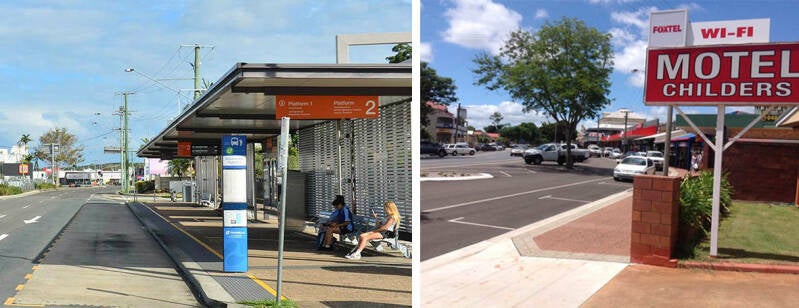
First stop after fleeing Brisbane was the Greyhound bus stop at Maroochydore from where I took an Uber to the airport to hire a rental car to take me north. At the end of my first day as a Covid refugee I found myself in the rural central Queensland town of Childers.
Driving away from the airport, sealed inside the car, I finally felt safe and back in control of my destiny. A car gives a person security, privacy, mobility and, most importantly, options.
So I drove north into the encroaching darkness, planning to drive as far as I could until exhaustion stopped me. As darkness descended and intermittent rain fell I had to use the dip-lights on the little car which were totally inadequate and the cause of much tension as massive semitrailers hurtled towards me down the Bruce Highway.
I got behind one of these behemoths and followed along in its massive glow. After an hour or so, on the verge of hallucinations, I started to doubt my ability to carry on as it became increasingly more frightening to plunge into the dark gap to the left of oncoming cars and trucks with their blazing lights, ignoring the fact that I was suffering the brain-fogging symptoms of the rapidly worsening coronavirus infection.
After three hours on the road I finally made it to the small town of Childers where I found a cheap, old-fashioned motel just before its reception office closed for the night.
What a relief it was to take the key from the elderly manager at the desk, take refuge in that classic motel room and finally bring my day on the run to an end.
After procuring the worst fried rice I've ever experienced from an adjacent Chinese restaurant I experienced the awful feeling of being a refugee, fleeing some unknown source of aggression; or a fugitive on the run and that at any time "special agents" would burst through the door and I would be captured and have my slender hold on freedom ripped away from me.
I woke at dawn to a cloudless central Queensland morning and, dosed up with Panadol, found a takeaway coffee shop and took a walking tour of this old-fashioned Queensland town, population 1750. I imagined how a traveller down on his luck might be forced to stay in such a place, find accommodation and a job, and start a new life there. I decided it wouldn’t be so bad, despite Childers being the town that made international headlines in June 2000, when an arsonist set fire to a backpacker hostel claiming the lives of 15 tourists.
But after sitting in the sun outside my unit with the worst example of a Subway breakfast sandwich I’ve ever eaten, I hit the road for Agnes Water via Bundaberg, still three hours further to go.
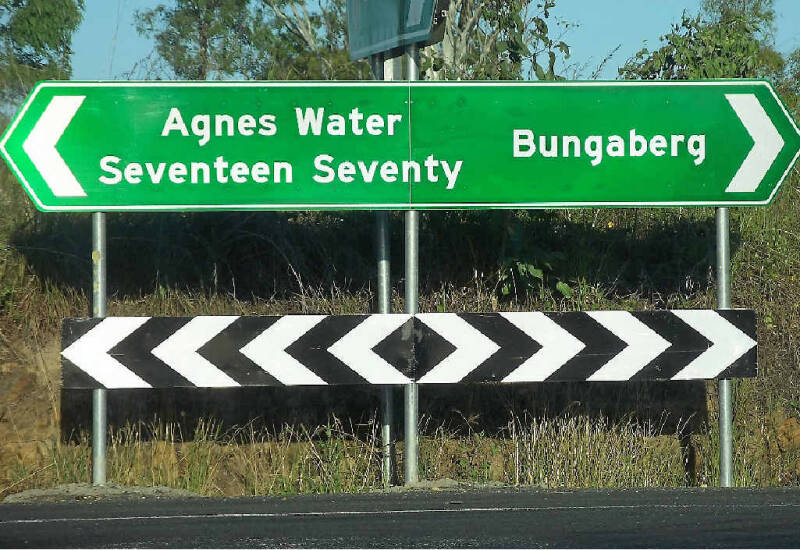
I drove in to Bundaberg under the full influence of Covid 19 and took the left turn to the coast.
In Bundaberg, I crossed the Burnett River and began the two hour final push to Agnes Water and the Town of 1770. I arrived at Agnes not long after noon and made a furtive foray into a brand-new supermarket that wasn’t built when I was here this time last year, and grabbed a few supplies. I was soon pulling in at the driveway at 40 Atlantis Boulevard, the home of Mark Pryor and Michelle Dwyer, my close Australian friends who were our neighbours and good friends when we lived in Burleigh Heads on the Gold Coast in the 1980s. Our relationship has been maintained over 30 years or more.
I was earlier than expected and no-one was home, so I drove down to the main beach to get my bearings and to check the surf, as you do in Agnes Water.
Named after the coastal schooner Agnes, which was lost at sea in the area in 1873, Agnes Water is known as the most northern surfing beach in Queensland. It’s tucked between the very beginning of the Great Barrier Reef and the north end of Fraser Island – now known as Ngari – attracting swells from a certain direction that squeeze between those two offshore obstacles.
The surf is usually no more than shoulder height, most often smaller than that, but a rocky point at the southern end of the long sandy beach creates an almost perfect small-wave machine. It’s a magnet for backpackers, grey nomads, South American and European surfers as well as a colourful band of rough-hewn, washed-up hippies reliving the 70s' dream on its palm-fringed golden sands.
On this day, the surf was knee-high, the wind offshore and the point was a-buzz with surfers of all ages, nationalities and genders zipping along the small winding waves.
A small kid of about five or six crouched down in the pocket of a perfect right hander, a middle-aged woman tore down the line racing the curl, and a poster-girl teenage longboarder gave a stunning display of walking the board and hanging five.
I returned to the house in Atlantis Boulevard to find my friends had just arrived home and were expecting me. The reality of having a contagious diseased kicked in as I put on my mask and we performed our greetings from metres apart. Smiles and laughter mixed with concern. The deal was that I would take myself around the back of the house to their self-contained, downstairs guest apartment where I would keep myself isolated for as long as it took to return a negative Covid test. This turned out to be eight days later.
In the meantime I had to wile away the days in pampered luxury; the fridge full of all the best things you could want to snack on – shelves of spreads, biscuits, chocolate and muesli bars; a pod coffee machine at my disposal. Fresh sourdough bread delivered daily by Michelle from her kitchen above. Not to mention delicious homecooked meals delivered to my door nightly.
So began my week in solitary confinement – however, it wasn't so bad. We were able to communicate while keeping apart, talking at a distance on the pool patio or through the screen doors.

What better place to spend eight days in isolation than on the beach at Agnes Water.
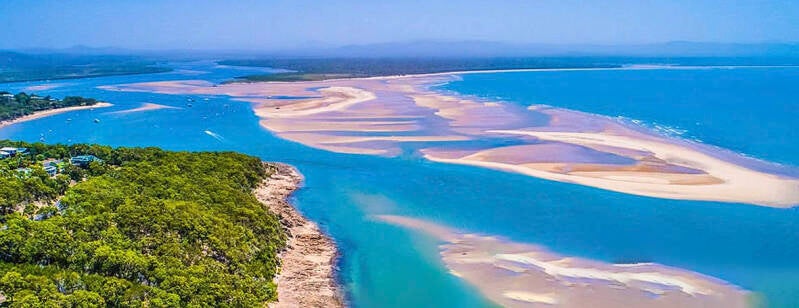
During my days in confinement I managed to venture out, mask-protected, to the Town of 1770, a magnificent location just north of Agnes Water.
After a couple of days it became obvious that I was not seriously unwell, mostly a vague headache and an intermittent cough. The house has access to the beach and I began taking long walks along the sand, about three kilometres to the point and the patrolled swimming beach. Here I could sit on the rocks and watch the swimmers and surfers, take a dip myself and soak up the sun. Not a bad concept for a vacation really. I would return to the house and watch Netflix; all the way through the Ripley series, and finally got to endure Oppenheimer.
On day five I ventured by car along the road to the nearby Town of 1770. Just seven kilometres north of Agnes, 1770 is hardly a village let alone a town. With a permanent population of just 125, the site commemorates the second landing in Australia by Captain Cook in May, 1770.
A huddle of holiday houses, a marina and caravan park, it hugs the western side of a promontory overlooking a vast estuary and a massive sandbar system and is a popular setting-out point for fishermen heading for the islands of the southern end of the Great Barrier Reef. By a quirk of geography it is one of the few places on the east coast of Australia where you can view spectacular sunsets across the ocean, over the vast expanse of Bustard Bay. Here I had a glass of wine at my favourite outdoor bar, The Tree Restaurant.
On day six I retested for Covid and for five minutes I was clear. But slowly over 30 minutes a faint red line appeared and darkened to positive, much to my dismay. That afternoon I helped Mark, while keeping a distance, paint some timber he was preparing to make repairs to the house deck.
On this day I found out, to my dismay again, that both Gillian and Willy, back on Waiheke Island, had Covid as well. I felt really bad. Even though I had no idea I had been exposed before arriving in Brisbane, I felt responsible. I understand now about Covid guilt.
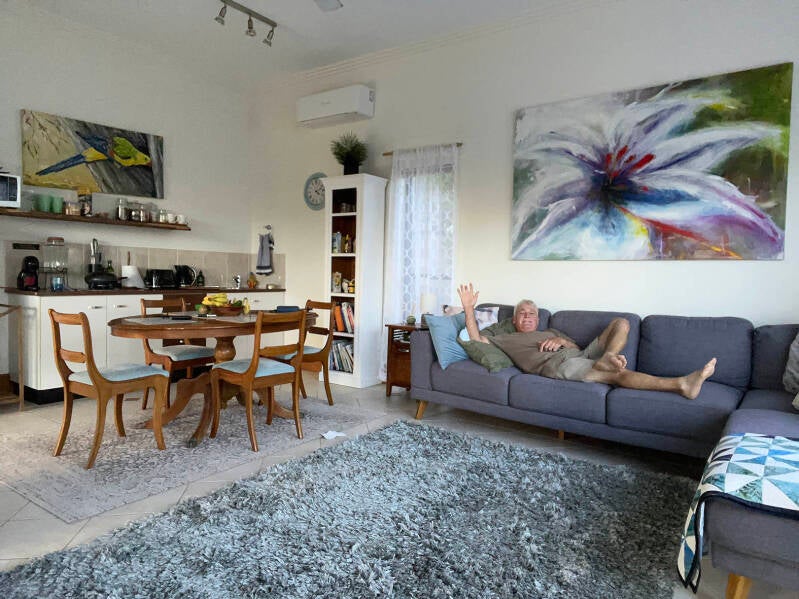
This was my isolation ward for the eight days I was struck down with the dreaded Covid virus.
I wake on the eighth day and start a fresh test. This time I cover it up and put my iPhone timer on 15 minutes. I start my breakfast and then the timer sounds. I take a look and I’m clear. There is not even the faintest red line where it shouldn’t be. Mark and Michelle have left the house early so I can’t share the news immediately. I send Michelle a photo of the negative test.
I start cleaning my apartment. Somewhere in the story of the Covid epidemic the term “deep clean” came into the common dialogue. The term has a draconian ring to it and reinforces your guilt and sense of shame. I am not wanting to downplay the contagious threat of Covid or the kindness of those who came to my support, but I would suggest going easy on the use of the phrase “deep clean”. It's a stab to the heart of the one who needs “deep cleaning”.
What actually does it entail? How “deep” can you go with a box of Dettol wipes and a can of Glen 20? Armed with the above I do my very best. Every surface wiped and sprayed. Dishes washed and drained. Door handles, window latches, chairs, tables, bathroom fixtures, containers, wiped, sprayed and wiped again. I wash all the towels and tea towels. A second load of all my bed linen goes in the machine. How far do I go? It’s been half a day since I tested negative and I haven’t yet left my room. I’ve cleaned as deep as the tools available allow.
But the world has reopened to me. After eight days on the run and in hiding, I can now rejoin the general population and resume my vacation. The plan is to leave on Monday, today is Friday. I’ve agreed to drive Michelle down to Hervey Bay to visit her niece who has just given birth. From there I will continue south back towards Brisbane, the plan to arrive Thursday night, spend the weekend with Tony and Noelene and then fly out on the following Monday.

After eight days in isolation in my friends self-contained unit, Mark and I finally get to hang out with our morning coffee at our favourite place overlooking the beach at Agnes Water.
I make a phone call to Tony and get the heartening news that he has not been infected. He talks to me on his car phone and I’m delighted to hear he’s taking Noelene for an outing and that she is feeling fine after what was a near death incident.
So I’ve got three more days at Agnes and another four on the road. But right now I think I’ll make a coffee and then go down to the beach and watch the surfers again. Tonight I plan to take Mark and Michelle out for dinner, the least I can do to thank them for giving this Covid refugee a place to hide.