My great-grandfather's amazing life
Introduction by Gray Clapham

The 'Attack on the Malakoff' by William Simpson (1823-1899), a Scottish artist and war correspondent during the Crimea War, shows the French assault on the Malakoff, the main Russian fortification before Sevastopol on 7 September, 1855. It was after this offensive that the teenage Neville Hale Thornton was awarded the French Legion of Honour which led to his wanderings in colonial Australia.
The story you are about to read has existed for more than a hundred years in the form of two hand-bound books; some 160 pages of double-spaced, typewritten text on fragile, yellowing paper. These typewritten volumes are themselves transcriptions of an earlier collection of handwritten memoirs—currently misplaced—penned by the author, Neville Hale Thornton, my great-grandfather on my father’s side.
I first encountered the handwritten memoirs sixty or more years ago when they came into the hands of my father, Ellis Thornton Clapham, the author’s grandson. Reading them was no easy task, as Thornton’s handwriting was a turbulent ocean of backward-slanting script. Thornton himself must have recognised the difficulty and at some time later in his life, probably after typewriters had been invented, he commissioned the typewritten transcripts of his adventures. These came into my view as other Clapham family memorabilia gradually found its way to Gisborne, my father being the youngest survivor of a family of eight.
The typewritten books bounced around family members for decades and were in my possession for many years before I passed them back to my late brother, Mark Clapham, when he began researching our family history in retirement. As early as 1990, I had explored ways to have the fading text converted into a readable, printable document that could be shared with a wider audience. From the outset, Neville Thornton’s descendants recognised that his jaunty recollections were not only fascinating as family history, but also of genuine historical significance in a broader sense.
Despite this, finding someone willing to manually input the text proved unsuccessful and the idea lay dormant for many years until the books recently returned to my care. In the meantime, computer technology had advanced and Optical Character Recognition (OCR)—the process of converting images of text into editable digital form—has become widely accessible.
I began by photographing every page on my cell phone and transferring the images to my computer for OCR processing. This was far from straightforward. The typewritten pages, many bearing handwritten corrections by the author, were not always accurately read by the AI software. Each page contained numerous errors that had to be carefully checked against the original text and sometimes against historical records.
As a result, I have edited the text for spelling, grammar, punctuation and occasionally plain logic. However, the period phrasing, rhythm and tone of our great-grandfather’s remarkable story have been preserved. To assist modern readers, I have added explanatory notes (in italics) to clarify place names, people and events—details whose historical significance can now be better understood with the benefit of hindsight and modern research tools.
As Neville Thornton was sparing in his use of dates when recounting his adventures and significant events, where possible, I have attempted to assign dates based on available historical evidence.
One final note: I would never have thought this story would need to be preceded by a warning, but in these current times some of the terms the author uses to describe indigenous Australians, Chinese gold miners and even outback pioneers hailing from the Emerald Isle, would not be acceptable and would be severely edited. But that is not my job here and to censor Thornton’s words would be unthinkable to me and would also dilute his original and colourful eye-witness description of the life and times of colonial Australia.
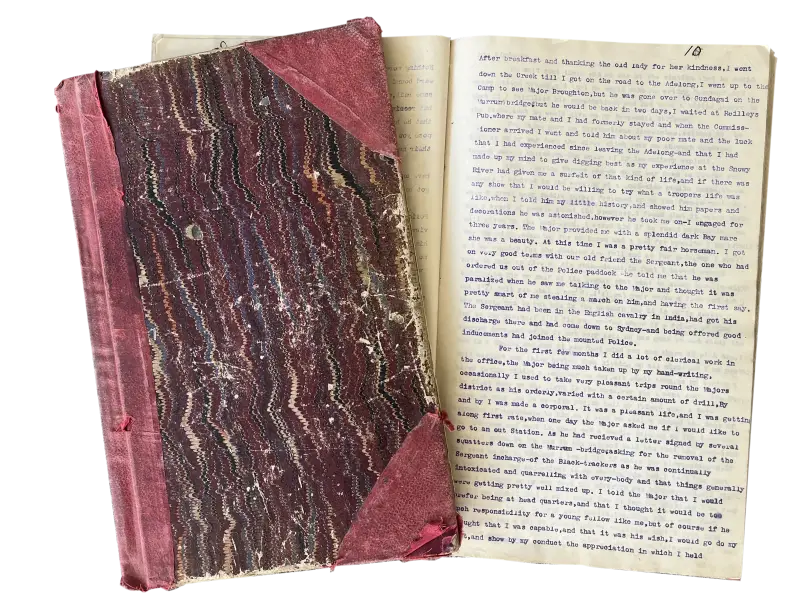

Thornton's typed manuscripts and a sample of his handwriting from the earlier edition.

An engraving of the butcher shop owned by Thomas Castro in Wagga Wagga, Australia, during the time Neville Thornton lived in the town. The butcher, also known as Arthur Orton, claimed to be Sir Roger Tichborne, the missing heir to a prominent English baronetcy.
THE ADVENTURE OF MY LIFE
From the battlefields of Crimea to the goldfields of Australia
THE EARLY LIFE OF NEVILLE HALE THORNTON (1837-1912)
FOREWORD BY THE AUTHOR
During the last forty years I have passed a very eventful life and I have ventured to make my debut as an author and I hope that the descriptions of the various scenes and characters that I have witnessed will interest the general public.
I have told my life as simply as I could, giving the colonial phraseology and terms. I have exaggerated nothing, but I have given a statement of facts and I hope that the rough and ready style of my book may be accepted as a recommendation.
It is a true adage that truth is stranger than fiction and I think that it will be verified in the minds of my readers; when they have perused my book.
The stories are considered by journalists and other literary men, to whom I have submitted my manuscript, as the most interesting and graphic descriptions of colonial life ever written and added interest is attached to them, as they are grounded on facts and being my own personal experience.
(Neville Hale Thornton, c.1887)
MY STORY
My name, Neville Hale Thornton. I was born in the little, quaint town of Harfleur in Normandy, noted for its siege by Henry the Fifth of England. Havre, formerly Havre de Grace, four miles away has supplanted it in trade, shipping, etc, so that Harfleur has since dwindled to a mere village.
My father was a Captain in the Old East India Company’s service, his mother was a Miss Hale, a lineal descendant of Sir Matthew Hale, Lord Chief Justice of England during one of the Henrys’ reigns.
There are at present two branches of the family still in existence. It seems that Sir Matthew was a sort of modified Mormon having, besides his wife Lady Hale, a mistress, one Mrs Blagden and two families were the result. The Hales (legitimate) and the Bladgen-Hale’s (illegitimate). The present representative of the Blagden branch is (Matthew) Blagden Hale, at one time Bishop of Queensland.
My father, recovering from a wound received in action against the enemy, obtained a leave of absence to visit England. (This would have been around 1836.) On the voyage home the East Indiaman in which he took his passage was lost, having foundered at sea, the crew taking to the boats. The boat in which my father was in happened to be the only one that was picked up, by a French ship called La Ferrier, homeward bound to Havre. The other boats were never heard of. (East Indiamen were merchant ships that operated under charter or licence for European trading companies which traded with the East Indies between the 17th and 19th centuries.)
On the arrival of the vessel at Havre, the Captain invited my father, who it seems was a pretty fair French scholar, to stay with him for a time to recruit himself from the vicissitudes of voyage. He accepted the invitation and the Captain (Captain Robert Neville) took him out to Harfleur where he lived, when home from his voyages, with an only sister. The consequence of the visit was my father’s marriage with that lady.
Shortly after his marriage he went to England, leaving my mother in France, returning after a while to Harfleur, intending to return to India in his brother-in-law’s ship which was bound for Pondicherry, a French possession on the coast of India and from whence he intended to get a passage to an Anglo-Indian port but, “man proposes and God disposes.”
My dad received a communication from England in reference to some business matter and which took him to Penrith in Cumberland in the North of England. My father arrived at Penrith on a Christmas eve and went out to a farm owned by the father of a brother officer and where he spent that Christmas day.
He left the farm that night to return to Penrith riding a thoroughbred mare. However his dead body was found the next morning at the gates of the livery stables, headless, having evidently been dragged along the road by his foot becoming entangled in the stirrup.
I was born that same Christmas night (in 1837) but my mother knew nothing of my father’s death for some weeks later as there was no telegraphic communication at that time with France.
My mother went to England to look after my father’s affairs, staying with his friends who resided at St. Cross’s near Winchester, his native place, close to the Tichbourne Estate. She spent a few years alternately in France and England, then she married again to a retired Major in the English Imperial service.
I passed my earliest years at times in England, at times in France. The Norman patois (dialect) was my first speech. English I learned going to school in England. I also went to the College Caen in Normandy and then was sent to the L’École Polytechnique at Paris.
I was 16 years of age when the Crimean war was declared (5 October, 1853 – 30 March, 1856). Some little time after the war had commenced an inquiry was made at the school if there were any boys who could speak English fairly well and, if so, would they be willing (parents and guardians consenting) to volunteer for service at the front as interpreters in the Commissariat Department, their duties chiefly consisting of accompanying fatigue or working parties boarding English transports and bringing ammunition, arms and clothing, etc for the troops.
I and four other lads were selected and I was the youngest of the lot. I was nicknamed Le Poupée Norman (The Norman Doll) on account of my fair skin, blue eyes and flaxen hair and looking even younger than I was. We went by train to Marseilles and embarked there for Balaclava, which we reached after a very rough passage. When we went ashore dressed in our élève (pupil) uniform, I was accosted by a ferocious looking old grenadier of a French infantry regiment. “What are you going to do here youngster,” he growled, “why, you don’t look strong enough to use a darning needle let alone a sabre.”
I told him, putting on a bit of side, not to speak disrespectfully to his superior officer. I had forgotten to state that we boys were invested with the honorary rank of sub-lieutenants to give us, I suppose, a sort of authority over the working parties and it is quite superfluous for me to say that we felt ourselves “some pumpkins”, at least I know I did.
I told the old grenadier that I was sub-lieutenant in the Commissariat. He looked surprised and exclaimed: “Quoi, un enfant come toi un officier (what, a child like you an officer)?” He then begged my pardon and gravely saluted me but I had a sort of suspicion that I saw him wink at some of his comrades and that he was only poking fun at me.
My nickname seemed to have preceded me ashore for when I reported myself at headquarters, one of the officers exclaimed: “Oh, you are the Norman doll!” On the following day I commenced my duties by going on board an English ship, the Abberton of London. The second day on board three or four of my men got drunk and had a terrible row, so much so that a Provosts guard had to come on board and arrest them. I was hauled up before my superior officers and threatened with arrest for allowing them to get drunk. I began to think that military glory was not all beer and skittles and which, alas, I soon found out was only too true.
I was in the Commissariat for some time and getting dissatisfied with the service, I asked for leave to join some regiment at the front. Before I could obtain permission from the Commissariat authorities, I was one day strolling about Balaclava off duty when I saw an officer ride in, evidently of high rank for he was escorted by two mounted chasseurs. I asked who he was and was told it was General McMahon; I watched him dismount and enter a building.
I waited till he came out when I went straight up to him, saluted and asked if it were possible for me to get attached to some regiment as a volunteer, or in any way, as I was very uncomfortable in the Commissariat, especially as there were one or two who were continually harassing me and that I was afraid of committing some breach of military discipline and which would no doubt bring me into trouble.
The General listened to me very attentively then burst out laughing. He asked me my name and how I came to be in the Crimea. I told him my name and he said, “Why that is an English one, it is strange and yet I see you wear a French uniform, in fact I thought you were a truant from the Lycee (a military school in Paris).”
I said: “General, pardon me but you are in the same predicament as myself for you bear an Irish name.”
“Oh well, he said, "that’s true but I will see the Chief of the Commissariat and make inquiries and at any rate I promise that you will hear from me again.” I saluted and thanked him, he then mounted his horse and rode away.
(General Patrice de MacMahon was a French hero of the Crimean War, famous for his daring capture of the Malakoff redoubt during the Siege of Sevastopol in September 1855 before he became a Marshal of France and later President of the French Republic.)
A few days afterwards I received orders to accompany some cavalry to the French lines. The Commissariat furnished me with a tremendous iron-grey horse which had originally come from Australia and had been in an English cavalry regiment in India but sold as unfit for service and bought with several others by the French authorities and employed on escort duty.
He was a brute; about the worst all-round specimen of a buck-jumper I have ever seen in my life. When I went to get on him he glared at me. I hesitated getting on him, when the crowd round the store began to chaff me. One little French man-o-wars man remarked that my division would not be able to go into action till their commandant, meaning me, arrived and he thought that I had better wait till they imported a donkey from Egypt.
“It would be the safest,” I retorted, “but I will not have to wait long for a jack-ass while you are there.”
It rather turned the tables on him. However I mustered up courage and got two fellows to hold the horse along-side some cases while I mounted. I must inform my readers that some time previously I had purchased a grand fur coat that had formerly belonged to a Russian officer. I intended to have it altered to fit me but I could not find anyone able to do it so I had to wear it as it was. It was like a Pursers shirt, it fitted me all over and touched me nowhere. However, I managed to mount my grey charger, for a wonder he was perfectly quiet.
The squadron of cavalry came up just then and he fell into the ranks as naturally as possible, having been an old cavalry horse. We got along all right till the officer-in-command told me that my route lay in a different direction to which he pointed which would bring me to McMahon’s quarters
I got along alright for a few yards after leaving the troop, when my “Rosinante” looked around and, seeing the other horses going in an opposite direction, did not evidently like the idea of being left a lonely orphan. So he began his little game of slewing around and presently he began bucking, I holding on like grim death but it was of no use. I had not sufficient equestrian experience to retain my seat.
Close by to where he began his circus business was the trunk of a dead tree with a solitary projecting branch. He rushed alongside it evidently with the idea of rubbing me off, which he did, but not perhaps in the way in which he intended. For as he jerked me up from the saddle the skirt of the long coat I was wearing caught in the branch of the tree and dragged me off and there I hung like Mahomet’s coffin, suspended between heaven and earth.
The wretch cantered off a few yards, looked around and I really believe he grinned at me, before starting off after the troop of calvary, leaving me like Absolom, hanging by the tail instead of the head.
I hung for some time vainly endeavouring to extricate myself when some field pieces and tumbrils came along escorted by some English light cavalry. As they drew near I sang out to them in English to get me down, telling them how I had got in that predicament.
One of the trooper exclaimed: “Holy Moses! Why is an English drummer boy trying to desert to the enemy?”
The trooper who made the remark that I was a English drummer boy, I met years afterwards under very different circumstances, he then being a sergeant of police. Poor old Bevan, who was in the Charge of the Light Brigade and I was a scenic artist in the Princess’s Theatre in Dunedin, New Zealand. Many a yarn and laugh have poor old Bevan and I about those past and gone Crimean days.
But I am digressing. As soon as I was extricated from my awkward situation I wended my way to MacMahon’s quarters. When I arrived I saw the General who told me to go to General Bosquet’s tent. He was General in command of that division. An orderly took me to the General where I explained my business. He asked me a few questions and then gave me a note to take to Colonel de Brancion of the Algerian Tirailleurs.
The Colonel treated me very kindly and employed me mostly in orderly room work and sent me to drill and made me practice regularly at sword exercise and I believe he used to give the sergeant, who taught me, something out of his own pocket. He seemed to take a great interest in me. He had a great desire to learn English and he used to get me to give him a few lessons after a fashion.
After a while the assault of the Lunette of the Marmelon was decided on. I asked the Colonel to allow me to accompany him. He tried to dissuade me, saying: “You do not know that if you go with me the chances are that you will get knocked over as of course, I must lead my men, so you will be amongst les enfans perdus (the forlorn hope).” But I thought it would look cowardly for me to remain behind so at last he reluctantly consented.
I was on speaking terms with the Vivandiere of the regiment, a young woman who came from Picardy, a French Province. The day of the assault she was with the regiment when we fell in and just before the order to advance was given she came up, shook hands with me and with tears in her eyes kissed me and bade me good-bye.
(The capture of the Mamelon Vert by French forces on June 7, 1855, was a crucial step in the eleven-month-long Siege of Sevastopol, which was the main objective of the Allied forces in the Crimean War. In military engineering, a lunette is a detached fortification designed to protect an exposed area or the approach to a main fortress.)
The attack commenced. I kept as close as I could to the Colonel. We got up to some embrasures; the Colonel got through one and taking a flag from one of his officers made his way to the parapet. I followed, close up, he just managed to stick the staff in the ground when he was shot dead, bringing the flag down with his fall.
I picked it up and just managed to replace it when I too was knocked over, shot in the groin, a wound in the jaw and my chest bones smashed by, I suppose, the butt of a musket.
I lost all consciousness and when I regained my senses I was lying in the Colonel’s tent and his dead body was stretched out on his camp bed.
The Vivandiere was sitting by my side. When I opened my eyes she got up from her seat and asked me if I had any message to send home to my friends as the doctors had told her that my wounds had given me no chance of recovery. I thanked her but said that I thought that I should get alright again. She nursed me for two or three days when Generals Caurobert, McMahon and Bosquet came to see me. McMahon took my hand and said: “My poor boy, if you get alright again you shall not be forgotten.”
The next day I was taken to Balaclava to my old quarters in the Commissariat and a day or two afterwards I was taken on board a French vessel, crowded with sick and wounded, that was going down to Constantinople. I shall never forget the horrors of that passage, the groans of the poor devils when it was rough; the fearful stench, the sight of the amputations, the dressing of ghastly wounds, poor mutilated wretches dying almost every hour. It was awful.
At last we reached Constantinople. I was taken over to Scutari and at my own request was placed in the English military hospital there. I was there for over five months, unable to get out of bed on account of the whole of my right side being kind of paralysed. I was visited several times by Miss Nightingale who used to chat with me and cheer me up.
(Florence Nightingale was an English social reformer and the founder of modern nursing. Nightingale came to prominence while serving as a manager and trainer of nurses during the Crimean War, in which she organised care for wounded soldiers at Constantinople.)
One of the nurses who used to come round, I met a few months ago in Hawera, Taranaki Province, New Zealand, now an old lady, Mrs Evans, with a grown up family and still following up her old occupation of nurse. It was an accidental meeting. I was staying at O’Driscolls Hotel when a young woman, the waitress, poisoned herself and the old lady I speak of was sent for to wash and lay out the poor girl and I happened to remark: “I suppose you have seen a good number of dead bodies in your time considering how many years you have been a nurse.”
“Oh,yes,” she replied. “My first experience was when I was with Miss nightingale at Scutari during the Crimean war, I was one of her staff of nurses, I was then Miss Clive.” After a little conversation she recollected me as the lad that was so long in the hospital and said she often wondered whether I ever got all right again when I was sent to Southampton as soon as I was convalescent enough to travel.
But to return to my story, while lying in my bed I had seen dozens of dead bodies taken out of the beds on either side of me. However I was sent to England as soon as I was able to be moved, as I explained that my friends were living at Portsmouth. So I got a passage to Southampton in a vessel conveying the sick and wounded home.
A young Chasseur who had been wounded in the hips and rendered unfit for service but convalescent, was allowed to accompany me to look after me as I was perfectly helpless. On the voyage the same terrible scenes occurred, only in a more mitigated form than those I experienced on the passage across the Black Sea. Every morning at a fixed hour a funeral service and burial was given to the bodies of those who had died since the last burial had taken place. Also sundry arms and legs that had been amputated were made into a package and thrown overboard.
At last we reached Southampton and when we went into the dock there was a tremendous crowd to see us land. I was taken on shore in my cot with the canvas sides down. I was then able to sit up, my Chasseur comrade walking alongside of me. They were about to put me into a kind of express but the people on the quay would not let them put me in the conveyance and four of them carried me to an hotel just through the Bar Gate of Southampton.
My mother and half-brother arrived from Portsmouth by the first train the next morning and I need not describe the meeting with my poor mother. She kissed and embraced my soldier comrade as if he was her own son when I told her how kind and attentive he had been to me.
We went to Portsmouth the next day. My soldier friend stayed with us over a month. My mother gave what to him was quite a little fortune, besides his receiving several presents from different members and friends of my family and my mother defrayed his passage to Cherbourg in France, near which sea port his family resided.
After staying at home for some months, thanks to a good constitution and my youth, I got alright again, excepting at times at changes of the weather when the wound in my groin used to trouble me, chiefly on account of the ball not being extracted. But for many years I have felt nothing of it.
I then went to Harfleur to visit my mother’s friends, then to Paris where I went to my old school, the Polytechnic, to see some of my old teachers and school mates who were glad to see me again. I had grown a lot taller and was as thin as a clothes peg.
I made inquiries as to where General MacMahon’s residence was and one day I went to his hotel. He was astonished to see me for he never for a moment thought, so he told me, that I would ever recover. We shook hands heartily and he and congratulated me on my recovery. He then introduced me to Madame MacMahon, telling her my story and she made me a present of a ring set with small rubies which she took off her finger.
The General asked me where I was staying and when I told him he made a note of it and said that I was not to leave Paris until I heard from him, because you know, he said smilingly, you have not received your discharge from the army. He then made me a present of two hundred francs saying it will enable you to see Les Spectacles de Paris (the Parisian theatres).
I thanked him and withdrew. About a week afterwards I received an official note from the Bureau de Guerre (War Office) commanding my attendance at the Polytechnic on the following Monday, by Order of the Emperor Louis Napoleon.
I did not know what to make of it. I was puzzled to know what the dickens the Emperor wanted poor me for. Anyhow I went at the appointed day to the school and was interviewed by the Principal, who he told me that he had received orders to parade the boys at two o’clock that day and that I was to fall in with them. So I waited till the appointed time when the Emperor, attended by a staff of officers including General McMahon, rode into the courtyard.
I was called to the front, where I stood at attention and saluted the Emperor who I recognised by portraits I had seen of him. He turned towards General McMahon and said: “Can this be the young sous-lieutenant you spoke to me about who was with the Algerian Tirailleurs at the assault of the Lunette of the Marmelon? Why he is quite a boy.” “Yes, sire,” MacMahon replied, “The same.”
The Emperor then asked me my name which I told him. He made the same remark that General McMahon had made to me in Balaclava, viz. that my name was English and asked how it happened that I was with the French troops in the Crimea. I explained as briefly as possible.
“And so you were wounded, youngster, in picking up the flag when your Colonel fell?
“Yes, your Majesty,” I replied, “but I am nearly alright now.”
Then turning to McMahon he said: “I suppose we must recognise his action in some way.” After conversing for some little time with one or two of his staff, the Emperor told me to report myself to the Bureau de Guerre the next day where I would receive “your decoration of the Legion of honour which I accord you.”
“I confirm also your rank as Sous-lieutenant and instructions will be given that you receive your pay as such from the time that you were wounded.”
I thanked the Emperor and they then rode away. The school authorities and scholars congratulated me. I then left the school feeling as proud as if I had been made a Marshal of France and thus happened the most eventful day of my life. The next morning I went to the Bureau de Guerre when I received my cross and papers. My backpay I did not receive for some days afterwards.
(The Légion d’Honneur [Legion of Honour] is France’s highest national order, established by Napoleon Bonaparte in 1802 to recognize outstanding civil and military service to the nation, regardless of background. It is awarded for exceptional merit and commitment, serving as a symbol of French national recognition and prestige, with recipients often held up as examples for others.)
While I was in Paris I got acquainted with a young Sub-lieutenant belonging to the Chasseurs D’Afrique (African Chasseurs) and we got very chummy together. Just about that time my wound began to trouble me and I felt pains in my chest and other unpleasant symptoms. So I went to a doctor who told me that I was suffering from sub-acute indigestion, consequent of my wounds and that he would strongly advise me to go to a warmer climate.
When I told my friend Paul what the doctor had advised me he remarked: “I think that you might be able to fix that up alright. Try and see if you can get attached to my regiment which is stationed at Oran in Algeria and if you can manage it you can go with me as I have to rejoin my regiment in a few weeks.”
I took his advice, first getting a certificate from the doctor and then we both went to the Bureau de Guerre and I sent in my application stating particulars. In a few days I received orders to accompany my friend when he started to rejoin his regiment.
I being in funds, invited my chum to visit my friends in England. We got the necessary permission to leave France so we started out, calling at Havre on our way. We spent three or four jolly weeks in England, visiting London in the meanwhile. We were splendidly treated everywhere and our Chasseur uniforms attracting much attention. At length I bade goodbye to all and returned to France, my purse made lighter from my visit to England.
I had nearly forgotten a little matter that happened while I was in London. My mother and a lady cousin accompanied us to town. Every evening we used to visit a different theatre. One evening we went to a theatre called, I believe, the City of London, situated as near as I can recollect in Bishopsgate. The play was Jonathian Bradford. We were both in plain clothes as we found that our uniforms attracted too much attention and were too conspicuous.
My mother did not accompany us that evening, being indisposed, My cousin was with us and we took seats for the boxes. During the performance two or three young fellows came in, evidently under the influence of liquor as one of them insulted my cousin. I of course, naturally resented the insult and we had a bit of a struggle which ended in my antagonist falling over the front of the box into the stalls and breaking his arm.
I was arrested and taken to the Police Station, but was bailed out and appeared the next morning before the Police Magistrate. But the other two young fellows were manly enough to state the true facts of the affair, so the case was dismissed.
A few days after our return to Paris we received orders to rejoin our regiment as a detachment was leaving for Algeria. We embarked at Toulon, arriving after a very pleasant voyage at Algiers from whence we proceeded to Oran. I was very comfortable there and was treated with great deference both by my brother officers and the men, my Cross of the Legion being a passport both to their respect and goodwill.
I got on first rate at Oran but by health did not improve, the climate seemed too trying for me, besides I had the sorrow of losing my poor old chum Paul who died of fever. He was only twenty years of age and I missed him terribly.
Some little time afterwards I made application for leave of absence on the plea of ill health which was granted me and I obtained a passage back to France. As soon as I arrived at Brest, a French naval seaport, I paid my own railway fare to Paris and immediately went to the War Office and stated my case and my wish to leave the service. After a few days I obtained my discharge and I then went down once more to Harfleur and from there to Southampton, then to Portsmouth.
After staying some five months with my friends, my health wonderfully improved but I was advised to take a long sea voyage. I thought the matter over and finally made up my mind to go to India but with very vague ideas of what I was going to do when I got there. However, I got letters of introduction to several influential people in Calcutta and a little money from my people.
I went to London and took a passage on board a fine barque called the Grantham, bound for the Mauritius via Adelaide, South Australia, for a cargo of sugar. My idea was to see Australia then Maurititus and then get a passage up to India. We had a pretty fair voyage out to Adelaide but unfortunately, having a lot of idle time on my hands, I was induced to join in a nightly game of cards, with the result that when I landed in Adelaide I was stone broke. I had only paid my passage to Adelaide as I thought I might possibly stay in Australia and go no further, so there I was without money or friends; completely stranded.
On the voyage out I got acquainted with a young fellow passenger, a doctor’s son, who, when he landed, was about as near being a millionaire as I was. We tried to get something to do for work but Adelaide was very bad at that time, however we managed to live for a while by selling occasionally a few trinkets; clothing, etc. I had a small gold cross and chain set with diamonds which had been round my neck all my lifetime. I used to take a diamond out now and then and sell it to raise funds till at last there was nothing left but the setting.
We eventually made up our minds to clear out of Adelaide and make our way to Victoria. So we started on our journey without swags or money, excepting one solitary half-a-crown.
The first day we got as far as Hahndorf. It was a very hot day. We went through the village and came to a vineyard on the side of the road. My mate went through a gate and asked an old German woman if she would give him a few grapes. She gave him three or four very nice bunches whereupon we proceeded a short distance further and then, sitting down, we tackled the grapes. They were delicious but almost immediately after eating them I was seized with agonizing pains in the stomach so severe, indeed, that I thought I was going to “peg out.”
My mate got alarmed and rushed down to a house that he saw some distance up the road and which proved to be a wayside public house. He told them the condition I was in and they very kindly, gave him a tin pannikin nearly half full of rum and a bottle of hot water. After I had taken a good dose of the rum I began to get better and I really believe that it saved my life.
After a while we resumed our journey and that night we put up at the “Hotel de Haystack”, pleasantly situated in a paddock. The weather being warm we dispensed with bed clothing and I need not say that our hotel bill next morning was hardly worth mentioning.
That evening we struck a small village in the Tinpot Ranges, a copper-mining village, where we got a good supper and a shake-down from the mining boss who was a Cornishman and, as my mate was also Cornish, we were in clover.
The next day we did a good stretch having plenty of tucker which the Cornishman had given us when leaving. That day we reached a place called Murrundi, or Blanchetown, so called after a Governor’s wife, an embryo city on the Murray River consisting of a public house and one or two huts. A little down the river was a Police Station, garrisoned by a sergeant and two troopers.
We went into the pub and entrenched woefully on our funds by spending a shilling out of our solitary half-crown. I asked the landlord, an Irishman who had been in the police force, if he could give us a job. He asked what we could do and my mate replied: “Oh, anything from pitch and toss to manslaughter.” He gave my mate a job to look after the stables and yard, in fact a sort of wood and water joey. Your humble servant was set to quarry limestone which was a fairly easy job as the stone was soft and easily got out, it soon hardened, however, when exposed to the air.
The boss had very big ideas. He intended to build a stone hotel as soon as he had a sufficiency of stone quarried. Another of my duties was to bring home every evening a mob of goats to be milked, which operation was performed by the landlord’s sister, a recent arrival from the Emerald Isle. She had come out with the avowed intention, so she told me, of marrying a squatter, but up to that time no squatter had made her an offer of his hand and heart. She was a big strapping girl about twenty-one years of age.
The goats used to go sometimes along the brink of the limestone cliffswhich ran along side the river for some miles. They ranged from fifty to one hundred feet high and perfectly perpendicular. Sometimes the goats used to go down to the bank of the river below the cliffs, down a sort of tough stony staircase which led to a narrow slip of level riverbank extending for a mile or so along the river and then ended up against the cliffs, preventing any further advance in that direction. Sometimes I would fancy that they had gone along the river bottom and when I had gone some distance I would see the wretches hanging on by their eyebrows along the overhead, I had then to retrace my way, climbing the cliff being simply impossible.
One day I had been served that way which made me rather late getting back. The tea was over, the cook, a young Cockney girl, said that a lot of men had stopped to tea and that there was nothing cooked left but that if I would not mind frying myself a bit of steak she would make me a fresh cup of tea.
I went out and cut myself off a piece of steak from a joint hanging up in an outhouse. I brought it inside and placed it in a frying pan with a very long handle which they call a bush banjo. It is necessary to have a long handle as it is not possible to get near the big wood fires, especially in bush localities. While the steak was cooking I left it for a moment to do something when the fat ignited. I rushed to the fire and snatched the pan off striking the landlord’s sister, who had just entered the kitchen, knocking her flat on her back. She set up a terrible yelling, picked herself up and rushed into the bar, telling her brother that I had grossly insulted her.
Her brother immediately snatched down a sword that was hanging up in the bar, rushed like a maniac into the kitchen and went for me trying to cut me down. I dodged about the kitchen trying to escape out of doors. While trying to evade him I snatched up a stick that was used to poke the fire logs together and used it to parry off his blows; knowledge of sword exercise standing me in good stead.
Things were beginning to look rather crooked for me but when the landlord was chasing me round the big kitchen table his foot slipped and he fell across it. I immediately let him have a thundering whack on the side of the head laying him out insensible. I immediately made tracks down to the Police Station and told the Sergeant what had occurred, showing him the stick scared with the cuts from the sword.
The Sergeant and one of the troopers went back with me to the pub. We found the landlord sitting in the kitchen with his head bandaged up. When the Sergeant asked him the meaning of the affair he swore that he had never used a sword. He said that when his sister had complained to him that I had insulted her he came into the kitchen and, without the slightest warning, I had picked up a stick and split his head open.
The Sergeant asked him where his sword was and he said it was hanging up in the bar. The Sergeant asked my mate, who was standing by, to go and fetch it, which he did. The Sergeant found some blood on the hilt of the sword which had evidently come from a wound to the landlord’s hand which was quite fresh. Besides he compared the nicks on the stick with the blade and found that they corresponded. The cook corroborated my statement in every respect. The Sergeant then told the publican that he had better let the matter drop as he was evidently to blame and that he was liable to be charged with serious assault. He took the Sergeant’s advice, paid my wages and my mates, as my mate would not stay on without me.
The next morning, just before we left a swagger came in and we bought his swag (blankets, billy, tomahawk etc) as he was going into Adelaide and had no further use for them, the Sergeant also kindly gave me a red blanket.
We started up to a place called the Overland Corner. It was a broiling hot day, our road lay across a series of sand hills called the Seven Sisters. Up to our ankles we sank and sometimes deeper in the sand and it was a tough journey, for though the river was in full view below, we were choking for a drink but we could not reach it on account or the perpendicular cliffs of which I have already spoken.
At last we reached a horse station, a station where only horses are bred. It was evening when we arrived, we went into an empty hut and looked about and for some materials for a fire. I left my mate to light the fire while I went up to the homestead to get some flour and meat. We had tea and sugar.
While I was away a lot of blackfellahs and their lubras (wives) came round the hut and began cadging for sugar and tobacco. They frightened the life out of any mate for when I got back he had got the door barricaded. A stockrider had come back with me and after a while my mate opened the door when the stockrider explained that they were only a lot of harmless station blacks. But to a new-chum like my mate they certainly looked like a lot of ferocious scoundrels.
The next morning we once more started on the “wallaby” (Australian slang for a person wandering about looking for work). In the afternoon we struck a sheep station kept by an old Scotchman. We went up to him where he was sitting under the verandah and we asked him if he could give us a job. “Can you saw young fellow?” he asked. “Of course I can,” I replied. “Oh! very well,” said the Scotchman. “Come along with me and I will show you what I want sawing.”
He then took us round to the back of the house and showed us a lot of logs about twelve feet long and eight inches in diameter. They were Murray pine, a tree that grows on the sand hills in the Riverina district, of a yellowish colour, variegated with dark rosewood colour bands or ribbons.
It emits a very pleasant odour when split or cut into slabs but is very brittle and short in the grain. The old fellow said that he wanted them cut down the middle to make a floor for the verandah. He agreed upon a price per dozen and our rations. He took us to the store and gave us a new pitsaw and an old stationhand showed us how to rig up a sawpit on the side of a bank which we very soon rigged up and carried all the logs round.
As I mentioned, the saw was a new one and in trying to put the square bolts into the head of the saw to fasten the tiller or handle on, the bolts were a trifle too large and in trying to get them through we split the saw right across. When we told the boss what had happened he blasphemed enough in five minutes to last him ten years and he called us naughty names not to be found in the New Testament.
It seems that there was not another saw in the district, so he gave me a horse to go to the nearest township some twenty miles away and take the saw to a blacksmith and get him to make two fresh holes. It was not a very pleasant job carrying a pitsaw that distance on horseback. The blacksmith, in trying to make the holes, split it across again, rendering the saw perfectly useless.
I went back, lingering along the road till it got dark, as I was afraid to face the old man and I was also frightened that I might have his death on my conscience as, in his passion, he might have a fit of apoplexy, (he looked an apopletic subject) so when I got to the station I went down to the men’s hut and told my mate. We then made up our minds to clear out, which we did, leaving the saw and a polite message for the old gentleman.
We travelled all night and at daybreak we camped, boiled the billy and had some breakfast, had a sleep for an hour or two, then pushed on.
We reached another station about three o’clock in the afternoon and went through some sheep yards then up to the house and asked for a job. The boss gave us a job to roof a woolshed with some sheets of stringy bark and we started on the work the next morning.
We worked two or three days when my mate fell off the roof and nearly broke his back and was laid up for two or three days. Of course I could do nothing single-handed and as my mate did not feel able to go on with the work, the squatter paid us for what we had done and did not charge us for the three or four days tucker while we were not working.
We then made another start, this time we got a job to sink a tank on an out station on one of the back blocks. We worked like niggers for about three weeks but we found that we could not clear our teeth; of course the deeper we got, the worse it was, so we emigrated from there and started once more for fresh fields and pastures new.
Our next stopping place was a small township called at one time Lang’s Crossing Place, on the Murumbidgee, now called Hay. At that time the township consisted of one public house kept by a man named Leonard, an American; one Store, Major Cadell’s (the pioneer of the navigation of the Murray river); a Blacksmiths shop and one or two slab huts.
On the bank of the river was a big mob of blackfellahs camped. We slept that night in the “dead-house,” a building so-called that was put up next to the hotel and fitted up with rough bunks where poor devils who had melted their cheques or were hard up, were allowed by the landlord to stay a few days and supplied with a bit rough tucker. They were then given a bit of food and cleared out.
The next morning my mate said that he had been thinking matters over and that he had an idea that he would do better by going to Melbourne where he had a sister who, he believed, had married pretty well and that perhaps she would put him in the way of doing something.
But to leave it to chance, he would toss up a coin. If it came tails he would stop with me, if heads he would shape for Melbourne. He then tossed up and the coin came down heads, so he packed up his swag, shook hands with me and we bade each other good-bye. I met him years afterwards at Gundagai, doing fairly well as a commercial traveller.
After he started out I had a look around the township but could see nothing likely to turn up. I then went into the pub where the landlord was in a terrible state about the cook, who was lying speechlessly drunk in the kitchen. There was no one to cook the dinner and there were several station holders there, who had just arrived and intended staying for dinner.
Mrs Leonard was in the kitchen trying to get things ready when I volunteered to help her. I believe I was the only sober individual about the place with the exception of Mrs Leonard. Mr Leonard thanked me, saying, “for God’s sake go in and do what you can.” We then went into the kitchen and to start with we cleared out the cook, I then did the best I could. We got on all right and managed to get the dinners ready.
They kept two tables, one for the swells and one for the bush hands. We had plenty of help to fetch, water, chop wood, wash dishes, etc, in the shape of a half a dozen lubras who were only too glad as, when they were done, we gave them the scraps off the plates and a small piece of tobacco each.
I helped for a day or two as nothing came along in the shape of a cook; the boozy predecessor having cleared out altogether. Mrs. Leonard asked me if I would stay and, if so, she would show me all she could. So I stayed but the work was a caution. It used to take nearly all my time making campoven bread which was only used for the best table. For the men’s table I used to make dampers.
Dampers are a kind of bread made by mixing flour, water, salt and sometimes a little carbonate of soda, together and thoroughly kneading the ingredients. It was no joke as sometimes they were as big as small cart wheels. I used to get one or two of the lubras into the kitchen at night and set them on the job. My kneading trough was a large sheet of stringybark which I improvised for the purpose. I used to close the kitchen door as I thought, perhaps, people might object to me employing coloured labour and feel a sort of prejudice against the ladies as they were not generally in the habit of using, pocket handkerchiefs, they also resorted to that old custom that our ancestors used before the invention of forks.
Sometimes I used to soar into the realm of pastry by making puff-de-lunas (criossants). I am not certain about the orthography of puff-de-Luna, never having seen the word in print nor am I aware that it has ever found its way into any modern dictionary. An old Van Demonian gave me the recipe. You simply mix the flour with the water, sugar, carbonate of soda and if you could get a few carraway seeds, so much the better. You then got a camp-oven half full of fat and, when boiling, you immerse your cakes, cut into diamond shaped pieces and in a minute or two they would be nicely browned and not a particle of fat adhering to them.
By the way, I would strongly recommend them to the promoters of church tea-fights and bun scrambles, especially if they had a “down’’ on their clergyman, for one or two of them would kill any dyspeptic person. I may yet be thanked by some grateful church committee for the suggestion as 1 know what kind and Christian feelings exist, especially when there is a difference of opinion between themselves and their beloved pastor.
I have forgotten to explain how the damper was cooked. After making up a good wood fire, you rake all the ashes of the hearth, cleaning with a brush a space large enough to lay your damper on then sprinkle a few hot embers on the bottom, put on your damper and then cover it up with all the rest of your embers. Practice will teach you how long it will take to cook and when done, take off the ashes where you will have a loaf with a nice light brown crust and as clean as if baked in a bakers oven
The men who used to be knocking about spending their cheques were accustomed to coming into the kitchen and asking me to give then a drop of soup, especially when they were suffering from the effects of a prolonged carouse. They generally brought in a drop of rum in a bottle as I invariably refused to go into the bar. I could not possibly have drank a twentieth part of what was being brought to me, so I used to bottle it so that by-and-by I had a good many bottles full. I used to sell them to the fellows when they were leaving so that it made a pretty fair addition to my wages.
While I was at the pub a man came in one day and asked me for a drop of soup. He had not been drinking but he said that he did not feel very well. He spoke English with a very foreign accent. I gave him some soup and after he drank it and seeing my bedroom door open, he asked me if I would let him lie on my bunk for an hour. As he seemed to be a decent sort of fellow I consented and he laid down and had a sleep for an hour or two.
When he woke up he came into the kitchen and thanked me and said , that he had seen a French book lying on my pillow. “I suppose you read French?” he asked. “Oh, yes,” I replied, “and speak it too.” We then entered into conversation, speaking French. I told him a little of my history. He said it was a funny coincidence. “I am like yourself, my mother is French, my father was English and like you I have been in the army, only I was in the English service.” He then asked me to come into the bar and have a glass of wine with him and I, for once, broke my usual custom.
After we had our drinks he told me that he was going over the Old Mans Plains, to the sand dunes, now called Deniliquin. He then wished me good-bye. He had a saddle and a packhorse. I have often had an idea that my friend was no other than Roger Tichborne as his appearance, accent and general peculiarities tallied with the description that I have read of the lost Sir Roger. (More about Sir Roger Tichborne later.)
After a while the work increased and became too much. Mrs Leonard being in a delicate state of health and not able to help me, I was not able to get through the work and Leonard refused to get anyone to help me. So I gave notice to leave and waited till he got another cook (a Chinaman). I stayed a day or two at Mrs Leonards request to see how the chinkie got on, but he only lasted three days, he was a swine. He would not allow anyone in the kitchen and as for giving any of the poor devils a drop of soup, he would take scalding water.
I think it was the third day, a lot of shearers were knocking about, when he had some words with one of them which ended in him being laid out, by seemingly a legitimate occupant of the dead-house. I had to go back to work to oblige Mrs Leonard till another cook turned up, this time a station cook, an old hand and a bit of a bruiser.
When I left Mrs Leonard made me a present, over and above my wages. I bought a horse, saddle and bridle pretty cheap so that I was now a howling swell (slang for someone fashionable or wealthy) and travelling very comfortably, not having to walk and carry my swag. Hearing that there was a likelihood of getting something to do at a station lower down the river, kept by an old Frenchman, I wended my way down.
On arriving at the station I rode up to the house and inquired for the boss. On his coming out I accosted him in French, asking if he would give me a job. He asked me a few questions finally giving me a billet to look after the stores, keep the books, take the rations to the out stations and act as a schoolmaster to teach his family, which consisted of two daughters, aged respectively eighteen and sixteen and a son about ten or twelve. I got on all right for a few weeks. Gabrielle, the eldest daughter, was my favourite pupil; she had a great fancy for astronomy.
Of course I thought that the beautiful Australian starlit nights were the best time for studying the stellar regions. So one night we were sitting, Gabrielle and I, on the top of a three-railed fence. I must admit that I had my arm around her waist but it was merely to steady her seat on the top rail.
I was explaining to her the legend of the Pleiades, telling her the story of the lost Pleiade when suddenly I received a whack on the side of my jaw. I thought some erratic comet had struck me. Gabrielle let out a screech which fairly frightened the possums off the gums which fringed the water hole lying just below the three-rail fence and in which I found myself immersed up to the neck, having been catapulted there by the old man’s boot.
I heard him using the reverse of courtly language to poor little Gabrielle and as for me, I should there and then have been a tenant of Hades or Sheol, or whatever it is that the parsons call if he could only have had his wish. I got out of the water hole, my ardour for astronomical studies considerably dampened. The next morning I got my walking ticket and left thinking what a pity it was that poor little Gabrielle’s astronomical studies should have been so abruptly terminated.
After leaving the old Frenchman’s, I wended my way once more up the river, staying a day or two at Leonard’s Pub as an invited guest. After leaving there I got on all right till I came to a property called Narrandera which at that time was simply a sheep station. Jimmy Flood was building a public house which was nearly finished when I arrived.
I dismounted and went into the bar (the house had been open just three or four days). I asked Jimmy if he could give me a job. He asked me if I could paint, as he wanted the house painted outside. I replied in the affirmative. “Then what screw do you want?” he asked. “The usual wages,” I replied though I hadn’t the slightest idea what they were. Jimmy said, “I will give you ten bob a day and your tucker.” I thought it was good enough so I accepted the terms. He then told me to go across the road to his store and tell old Bill the storeman to give me what I wanted in the shape of white lead, boiled oil and turpentine.
I went across to the store when Ancient William officially informed me that there was plenty of white lead and but no sanguinary boiled oil. I went back to the pub and told Jimmy and after thinking for a few moments, he said Lupton at Berimbed, a station a few miles up the river is building a new house and he might possibly have some oil to spare, “anyway I will give you a note to him you can take a cart and go up there in the morning. You can’t miss your way, for there is a good road up to and past the station.”
(John Lupton was an early European settler and pastoralist in the Murrumbidgee region of New South Wales who established the Berembed sheep station in the 1830s. )
I got up to Lupton’s, presented my note, whereby Lupton, told me that he no boiled of oil but that there were three or four five-gallon drums of raw oil that I could have one of them. I took the drum of oil and started back. I had an idea that I could boil the oil myself, so as soon as I got back, I went into the kitchen and asked the cook if he would allow me to boil some oil. He said, “All right, as soon as the tea is over.”
As soon as the fire was disengaged, I got the drum of oil and placed it on the fire, then entered into conversation with the cook, who confidentially informed me that he was a “government man” (convict) out on his ticket and that he was a lifer. Of course there were many expressions that he made use of, that I had to ask the meaning of. “Ah, young un,” he said, “anyone can see as how, you’re a bally lime-juicer (new-chum) and you won’t get bally-well colonised till you get lagged.” (Sent to prison. Up to the present I had not been thoroughly colonised).
After a while when I thought that the oil was nearly boiling, I took a slush lamp off the table and put it near the hole in the top of the drum to see if the oil was boiling, when it burst into a sheet of flame right up the chimney. The chimney was made of a sapling frame covered with sheets of stringy bark. I was afraid that the chimney would take fire from the burning oil, so I grabbed up a stick, a kind of-poker standing in the fireplace and inserted it in the flat iron handle usually found on the oil drums and lifted it off the fire.
I tried to run out of the kitchen with it, but there was a stiff wind blowing right into the kitchen door. The wind blew the flames right into my face scorching all my hair and eyebrows and my incipient moustache and setting my shirt sleeve on fire. I had to let go the oil drum and it capsized, the burning oil ran out and made its way underneath the building igniting a quantity of shavings that had been left there by the carpenters. In a very short time the whole of the building, being built of Murray pine and very inflammable, was in flames and was soon a thing of the past. The Hotel Narandera no longer existed.
After the place was completely burnt down, old Jimmy came up to where I was standing and said: “You are a pretty ..... (He didn’t call me a missionary). Where is my sanguinary hotel now? There’s as good as three thousand sheep wasted and I wish as you were damn well shepherding them. “
There were three or four carpenters working on the job and we managed to fix up for the night in one or two empty huts and while talking the matter over one of the carpenters remarked that “God was good” as there would be another job as Jimmy Flood was bound to build one again, he having plenty of money.
The next morning I got up very early, went to the paddock where I had put my horse, saddled him, (fortunately I had left my saddle and bridle in the cart in which I had gone for the oil and put the cart in an outhouse at the back of the store) then started on the road. I did not wait for breakfast nor yet had I any desire to wake Jimmy Flood up to wish him goodbye.
I had not made up my mind exactly which way I would go. However I went up the river as far as Berimbed Station, where I had got the oil, but as there was nothing there for me to do I crossed the river and went down it till I came to Clark and McLeay’s station, Black Allen’s station being immediately opposite. There was a Police Station at Clark and McLeays, the force consisting of a Sergeant and six black trackers. There was only the overseer at the station, a Scotchman and his wife, the owners not residing there.
I met a man at the station who had been in the 16th Lancers, he had been a sergeant and was a fine soldierly looking man of about forty-five years. He was staying with the Police Sergeant, who had charge of the black trackers and was looking for a horse that had got away from him and we soon got very friendly. He told me that lie was going across the Old Man Plains and then to the out Korong Gold fields in Victoria and that if I liked I could join him as a mate and also that he intended to start as soon as he had found his horse but that he would not waste more than three or four days and if he did not find the brute in that time that he would give it up as a bad jo and get another.
I agreed to join him. The Scotch overseer very kindly asked me to stop at the house till my mate was ready to start. He found his horse two days afterwards, or rather one of the backtrackers brought it in from one of the out-stations, a favourite locality for stray horses and cattle as it was salt bush country of which stock are very fond.
We made a start the next morning with two saddle- and one pack-horse. Just as we were leaving the overseer’s wife gave me a small jar containing about two pounds of fresh butter, a very welcome gift as butter was very scarce, although there were any quantity of cows, hardly one station out of ten produced a pound of butter.
Before we started the overseer advised my mate to go by the Yanko and Billabong Creeks which would bring us out by Rutherford’s sheep station and from there we could easily make Deniliquin. He said that we would not find a drop of water on the Plains and that fellows had been lost and found dead there, having perished for want of water. I believe that of late years, artesian wells have been sunk on the Plains.
However, my mate said that he would go straight across as he knew the lay of the country and besides he had a first rate pocket compass so that there was no fear of getting lost. We made a start about three o’clock in the afternoon, the Sergeant accompanying us with one of the trackers as far as our first camp.
We had a bottle of rum with us, plenty of tucker, a tin bottle holding about three quarts of water and three or four glass bottles full. When we camped my mate opened the bottle of rum and we had supper, the others drinking rum and water. We could not make any tea as there was no fuel to be got and we used far more of our scanty stock of water than we ought to have done. The Sergeant and the black tracker bid us good night and started back home.
The next morning we made an early start but while we were fixing up the packhorse he got restive and managed to put one of his hind feet on my mate’s waistcoat, the consequence was that the compass was smashed to pieces.
I was for retracing our steps and going by the way recommended by the Overseer as there was nothing around us excepting the dreary level plain and sky overhead, not a bush or land-mark of any kind could be seen. However my mate over-ruled me, laughing at my fears, so we started out, the weather at that time being very hot and after a few hours we camped and had dinner reducing still further our stock of water.
There was fairly good feed for the horses. When we camped that night there was nothing but the interminable plain in sight. The next morning saw the last of our water and the poor horses had not had a drop since we left the station. We traveled all that day having nothing to allay our thirst but the butter and that was beginning to be more like oil and quite tepid. The horses began to show signs of distress. My mate was the first to feel the pangs of thirst as he had indulged pretty freely In the rum, whereas I hardly touched it.
That night I could not sleep, my thirst was terrible and the poor horses stood round hardly moving and not feeding. All the next day we simply stumbled along keeping as near as possible, as we thought, to a straight line but we must have circled round, a thing that often happens when one is lost in the bush.
My mate’s sufferings were terrible. Mine were bad enough but were not to be compared with his. His tongue began to swell and turn as black as a cockatoo’s, then he became delirious and kept falling down. We had both dismounted and were leading our poor brutes, the packhorse following. We had thrown away half of his load to lighten it. We were literally groping our way in the glare of the pitiless sun.
About two o’clock in the afternoon I saw four men on horseback coming towards us and just at that moment my mate fell down again and refused to get up, cursing and swearing at some imaginary recruits that he was drilling. We had a bit of a consultation as to what direction we should take, they differed as to the route. Two of them said they would go as near as they could judge to the north, which would take them to the Murrumbidgee, while the other two were of my opinion.
So they divided, two of them staying with me, the others, before they went, helped to get my mate on one of their horses and mounted me on the other. We got along pretty well when, just as the sun was setting, I fancied I saw a long dark streak on the horizon which I called their attention to. It seemed that I had longer sight than the two men who had ,joined us but they told me that if I was right that most likely it would be a belt of timber and if so it would be the Murray or the Yanko creek, most likely the former.
After we got nearer we rose the timber and after a while we saw smoke, then the buildings of a home station which turned out to be Rutherford’s, the very place they had left that morning, they had been doing as I thought we had, traveling in a circle. When we got up to the station and told our story, Rutherford sent two men out on horseback after the other two.
The people at the station took my mate into the men’s hut and gave him, sparingly, some wine and water and rubbed him down with damp cloths. They did the same to me and the first few drops of wine and water that they gave me was like molten lead going down my throat. After a while I was able to eat and drink with little or no difficulty but my poor mate was not so fortunate as myself for he died during the night.
The next morning a little after daylight, the stock keeper, who had been sent after the other two men, came back bringing them with him. Rutherford made me stop at the station till I got all right which I did in a day or two. I sold him my horse, keeping my mate’s and the packhorse which was our joint property. My mate had about twelve pounds in cash and a draft for fifty-six pounds on the Bank of Victoria.
We found letters in his pocketbook but nothing that would give any clue as to his relatives or friends. Rutherford gave me a receipt for the money, watch and made me take six pounds, saying, if necessary he would refund it and that he would advertise in the Sydney and Melbourne papers and try and find out his friends and relatives and that he would let me know after awhile the result and that I was to keep him posted up as to my whereabouts.
I left the station the next day ,making my way to Echuca. I stayed there a couple of days then I went to the Terricks Station on the Mount Hope Plains. The Terricks are two hills which stand isolated on the plains. I was making my way to Mount Korong which was our original destination. I stayed one night at the Terricks and sold the packhorse as he was suffering from a fistula which was getting very bad. I did not get very much for him but under the circumstances I was glad to get rid of it.
The next morning I shaped for Korong. As you went across the plains you could see Korong on the Pyrenees range but as you got closer to the foot of the hills you lost sight of it. I traveled all day but I was off any road or track. When I got to the creek I hesitated whether I would go up or down, because if you are in a quandary about your whereabouts you cannot, as a rule, do wrong by following a watercourse either up or down stream.
I decided to go up the creek and did so when I was stopped by a dense growth of scrub which I afterwards found out was the whip stick scrub at the lower end of Bendigo Creek. It is called the “whip stick” on account of the bullock drivers making whip-handles of it. They grow up perfectly straight from ten to twelve feet high something like a willow plantation. I thought it was no use my going further in that direction so I retraced my steps, going down the creek till I saw a shepherd’s hut on a sandhill on the other side.
I crossed the creek and rode up to the hut, I called out but received no reply, I then dismounted and went inside and found that it was deserted but there was a kettle, a large camp-oven, an axe and several other things about. It was what is termed a “married man’s hut’ there being two rooms, the kitchen and the bedroom. The bedstead consisted of four forked saplings driven into the ground, two sapling rails and an old sheep hurdle, covered with a sheet of stringy bark, constituting the nuptial couch.
It was then beginning to drizzle with rain so I took off my saddle and swag and took them into the hut. I then hobbled my horse with a stirrup leather and there was plenty of feed for him all round the hut. I then fossicked about and got some sheep hurdles and bits of stringy bark and soon made up a fine fire. I then went outside and brought in a large sheet of bark and which had evidently formed part of a sort of skillion shed. I put it down in front of the fire place, then went down the creek, filled my tin pot, brought it up, put it on the fire, spread out my rug, making a pillow of my saddle, made a pot of tea, opened my saddle bags, got out some meat and damper and began my supper.
While I was eating my supper I noticed a terrible stench which began to get unbearable.. I got up, took a string of stringy bark, lit it and went into the other room but could see nothing to cause the smell. I then went outside, lighting another piece of bark and fossicked about the thick growth of weeds, marshmallows etc growing around the hut, but beyond an old sheepskin or two, I could find nothing to cause the intolerable stench.
I went inside again, put on a little more fuel and tried to finish my supper but it was no use, the stink seemed to go down with the food and I had to knock off. I got up again, lit a fresh piece of bark and went once more into the back room, taking with me a piece of sheep hurdle. I noticed in a corner of the room a heap of old rags, sheepskins, old jumpers and trousers.
I fancied that the stench seemed stronger there than anywhere else. I began routing about the heap, when I noticed a man’s hand, the flesh looked slimy and rotting off the fingers, I then poked amongst the rags and exposed to view a horrid sight, the face of a corpse. The bones of the skull exposed where and revolting the flesh had rotted off, a more hideous sight could hardly be conceived.
The stench was overpowering, enormous maggots were crawling in and out of the eye sockets, nose and mouth; the exposed teeth seemed grinning with a ghastly smile. I covered up the face with the rags and sheepskins, then went out and looked at the weather, it was raining pretty heavily. I listened for a while for my horse and at length I could hear him making the short jumps, caused through being hobbled and feeding quite contentedly as there was plenty of fine feed all about the sand hills.
I thought of getting him, packing up my swag and clearing out as I did not care much about stopping in the hut with the hideous object that was in the next room. It began to rain even harder, I did not like the idea of camping out without shelter as it was open plains just there, so I made up my mind to stay where I was.
I went outside and dragged in two of the heaviest sheets of bark that I could find. I tore the sheet of bark off the bed and, together with bits of sheepskin and all the rags I could find, I piled the lot on top of the body which had the desired effect of keeping down the terrible odour. I then made my fire up a bit and barricaded, as well as I could, the door of the room, why, I don’t know, unless I had a thought that it might wake up from its eternal sleep and come out into the other room during the night.
I then got into my rug, rolled myself up and slept like a top till the morning. I got up and had a wash in the creek, made a pot of tea, had breakfast, finishing up what eatables I had. I then went outside and had a look round for wheel marks, as you invariably find tracks made by the cart from the home station bringing out rations for the shepherds and after awhile I found some tracks but at some distance from the hut as the rank growth of weeds and grass had hidden them nearer.
I then got my horse saddled up and followed the tracks which were pretty plain, for about three or four miles when they took me into a road which I went along for another few miles, then struck a three-rail fence which brought me to a home station. I went up to the house and inquired of my way to the Serpentine public house on the Loddon River, which I had been told, was on my way to Mount Korong.
The squatter himself came out and gave me the directions and he asked me where I had come from, so I related my adventures since leaving the Terricks the day before and about my finding the body in the hut on the sand hills. He told me the hut was one of his winter out-stations for a flock of sheep but that there was no water there, as a rule in the summer. Consequently the but was empty and he never troubled about bringing in the heavier cooking utensils, which accounted for my finding them there.
As for the dead body, he could not account for it as none of his men were missing but that perhaps it was some poor devil of a swagger that had been overtaken by illness and died. He said there had been a great many passers-by some weeks back, mostly diggers from the Bendigo who had been to the Terricks as a bit of a rush had taken place there, though it turned out to be nothing and they were making their way to Mount Moliagu, Korong, New Bendigo and other small diggings and that it was perhaps one of those men whose body I had found in the hut.
He said that if I liked I could stay till the next day and that he would send out a cart the next morning with two men, examine the body and bury it. The next day the boss gave me a horse of his own to ride so as to give mine a bit of a spell and he, I and two men then started for the hut, taking with us a pick and shovel.
When we arrived at the but they took off the sheets of bark that I had thrown on the body, then lifted the body on to one of them and brought it outside. The appearance of the ghastly relics was a sight not easily forgotten. But the men did not seem to care a bit, as soon as they brought the corpse outside and laid it on the grass, one of the men said, “I suppose governor we had better frisk it.” What do you mean by frisking, asked the squatter. “Well, search the stiff’un, of course and see what’s on him.”
“Oh, very well,” replied the squatter and they immediately began searching the body in a very methodical manner, in which conveyed an impression that it was not the first time that they had been so employed. They found a small, round, wooden matchbox, the mouth covered with a piece of rag tied round tighty with a piece of leather shoe string, in it they found about three ounces of gold. A nugget ring was on his finger. In a small chamois leather bag were found two one-pound notes and three two-pound notes (two-pound notes were in circulation at that time) and a few shillings in silver — but not a scrap of paper of any kind that would lead to his identity.
The two station hands dug a grave on the sandhill and consigned another unit to the long, sad list of unfortunates who had filled so many nameless graves, having met their fate through murder, thirst or accident during those early years of the Australian gold fields.
The squatter offered up a prayer and a short kind of burial service and they then filled up the grave and left the poor devil to his long and lonely sleep.
When we reached the station one of the men asked the boss what he was going to do with the money and gold that they had found on the body, to which the boss answered that he had been asking himself the same question but had arrived at no conclusion. One of the men said: “Boss, as no one knows who he was, what do you say if you whack it among the three of us and you keep the ring as a sort of keepsake. “Yes”, replied the squatter. “I think you may as well have it as the government. You ought to get something for the horrible job you had with the body.
So he weighed the gold, divided it into three parts, gave me one third and three pounds and divided the rest between the two men. I heard one of them remark that he would not mind finding a stiff’un like that, every week.
I left the next day, arriving at the Serpentine in the afternoon. The next day I reached Mount Korong township (I have forgotten the Government name)and stayed at the only public house that was there at that time. During the next day, while I, was in a store kept by a man named Brighouse, purchasing a few articles, an old Frenchman came in and we entered into conversation.
(Serpentine is a town in north west Victoria, Australia. Located on the Loddon Valley Highway, the town is 201 kilometres north west of the state capital, Melbourne and 51 kilometres north west of the regional centre, Bendigo. The town site was established as Serpentine Creek in 1863. Mount Korong is a granite outcrop located between Inglewood and Wedderburn. Gold was first discovered at Wedderburn in 1852. The field was first known as Korong or Mount Korong.)
He told he had a mate, a Yorkshire man and a very good fellow, “but, mon dieux how he can eat.” He said that he would like to get another mate who had a few pounds so that they could buy a horse and cart and go down to a place that he had prospected on the Loddon. They were working some old ground at the old Queen’s Gully, a mile or so across the range from the township. He invited me out to the tent. I went out with him and while there I met his mate the Yorkshire man. He seemed a very decent sort of fellow but, recollecting what the old man had told me about his capacity for eating, I did not wonder when I looked at his mouth for it was like a camp oven. And when he laughed, the top of his head seemed half off. The diggers, I was old, had christened him, “Mouth Almighty.” I have only met one person in my life who could rival him and that was a lady friend of mine who, I really believe could give him points and, by a strange coincidence, she was generally known by the same playful appellative.
I asked them how they had been doing and they told me that when they first went out to the gully they did nothing. In fact they did nothing for a long tine as they could not hit upon any sound blocks amongst the old workings and when they did, they got nothing worth speaking about. They explained that the gold was very coarse in that locality.
They ran out of money and exhausted their credit both at the store and at the butcher’s but there was a slaughter yard a little way up the gully and they used to go and get bullocks heads, paunches and liver. The liver they used to boil dry as a substitute for bread but that resource failed after awhile as the slaughterman knocked off killing beef and substituted sheep. They then changed their bill-of-fare to sheeps heads and trotters, but even these delicacies became monotonous so they went into the township and made a final appeal to the storekeeper, who let them have a few pounds of flour, tea and sugar on the strength of their representing that they had struck a sound block of ground and had washed a good prospect.
They then went to the butcher but he was inexorable: “Nary a pound of meat,” said he.
“My Yorkshire friend said, ‘you might let us have a little bit of meat for, after all, our bill is not such a long one.” “Not long!” exclaimed the butcher. “Not long? Why, it is as long as a damned kangaroo’s tail.”
So it was a failure. When the Yorkshire man went back to where his mate was sitting in the bush, a little way out of the township, he told him about his non-success. They formed a committee of ways and means and decided that one of them should go round to the butcher’s shop when it was dark and annex a piece of meat.
So when it got late, Yorky goes up to the butcher’s shop, which consisted of a few upright blue gum saplings forked at the top and sunk in the ground, then a few cross pieces to form a sort of frame. The roof was nothing more than a lot of blue gum leaves and branches and behind this primitive shop was the butchery. Yorky looked round carefully to see that there was no dog, then entered the shop without difficulty as there were no walls but found to his disgust on entering that there was nothing but whole carcasses of sheep.
So he went back to his French mate and told him how things were. “Sapristi!” exclaimed Frenchy. “What for you no bring a whole sheep, You able to eat him!” “Oh, that be blowed for a yarn,” said Yorky. “You go yourself.” Okay, I go get him, you carry him to tent.”
Frenchy started off on his nefarious errand , unhooked a whole sheep and carried it, without being detected, to where his mate was. They took turn-about to carry the sheep over to to their camp. “Yes,” said the old Frenchman. “The frypan he go busy all night.”
A day-or two after the burglary they struck upon a patch of gold which enabled them to clear off their liabilities and re-establish their credit, having a few pounds to the good. This was their position when I met them. They explained that they had nearly worked out the patches of ground and were anxious to go down and prospect the locality that the old Frenchman had told me about.
We arranged matters and bought a small tilt-cart, a horse and harness, laid in a stock of rations and extra mining requisites. When they had worked out their piece of ground, which took them four or five days, we started for the Loddon, reaching the river all right. We got to the spot that the old man had prospected. It was the mouth of a small creek running into the Loddon river. There were one or two water holes just below where we were camped but not very much water in them. Their banks were partially undermined by the action of the water, when the creek was running, laying bare the strata which consisted of a layer of turf, then a gravelly formation resting on a pipeclay bottom which is a very good indication of auriferous country.
We took our tubs, cradle and digging paraphernalia down to one of the water holes and then put up our tent. The old Frenchman said that while we were fixing up our tent, he would take his gun and go up the river to try and get some wild ducks or pigeons as he had noticed a lot on the river when he was down before. The old man started out carrying a game bag in the shape a gunny sack. We got our tent up all right, dug a trench around it to keep out the wet and fixed up our bunks, making things pretty comfortable. The old man returned carrying his bag evidently well-filled.
What visions of stewed duck :and baked pigeons floated through out mental faculties. “Well old man, had good luck? we inquired. “Oh my comrades, glorieux! We will regale ourselves like the nobité Anglais.” He then opened the sack and drew out seven or eight laughing jackasses (kookaburras), all feathers and beak, veritable carrion, shags not much better — and one poor little wood duck nearly all blown to pieces. I am afraid that we used profane language and threatened to throw the old man in the waterhole if he didn’t cart the carrion out of the tent, which he did, but very reluctantly. So our hopes of an Epicurean feast were cruelly blighted.
After supper we turned in. The next morning we went down to the creek and when we got there we found to our consternation that the water was running bank high. It had been raining up in the ranges but not a drop of water had fallen in our neighbourhood, the consequence was that all our digging gear had been swept away down the Loddon. Of course we could do nothing without tools for all we had left was an old driving pick and a spade that we had dug the trench with around the hut. So there was nothing for it but to up sticks and clear out, which we did and returned to Mount Korong
When we got back we disagreed as to what we should do, however we sold the horse and cart and what “tucker” we had left we divided. The old Frenchman went down to the Maryborough diggings and Yorky and I started the Avoca gold fields. We left Korong one morning about ten o’clock, using my horse as a pack. I had paddocked him while I was with Yorky and the French man.
We were both walking and when we got a little way out of the township we came to a log and bark shanty on the side of the road, a board was hanging outside bearing the legend: “Sugar beer sold here sixpence a pint.” We went in to get a drink of “sugar beer” which I might mention, was the same as what is now called “hop beer.”
A woman came out of a back room and told us that she had run out of beer and was just then making more but that it was not quite fit to drink. While she was speaking a man came out of the back and said: “Mates, if you like, I can let you have a drop of good rum.” “All right,” said my mate. “Bring it in.” The rum was brought in but I declined to drink any of it, however, being thirsty, I asked the old lady if she had any milk, whereupon she went through to the back and soon returned bringing me a pint pannikin full. My mate had one or two nobblers of rum and I could see that the shanty keeper was trying to induce him to stay, evidently with the idea of getting him on a spree. But I was determined not to stay nor yet let my mate stop and, with great difficulty, dragged him away.
The man who kept that shanty was Sullivan who was convicted of the murders on the Maungatapu in the Province of Nelson, New Zealand and also of the murder of poor Dobson on the Brunner Road , near Greymouth. I saw him years afterwards in the Nelson jail flattening out a lot of old ships’ copper sheathing. It was from the old churchyard which overlooked the jail and from which the prisoners could be seen, that I noticed him. I have heard that, since his conviction, several bodies had been found in the workings at the back of his shanty.
(Joseph Thomas Sullivan was born in Ireland, but was convicted for burglary in London on 1840. He was transported to Tasmania where he received his ticket-of-leave in 1845. He then “jumped” to Victoria but was recaptured and sent to Port Arthur and was released in 1853. He then ran a public house at Wedderburn, Victoria (1855–66). He arrived in Hokitika in April of 1866, meeting Burgess, Kelly and Levy. They formed what became known as the Burgess Gang who went on a bushranging crime spree which resulted in the murders of five men.)
We did not keep together long, Yorky and 1, for as we went along the road we dropped across another shanty. I tried to pass without going in but my mate insisted on stopping but I could see he wanted more liquor for what he had drunk at Sullivan’s had whetted his appetite for more. We had a few words and when he got quarrelsome and talked about fighting and I believe I would have had a poor show with him as he was a strong lump of a fellow. I tried to reason with him but it was useless so I let him go inside. I then unpacked the swag, took out his belongings and left them inside the shanty and went on my way.
I went along the road for a few miles when I came to a sheep station. The homestead stood some distance off the road and I went up to it for the purpose of trying to buy some sort of a saddle as I had only a make-shift pack saddle, having sold my old one when I joined Yorky and the old Frenchman. Having got rid of Yorky’s swag I could manage my own in front of the saddle and be able to ride instead of walk. I managed to buy a second hand one from a stock-rider very reasonably and the boss made me a present of a couple of saddle straps so that I was set up again.
They invited me to stay till the next morning and I accepted the invitation. On leaving the next day I made my way towards the Loddon River which was no very great distance. My idea was to cross the Loddon and go on to Bendigo and if I did not drop across anything to do, then to go to Melbourne. I reached the river about mid-day and saw a cottage a little way off the road. I was a pretty little place with a flower garden in front; I never saw anything which reminded me so much of home.
A young woman was busy among the flowers and had evidently not heard me ride up to the little gate but when I bade her good afternoon, she looked up seemingly a little scared. It was a doctor’s house and there were no other houses that I could see anywhere about. I thought that I had never seen such a pretty woman, with her long, fair hair and handsome face and figure. I asked if I was on the right road for Bendigo and she replied that I was but, on seeing her husband returning home, advised me to ask him as she thought that he would be able to direct me better than she could.
When I explained to the doctor the motive of my visit he very kindly gave me directions, distances and also invited me to dismount and join them in partaking of lunch, an invitation I very gladly accepted.
I had on that occasion and for the first time, the pleasure of tasting mead. It was made from wild honey. The doctor explained that he used to get the blacks to get the honey and that his wife made the mead as she had helped to make it in Devonshire. A young fellow, who had accompanied the doctor home and with whom I got acquainted owned a station between the river and Bendigo. He had lost two horses from his place which he had purchased at Bendigo and he was having a hunt round for them. He heard that they had been seen at Gardiner’s Station on the Gunbower Creek, just below Maiden’s Punt — which was very likely as they had been bred on that run and which would account for their having been seen there.
He asked me if I would like to take a run down to the Murray with him as we were no very great distance from it and when he got his horses that he would take them home and go up with me to Bendigo as he had some business to transact there. He said he would defray all expenses on the road and that it would be company for him. As I had nothing definite in view I agreed to go.
The doctor offered me a “shake down” for that night and we spent a very pleasant evening. It was civilisation once more, for the doctor had a piano which was the first that I had seen since leaving home and the doctor’s wife could play very well. The doctor and his friend had very good voices, so we had quite a concert party. I am afraid that my contribution was not much, as I have never discovered, since then and up till now, that I ever possessed. the ghost of a note of music — vocal or otherwise.
In reference to the mead that I have spoken about, the doctor explained how the black fellows got the honey, He said they would catch a wild bee and fasten a bit of a feather or cotton to it, just as much as the bee could fly with. The bee would then go, as a rule, straight to the hive which was generally in a hollow tree. The black fellows would then rifle the hive, taking as much as three or four buckets of honey from a single tree.
The honey was generally strongly flavoured and of a dark brown colour. The doctor said that the black fellows were very useful to them, bringing wild ducks, pigeons and sometimes a wallaby, fine Murray cod fish, little cray fish and fish from the water holes — and in the season, quantities of quandongs. The quandong is a sort of wild plum that grows in the mallee scrub and when made into jam you can not tell it from damson, It has a perfectly round stone the size of a marble and deeply fissured. Scarf pins, necklaces and bracelets are often made from the quandong stones by the colonial jewelers.
The doctor told me that he was doing pretty well, that he had a fairly good practice amongst the surrounding stations and that his reason for living where he did was on account of it being so central and such a pretty spot and besides he had no landlord to worry him for ground or house rent, the only drawback was its loneliness, the nearest neighbours being five miles away but there were occasionally passers by going up and down the river.
The next morning after a hearty breakfast, we bade goodbye to our pleasant host and hostess and took down the river. We got to a public house situated at the mouth of the Loddon where it runs in to the Murray, which was kept by a man named Blinkie Hopwood (he got that nickname from a habit he had of blinking his eyes when speaking to anyone). He had the reputation of being one of the hardest cases on the river and his house was reckoned a regular lambing down shop, where poor wretches of shearers, shepherds and bush hands were soon relieved of the weight of their cheques.
Modus operandi was as follows: On the arrival, the gentleman with the cheque, sometimes representing twelve weeks savings, riding perhaps a saddle horse and leading a pack, would dismount and ask for a drink, then another. The loafers, sundowners, flyblown shepherds and others would rally round the latest newcomer when, as a rule, he would invite all hands to drink.
When the man would tender Hopwood his cheque to be cashed he would say that he had not sufficient money in the place. The consequence was that the foolish fellow would hand over the cheque to Hopwood for keeping, telling him to keep account of what meals, drinks, etc that he might have during his stay. Sometimes Hopwood would make a pretence of being unwilling to take charge of the cheque but it remained in his hands all the same. I need not say that our worthy Boniface never forgot the injunction to keep count of what the man would have, for the account was generally kept with a pen or pencil having more points than one.
One of Hopwood’s victims told me that while he was knocking about the hotel a man came in with a cheque for seventy odd pounds, it was a cheque made out by ‘Hungry’ Tyson, a very rich squatter in that district who had been christened that name on account of the very mean-spirited manner in which he treated travelers, bush hands and swaggers who called at his numerous stations and out-stations, especially when open doors and plenty of food was the order of the day at almost all the other stations in the Riverina and other districts.
(James Tyson, [1819-1898]was an Australian pastoralist who is regarded as Australia’s first self-made millionaire. When he died in 1898 he held about 9.6 million acres.)
The latest victim in question was well mounted, had a good saddle and bridle and a decent swag. Hopwood took care of the cheque (with a vengeance). The usual carousal took place and two or three days later, the poor devil was lying on the grass in front of the pub, speechless drunk when the publican, who was serving in the bar, said to the men standing about: “There’s that damn fool singing out for me again, I wonder what he wants now.”
At that time the drunken man was perfectly oblivious to everything. So out goes Hopwod and, stooping over the prostrate and insensible fool, said: “Well, what do you want now? More booze eh? No fear, you’ve had enough, What? You will have it? Oh well, if you will I suppose you must. Well, what do you want? What! A case of Porter?, Why you can’t drink that yourself. What? For the boys? Oh very well, at this rate your blooming cheque won’t last long.”
He then went back to the bar and the case of Porter was opened and imbibed by the thirsty souls standing about. I need not say that the order for the porter and the conversation between Hopwood and the bushman was purely imaginary. This kind of thing went on for a few days longer when, one morning, the poor unfortunate wretch, trembling in every limb, asks for a drink and is told by Hopwood that he has been giving him food and drink for nothing for some days, as he had spent his cheque, horse, saddle and bridle and that he, Hopwood, had tried all he could to prevent him from spending his money and giving it away to the “infernal loafers” standing around.
He also produced an account for meals, drinks and money lent, actually bringing him in Hopwood’s debt. The poor devil then going on his way with a bottle of rum and a bit of tucker given him by the “generosity”of the landlord, minus his cheque, horse, saddle and bridle. He was but one of hundreds who has experienced pretty near the same thing.
Later, I came across an obituary notice of our friend Hopwood, extolling his goodness and virtues. It strikes me that all the loving husbands, dutiful wives, affectionate sons and daughters and exemplary and esteemed citizens were more plentiful at one time than they are now and one would have grave suspicions that the inscriptions on their tombstones had been written by Ananias and Sapphira.
We resumed our journey reaching the Gunbower station where my friend was fortunate enough to find his horses and we returned the way we came. We rode up to Hopwood’s reaching there about two o’clock. We hitched up our horses to the posts in front of the pub, drove the other two horses into the yard, fixed them up and went into the public house and asked for a dinner.
There was a table covered with a dirty cloth, plates and dishes and an awkward and slovenly looking girl came in. We asked her if she could give us some dinner and she said we could help ourselves. To what? we exclaimed. “To what you see on the table,” she snorted. “For that is all there is, you ought to have come sooner. What we saw was a big dish of boiled mutton surrounded by ice-bergs and floes of cold fat, two or three hunks of stale camp-oven bread and a bottle of English pickles nearly empty. We asked her if she could not get us some thing better as we would not mind waiting.
“Better! she exclaimed. “It was good enough for us so I expect it ought to be good enough for you blokes.”
My friend requested the girl to tell Hopwood that we wished to see him. The girl went out and presently in came Hopwood. (It was the first time he had seen us as he was confined to his room on our previous visit).
“What’s all the hanky panky business about the tucker? he shouted,. “If you don’t like what’s on the table you can go without, I’m not agoin’ to allow any damn side in my house. Bloomin’ swells like you give more damn trouble than a mob of shearers, so you make tracks as soon as you like.”
With that he cleared out of the room.
As soon as we were alone my friend said: “I think that we can get even with that old pig and at the same time have a bit of fun with him. You go out and take the horses into the stable yard and get them a feed, don’t bother about the other two and don’t be in a particular hurry to come in again.”
He then explained what he intended to do. I went out, got the horses a drink and a feed and then loitered about till my friend came to the door and beckoned for me to come back in. When I got inside he took me into the dining room and I saw at one end of the table, a small clean table cloth (the dirty one and dirty dishes had been removed) and clean plates, knives, forks and, wonderful to relate, two table napkins and a small earthen jar filled with Wattle blossoms.
“Behold! exclaimed my friend. “I think that I’ve fixed Hopwood Esquire all right. After you went out to look to the horses I called Hopwood in and said, ‘do you know that young fellow who has just gone out?’ ‘No,’ said Hopwood, ‘nor do I care a damn who he is.’ I replied, I think you will alter your tune when you do know, for I think you have put your foot in it this time.
“You probably know that there are some very ugly rumours as to the way in which you conduct this house, so the Goldfields Commissioner at Bendigo who, as you might know, has a big say as regards the licenses of the Bush Public houses, thought that he would make sure before taking any severe measures, so he sent his son, accompanied by two troopers, to investigate for himself and ascertain exactly how matters stood.
“And so as not to rouse any suspicion as to who he was, or his object of calling, he left the troopers at the station just above. It seems he went by your house, through the bush so as to make it appear that he had come from the direction of the Murray. I also told him that I met you quite accidentally and having some slight acquaintance that you had asked me to dine with you and that you had explained your business down this way, adding, if there is anything crooked going on you could call upon me as a witness.”
My friend told me that Hopwood looked horror-stricken and that his face assumed the colour of a diseased turnip, gasping out: “My God, you don’t say so, but you see I’ve been so worried by these damn loafers that I ain’t myself at times and I am more like a blooming lunatic than anything else. But I hope as how he’ll not think anything of it, but I’ll try and get something for your dinners.”
“I told him that I was afraid that you would not stop as you were so thoroughly disgusted and that you swore that you would make it hot for him for the way in which he had treated you, for although you were only a young fellow, still you had a will of your own. After apologizing and making more excuses I told him that I would try and induce you to stay to dinner if he would promise to get us something worth eating. He said: “You shall have the best that I can fossick up.”
With that he cleared out towards the regions of the kitchen
On my return to the table I heard Hopwood using Bible language to the kitchen folks. I then heard a fowl being chased and evidently caught, for I fancied I heard it offering up its last prayer. And, here comes someone—the gentle hand maiden, who had been so retiring and civil, entered the room. She told us how dinner was ready, “that is as soon as the spuds were done.”
Soon after, dinner was served. It consisted of the departed fowl, split open, flattened out and grilled (not bad) Some boiled potatoes (quite a luxury about that quarter). Pickles and a fresh loaf of bread and for dessert we had some English bottled red currants and raspberries.
So we sat down to dinner and requested the hand maiden to call in Hopwood. When he entered I asked if he had any decent hock or claret. “Oh yes, I’ve got claret,” he said. “But as for hock I’ve never been asked for it.” So I asked for the claret in a sort of club style and as if that was my usual dinner beverage. Hopwood went out and brought in the wine. I then requested him, in a very uppish kind of manner, to bring in another glass, which he did and I then invited him to join us.
Previous to this, I might mention, he had been very profuse in his apologies to me and said: “I’m sure as how you’re very kind and I hope you’ll find the claret all right.”
“Yes,” I said. “It is passable, quite as good as one could expect in this out of the way hole. “Of course,” said Hopwood very deferentially. “I know as how you gents are used to better tack than that. “
After dinner the girl brought us some coffee and said the boss thought that we would like a cup. We called in Hopwood and asked for his account and to our surprise, he charged us but half a crown each, which of course was very reasonable considering that ordinary meals were the same price. I then asked him the price of the claret.
“Oh,” said Hopwood. “I wont charge you for that and I hope you enjoyed your dinner.” He also expressed the hope that I would take no notice of any unpleasantness that had occurred, wished me a pleasant trip back to Bendigo and requested me to give his respects to my father.
I fancied I would have a difficulty in doing that considering how long he had been dead and besides, not knowing his address. I had been very careful in not making any allusion to the Gold Commissioner or representing myself as his son, which of course he took for granted from the earlier conversation with my friend.
Before we mounted our horses old Hopwood asked me if I would have any objection to let the two troopers ride down and have a drink, “for of course you know, a drink is sometimes very acceptable in the bush.”
I promised I would send them down and he thanked me and hoped the next time I came that way that he would have something better to offer me. I got into the saddle and as I passed out of the front door, one or two of the crowd that were standing around, touched their hats to me, it having got round that I was the Commissioner’s son and I returned the salute in quite a military style which evidently impressed them very much.
My friend had got his two horses round from the yard and had driven them a bit up the road and as soon as we got into the saddle he called to Hopwood, who was standing at the door and, bending down, said: “Look here Hopwood”, in a tone of voice loud enough to be heard by everyone, “we’ve had you nicely, for that young fellow is no more the Commissioner’s son than I am, but we thought that we would pay you out for your infernal insolence and incivility. It may teach you a lesson, we enjoyed our dinners and the wine was excellent.”
Hopwood made a grab at the bridle rein but a sharp rap over the knuckles made him relinquish his grasp. Hopwood’s face was a study. Gustave Dord would have given a trifle to have had it as a model for one of his inmates of Dantes Inferno.
I have heard a few oaths in my time but Hopwood’s were the most original and quite refreshing for the quaint manner in which they were recited. Leah’s curse was quite a child’s prayer compared to them, we heard some awful denunciations and hopes for our eternal damnation and complete blindness. We heard his ravings for some considerable distance along the road and I believe the “sell” had such an effect on his. nerves that it made an angel of him before his time.
About six o’clock that evening we arrived at a station on the opposite side of the river to that on which we travelled on our way to the Murray. The owner was an acquaintance of my friend and we stayed there that night. The next morning we started out about nine o’clock, my friend driving one horse, having sold the other at the station where we had stopped over night. About twelve o’clock we went off the road to the river to give our horses a drink as we intended leaving the river and going a few miles across country to a station where my friend had a little business to transact and strike the river in the same place coming back.
When we got down to the river we found a digger and his wife camped on the bank. They had a tent and a light one-horse cart with a canvas tilt and were sitting outside the tent having dinner. They invited us to have a drink of tea and the wife insisted upon frying us some chops as well as some fritters.
The digger was a communicative fellow and I got very interested in his conversation so that after we had partaken of a very good meal, I elected to stay behind and wait till my friend came back to the same place, which he had to do to catch the river again.
After my friend started off, the digger began to tell me what brought him on the road and said that he had been working at Daisy Hill on the Back Creek, near the Avoca diggings, but that he hadn’t had much luck. A friend of his, an old mate, had written to him from Yackandandah Creek, on the Ovens diggings, advising him to come up as he thought there was a good show for him as he knew of a piece of ground that he thought would pay well.
So he was on the road there and said he had come down that way out of the direct road because he had an idea of getting a married couple’s situation on a sheep station which he named and take the billet for twelve months so as to have a few pounds to face the diggings with again, especially as their stock of money was running pretty low. They found however, that the billet at the station had already been taken.
I told them of our prospecting trip when we lost our digging tackle and said I felt sure that payable gold would be found there and if he liked that I would not mind joining him and would buy enough rations to last us a month or two and give the place a trial.
He replied: “All right, I’m your Moses, I’ve got all we want in the shape of tubs, cradle, buckets, picks and shovels also a half bag of flour and some tea and sugar in the cart but not very much and you can make a pretty comfortable doss in the cart as the tilt is water tight and you can close up one end altogether”
So we arranged to start on the following Monday, it being then Saturday and to call at the first station we came to and purchase what more we required in the shape of rations, then go across the river and make for the spot that we intended prospecting. When my friend returned I told him the arrangements that I had made and he wished me all sorts of luck, shook hands and said that our short acquaintance had been a pleasant one and that he should never forget the “Blinkie Hopwood” episode and that I should always be welcome at his place if, by any chance, I should find myself in his neighbourhood. He then rode away and as I watched him in the distance.
I could see him waving his hat when a turn of the road hid him from view.
In my description of Blinkie Hopwood’s lambing down I mentioned about a man having a cheque of Hungry Tyson’s and to show how well he merited that name, the following story will prove it. It was told me by the daughter of a poor fellow who died under pitiful circumstances as will now be narrated and, at the time she told me the story, she was waitress at Jimmy Maiden’s Hotel at Echuca on the Murray.
She told me that her father was employed on a station on the lower Murray and that when her mother died he left his billet and started on his way to Sawpit Gully, now Elphinstone, a township in Victoria where, it seems that some of her mother’s relatives were living, intending to leave her with them and then have a look round for some employment.
After they had been on the road a few days they reached Euston, a small township on the river, where her father was taken very ill and was bad for some time, When he recovered somewhat and was able to resume their journey, he found that he was almost penniless. However they battled along, all their little belongings being carried by an old pack horse,
“Poor old ‘Bob’, I recollect him well,” said the poor girl with tears in her eyes. “Although I was so young, being only about six years of age then. Dad and I were walking but after a day or two poor father began to weaken, he had evidently started on the journey too soon. Anyhow we got to a station belonging to James Tyson. We went off the road a bit and camped under some peppermint gum trees and where there was some very good feed for our pack horse. I shall never forget that camp. While I went round picking up some bits of dry bark and sticks for a fire, I noticed a lot of white stuff lying on the grass, I showed some of it to my father and he told me that it was manna and that I could eat some of it if I liked. I did eat some and thought it very nice, it had a kind of peculiar sweet taste, I thought I had struck quite a lollie patch.
“After father lit the fire he went down to a water hole lying some distance back off the road and filled our billy, he then told me to look after the fire while he went up to the home station to try and get something to eat as he had run out of both food and money. After he had been gone some little time a man rode up to the fire and asked me where the people were who had lit it.
“I told Tyson, for it was he, that there was only me and my father and that he had gone up to the station to try and get something to eat. ‘Oh, is that it.’ said he. “He might as well have stayed away.”
With that he jumped off his horse and began kicking the fire out and saying at the same time that he would not allow any “infernal swaggers to light fires on his run and close to my home station too. If I shouldn’t see your father you had better tell him to clear out as soon as possible or I’ll make it unpleasant for him.” And with that he rode off.
“Some little time after, my father came back, he was as white as a sheet and trembling and I noticed that one of his trousers legs was torn from the hip downwards-and when the leg was exposed a thin stream of blood was running down. He sank exhausted on a dead log lying close to where we had lit the fire and asked me why I had let it go out. I told him about the man on horseback and what he had done, stamping out the fire and ordering him off the camping pace.
“My father said, ‘Can there be a just God to allow such wretches as he to grind down and treat unfortunate devils like me as he does, a man claiming thousands and thousands of acres and yet refusing a poor wretch a meal to keep him and his little one from starvation.’
"Poor dad told me that he went up to the men’s hut and asked the cook if he could spare him something to eat for himself and his little daughter, explaining that he was camped just a bit down the road and telling him how he was placed. The cook said that it was as much as his place was worth to give any traveller either food or shelter but that he would advise him to go up to the house and see the overseer, adding, ‘I don’t think you will stand much of a show as Tyson himself is down here just now but you can try, go up and I wish you luck.’
“My father went up and saw the overseer and while he was speaking to him up rode Tyson. The overseer then referred my father to him but Tyson ordered him away telling father that he had better things to do besides feeding a lot of sundowners and loafers like him. Father said that he lost his temper and upbraided him for his want of common feeling and charity and that too in no measured terms, when Tyson jumped off his horse and in a frenzy of passion set two or three kangaroo dogs on him and father would no doubt have been torn to pieces if it had not been for the overseer who beat the dogs off with a broken wheel spoke that was lying handy on the ground.
“Father would have broken camp there and then and tried to have pushed on and reach a more generous squatter’s place, but he had received such a shock that he took very bad and was moaning nearly the whole night. But when daylight came he was very quiet. I thought that he was asleep, so I waited and waited till he would wake up for I was very hungry. At last I thought that I would wake him so I shook him but I could get no reply and when I looked at his face I thought that there was something strange about his looks.
“I was too young then to know what death was but I began to feel frightened and started crying. I still tried to get him to notice me but in vain and I hadn’t the sense to go up to the home station for help, in fact I did not know how far or where it was as a turn in the road hid it from where we were camped. I suppose it must have been three or four hours after daylight when two Chinamen came along the road carrying their swags on bamboo poles.
“They put down their swags on the side of the track and came over to where I was sitting crying by my father’s body. They had seen the smoke from the fire as I had relit it and had kept on feeding it. They had each a billy in their hand and one of them said to me ‘where you get up water’. I pointed to where the water hole was situated and then asked them to look at father and see what was the matter with him.
“They went over to where he was lying on a possum skin rug that we had with us and after looking at him they said, ‘your fader welly dead, no more swag’. They got sale tea ready and cooked some meat that they had with them and gave me a good feed. I was too hungry to let my sorrow for my poor father’s death affect my terrible hunger. Just as we were finishing our meal two bullock drays came along loaded with wool on their way to Melbourne. One of the Chinamen went across to the road and stopped the teams and I suppose told the drivers about my father.
“The two drivers came across and looked at him and when I told them what I have already mentioned, if cursing would have had any effect, Tyson would have been in a very awkward predicament. However, after unyoking their teams they went up to the station and brought back the overseer who, after looking at my father’s dead body and asking me a few questions, took me and ‘Bob’ and our little belongings up to the home station.
Tyson it seems had started away in the early morning, evidently not caring how my father had fared after he had been attacked by the dogs. My father’s body was put in the woolshed and the next day it was put into a rough coffin and buried. The whereabouts of my mother’s relatives were found amongst some papers belonging to my father and after staying for some little time at the station, I was sent down to them by a dray going to Melbourne.”
I believe it was forbidden on Tyson’s runs for the shepherds and hut keepers to kill sheep for their meat rations unless they were either scabby or suffering from footrot and the hours of labour on his various stations were invariably from sunrise to sunset. At the time of his death his wealth was estimated at from four to five millions. He died intestate, leaving his millions to be fought for by his nearest of kin, not leaving a penny to a charity or to promote the welfare of the land that he was supposed to love so well and yet a leading English review calls him a typical Australian. They must be a hard lot if so.
Sundowner’ is a term applied to a class of men who travel from station to station, especially in the back blocks, looking for work and praying to God not to find it. They are mostly men who were born tired and lazy and they try to contravene the dictum of the Almighty who said that “man should live by the sweat of his brow”. As the home stations are, in many instances, a good few miles apart, they would manage so as to reach within a mile or two of the home station and then turn off into the bush or to some cozy nook on the bank of a creek or river and wait till the evening to resume their journey. ‘Weary Willy’ and his mate or mates managing to arrive at the station a little before sundown and pretending that they had travelled a long distance that day and invariably getting their supper and breakfast the next morning then leaving to resume their usual programme ad infinitum.
On the Monday we struck camp and crossed the river. We had only a few miles to go tor each our old prospecting place. While they were fixing up the tent I took a prospecting dish and went down to the creek. I drove a little wash dirt out of the side where the pipe clay and wash dirt was exposed, took it to the waterhole and panned it out. I found a rough piece of gold about the size and shape of a grain of wheat but not another speck. On my way back to the tent I found a sinking pick and a long-handled shovel partly covered in sand and which were a portion of the tools that we had lost. When I showed my new mate the piece of gold he was delighted and we commenced work the next day.
In the afternoon of the first day I went down the river to look for some ducks that we had seen coming along. My mate had an old tower musket that had been converted from a flintlock to a percussion. After going a little way down the river and seeing nothing in view for a long distance down, I struck off towards a small lagoon where I saw five or six wild ducks in the middle of it. I managed to get within gunshot of them when I let fly. As soon as I fired I was uncertain whether it was the ducks or myself that I had shot, for the infernal gun kicked so hard that it landed me on the broad of my back causing stunning pain on the side of my head. I put my hand up, expecting to find my right ear had been torn off but it was only a deep scratch but I brought my hand away covered with blood.
However, I looked in the lagoon and found that I had bagged a brace of ducks which were floating in the water. So I stripped off and went for them, it being a pretty warm day and the water nice and cool. I thought that I would stay in a little while. So I amused myself by plucking the ducks as the feathers came off easily while they were warm.
When I had got them partly plucked I began to feel a pricking sensation on my legs. I put my hands down to feel what it was when I grabbed a thundering big leech pretty well gorged with blood. I cleared pretty quickly out of the lagoon when I found myself covered with dozens of leaches and when I brushed them off I was streaming with blood. However, it soon stopped bleeding so I dressed myself and started back to camp and although I saw a few more ducks I did not feel inclined to fire off my fowling piece. At all events my ducks were a couple of nice fat fellows and a welcome addition to our larder.
We began work by driving in the bank of the creek where I had found the prospect but, although we got the colour in every dish, still we couldn’t get anything payable.
We then sunk a shaft some distance back from the creek. We bottomed on the wash dirt at about twelve feet down. The first dish we tried gave us six pennyweight of gold, a splendid prospect, we thought out piles were made. We took up the bottom and mortgaged all round as far as we could reach without putting in a drive and got out seven or eight tubs of wash dirt, puddled them and cradled it off when all we got was about four pennyweights. We were awfully disappointed, it was only a pocket that we had bottomed on, however we put in drives in every direction but the wash got poorer and poorer. So we gave that hole up. We sunk three or four more holes but they all turned out rank duffers and, as our tucker was running low we, to a certain extent, reluctantly left what we had fondly hoped would have been to us an El Dorado..
We struck camp and made for the Campaspie river, on our way to the Yackandandah, When we arrived we found an old man camped there with an old Bullock dray and two dilapidated Poley bullocks. He had a little calico tent with a fly over it, just big enough for him to lie down. He was coming up from the river with a bucket of water and limping along with a stick. On the dray was a long box made of rough boards about fourteen feet long and about three feet wide and I must confess, we were very curious to know what the old fellow could have in that unusual looking case.
After we had lit our fire and had something to eat, the old fellow came across to us and entered into conversation. He asked which way we were going and, when we told him, he said he was very sorry that we were not going his road as he was trying to get down to Melbourne, though he was afraid that he would not be able to get any further than Castlemaine’s Forest Creek, where he would try and get into the hospital there as he was suffering terribly from rheumatics.
I asked him, if it was not an impertinent question, what it was that he had got in the case on the dray and he told us that it was a blooming alligator that had been caught in the Mary River in Queensland.
He said he had caught it and, being something of a taxidermist, he had prepared it so that it would keep and that he had travelled all the way from Queensland to where we found him, exhibiting the alligator along the road and that he had done pretty well.
His rheumatics, he said, troubled him a great deal and appeared of late, to be getting worse and worse and sometimes he had to camp for three or four days not being able to yoke up the poor old poleys. It was a good job, he said, they were so quiet. He had been in his present camp three days and an idea had struck him shortly after he started, to lengthen the alligator, which he thought could be done by cutting it in halves and putting in an artificial piece, five or six feet long.
He said that he had got the framework and the scales were already made but his rheumatism, especially in his hands, had prevented him from fixing it up. He showed us the scales, which were a capital imitation made of leather and he had got some paint with which he intended to paint the body so the inserted piece would be undetected and also would make the exhibition more interesting.
He said that when he had got to a small township on the Richmond river he happened to pass by a graveyard in which were a number of men taking up coffins and re-interring them in a new cemetery on higher ground as the river used to flood the old one. He noticed that there were several skulls, thigh bones and other relics of departed mortality lying about. So that night when it got dark he went back carrying a bag in which he deposited a couple of adult skulls and ribs and a baby’s skull together with a thigh bone or two.
These were to be exhibited as having been found in the alligator’s belly that he had captured. He thought it would lend interest to the show. He was good enough to let us have a look at his museum. I thought the matter over and asked the colonial Barnum if he would sell his stock in trade and, if so, that I would try and make a deal with him. But only on condition that he lengthened the alligator and fixed it up satisfactorily and that we would help him.
He said he would be glad to do so and I then made a bargain with him, giving him my horse, saddle and bridle and a few pounds to boot, subject to the conditions already mentioned. We set to, all hands, setting my mate’s wife to watch the road for fear of anyone discovering what we were about. We had our tent and the old man’s ready to throw over the alligator so as to conceal it from any prying eyes but, beyond a mob of fat cattle driven by two or three stockmen, no one came along.
In a couple of days we got everything fixed up grand and we gave the Saurian an artistic coat of paint. It was a clever deception. I then took the cart up to a station and got two or three blue gum planks so as to lengthen the case as it was too short for our alligator since he had grown. I explained that we wanted the planks to put new bottom in our cart. I also got some corn beef, flour, tea and sugar and some tobacco for my mate, I being a non-smoker.
When everything was ready we made for Bendigo and on arrival we set up a tent big enough to exhibit our alligator in. I bought a piece of calico and executed a fearful and wonderful piece of art, it was either pre-historic in style or pre-Raphaelite, I am not sure which, but I think the former, it was my first attempt, my maiden effort at scenic artistry.
It depicted an imaginary scene on the Mary River, the locality of capture. A tree of unknown species was growing on the bank (not described by Linnaeus or any other botanist) in the branches of which was perched an enormous cockatoo. A woman, supposed to be kanaka, was holding out her arms, evidently imploring her fetish, in the shape of the said cockatoo, to interpose and save her offspring which a wicked alligator was in the act of devouring. Or maybe thanking it for giving the little monstrosity, representing the juvenile kanaka, such a cheap and economical burial, where later on it would be found, not like Moses in the bullrushes, but in the alligator’s belly—it was left to the imagination what the story was. I used to stand in front and admire my handiwork which, if I were to see anything like it now, I should say it was done by a fellow in the horrors or a lunatic.
I improved on “Mr Barnum’s” original idea (who by the way went on to Melbourne) by getting a pair of little children’s socks and little boots, scraps of small underclothes, a bit of necklace, all of which had of course, been found with the child’s bones in the monster’s belly. We exhibited the relics on a table of horrors and I wrote a placard which I put up over the table: “Visitors are requested not to touch.”
My mate’s wife was the first robber, that is, she took the money—adults 1/-, children 6d.
I have seen the womenfolk look at the poor little infantile ribs and skull with tears in their eyes and pitying the poor mother whose portrait was portrayed on the backdrop. It was truly pathetic. We did a grand business and after we had scooped up all the available sixpences we departed for fresh fields and pastures new.
The next sojourning place was the McIvor gold fields where we did fairly well, we then went to the Goulburn River and found on arrival that there had been a flood and the punt had been washed away. It was being repaired but was not replaced so we were directed to go up the river some little distance where there was a fording place.
We followed directions but before crossing we camped on the side of the river. Being out of meat I went up to the station and when I asked about some meat they told me that they could not sell me any but that there was a lot of lambs knocking about where we camped, they did not know who they belonged to and thought that we might take one or two as others were doing. Which of course we did and as mushrooms were very plentiful just then, lamb chops and mushrooms were not to despised. I got a couple of lambs salted down in one of our puddling tubs, which lasted us for some tine.
It was on a Sunday morning when we crossed the Goulburn. I got across all right with the light cart, taking, fortunately, my mate’s wife. Then my mate followed with the bullock dray but, by some means or other, he got off the track of the ford and as the river was pretty high, it being up to the axle trees of the cart, the consequence was that the bullock dray got into a deep hole and capsized, the water running strongly right over it and the two poor old poleys were drowned.
The alligator was swept out of the case as we had not fastened the lid on very securely and the last I saw of it was its tail-end sweeping down one side of the current and his fore quarters on the other. We saved the box containing the remains of the poor little baby but what use were they when the leading man was gone.
Our business as “showmen” was at an end.
We left the river feeling rather downhearted at our loss but it was useless crying over spilt milk. We got to a place called Avenel, a small township. My mate and I went into a public house to get a drink and while we were having some refreshments, the landlord asked my mate if he was looking for a job and if he was a married man, for, if so, he knew of a good billet down on O’Days Plains and the party requiring the married couple had asked him to be on the look out for someone. If, therefore, he would like to go and see about the job, his wife could stay with him till he came back. So he agreed to go.
Three of four shearers were staying at the hotel on a bit on the spree, so when my mate told the landlord that he was afraid that the horse that he had in the cart was too heavy to ride, he said, “you can get a horse, saddle and bridle, dirt cheap from one of the shearers who has been trying to sell his turn-out this last day or two.” My mate said that he could not spare the money and would therefore, have to ride his own horse which he thought he could do especially as it was not a very great distance.
I thought the matter over and being without a mount, having upped my horse for the alligator and not knowing from one day to another when my mate and I would part, I thought it a good opportunity to get another turn-out, so I interviewed the shearer who had the horse for sale and concluded a very good bargain with him.
I told my mate that I would keep him company over to O’Days Plains now that I had a horse to ride and he was very pleased at the idea of having company. So the next morning we started, we got to the place all right and my mate got the billet. It was after dinner when we left to return.
At the station they gave my mate directions by which we could save a few miles. After we had gone some distance I had an idea that we were not following the track that had been explained to us but my mate was positive that we were, so I let him have his own way. After we had gone some distance we saw nothing of the road that we ought to have struck although I was under the impression that we ought to have came across it some time back.
“Oh, its all right, we will pull it up directly,”he said. So we still went on until it began to get dark and a light, drizzly rain set in but still no sign of a road or track of any kind when, just as we were making up our minds to be bushed for the night, we came up to a shepherds’ hut just on the edge of the plain.
We rode up to it and I called out to see if there was anybody in but got no answer. I then leaned over my horse’s neck and rapped loudly with my whip. Still no reply, the door was fastened. My mate said I should get off and see if I could open the door for even if the hut is empty, it would be better than camping out. My mate said that he thought it rather strange for the door to be fastened on the inside and no one in the hut.
I got off and tried to open the door but it was evidently fastened from the inside. My mate said, “go backwards a few steps and make a run at the door and most 1ikely you will be to burst it open as I suppose it will be only fastened with a wooden peg which is generally put in a hole bored in the door frame.” I did so and the door flew open, I then asked my mate to give me the matches, as it was then quite dark (there is little or no twilight in Australia) .
I struck a match when the rain and wind blew it out. My mate began to swear for he said that he had only got two or three matches left. I went inside to light another match when something struck me in the forehead. I put up my hand to feel what it was when I found that it was a man’s boot, I could then feel another and putting my hand’ higher, felt a man’s leg. I sang out to my mate as I rushed out of the hut: “By the Lord, Bill, there’s a man hanging up inside.”
He jumped off his horse and went inside and lit another match and there, sure enough, was a man hanging up by his neck. I said we had better clear out of this and try and find the track from the hut to the road as there was sure to be one nearby. But my mate replied that it was not good idea to go round fossicking in the dark for a track,
“I’m going to stop here to-night,” he said. I asked, “what with the joker hanging up there?” “Oh,” he replied, “we will soon get rid of him, so show me your back and I’ll get up and cut him down. I did so and my mate got up on my back and cut down the corpse with his fossicking knife, the body falling with a thud.
We then carried the body outside and deposited it at the back of the hut, covering it up to keep it from any wild dogs that might be knocking about. We then took the saddles off our horses, hobbled them, got some wood together, lit a fire and made ourselves as comfortable as we could for the night.
The next morning we started out pretty early. We soon picked up some tracks which brought us into a road and soon met a bullock team. The driver told us that we had gone past Avenel and that we were on our way to Wangarata. So we had to go back some distance along the road. When we arrived at Avenel we told the landlord about the body so he got a horse and rode up to to Wangarratta to inform the police who came back, with him.
An inquest was held after which I bade my mate and his wife goodbye and went to Wodonga and from there to Wangaratta on the Broken River and there to the Yackandandah. On my way to the Yackandandah I stopped at a wayside public house kept by a widow lady who treated me very kindly and the next morning when I asked her for my account, as I intended going on, she said, “Oh, what’s your sanguinary hurry, stop a day or two and have a spell it won’t cost you shucks, come have a drink along o’ me.”
So I joined the landlady in a morning’s potation but I said that I would rather go on.
“Oh, that be damned,” said the old woman. “You are going to stop here.” She called out to a man who was standing outside, to go into the stable and “get this young fellow’s horse and turn him out in the big paddock for he’s going to stay for a day or two”.
It was no use my remonstrating with the landlady, so I accepted the invitation and stayed. My hostess was particularly kind and attentive to me and was very curious to know all about me , who I was, where I came from, how long I had been in the colonies, etc.
I told her as much as thought necessary. She then told me that she was a widow and that she had been a good few years in the colonies and that she came as one of a batch of female prisoners in the Red Rover convict ship.
“Yes,” she exclaimed very emphatically, “and I glories in it. There ain’t many on us left. I ain’t no chicken but any ways I’ve taken a liking to you and as you seem a decent sort of young fellow I would like to splice you, what do you say? You can then settle down instead of bushwhacking about the bush.”
A thought struck me that in the event of a matrimonial alliance, if I did not do exactly as she wished that she would settle me, not knowing of course how Mr Landlord No. 1 or No. 2 had departed this vale of tears and joined the angel choir.
“Well,” continued the landlady. “How is it to be. This is own drum house and a few acres of land and I’ve got a bit of sugar (money) by me. If you marry me you won’t have to hump your swag or I and I won’t have to go out washing to keep you.” It was evidently a case of “love at first sight.”
The landlady was very impressionable and when my sweetheart laid bare her unsophisticated heart and offered me her hand and worldly belongings I was knocked silly. I fancy I must have blushed.
“Well, Cully,” said the landlady. “What do you say? Give us a cheek and fix the bargain.”
I’m afraid I was not quite so ardent a lover as she was and I recoiled a little from the beauty spot. “Come on,” she repeated. “Give us a kiss” and putting her face pretty close to mine she said, “you ain’t afraid that I’m a’goin’ to bite you?”
“Oh no”, I replied putting on a smile coupled with an expression that I fancy a man would have who was suffering from a sharp twitch of neuralgia. “Oh no, but you have completely taken me by surprise.”
I was truthful in saying that I was not afraid of her biting me as she did not seem to have teeth enough to make an impression on a hot cross bun.
I am afraid that I imprinted a kiss upon her youthful brow but I told her that the offer had come so unexpectedly that I hardly knew what to say and that I would think the matter over and let her know the next morning.
The next morning I thought the matter out and I must confess that the idea of marrying my ancient Dulcimea appalled me as everything connected with her I found repulsive. So I interviewed the old dame and told her I was aware of the honour that she had conferred upon me by offering to become my wife but that I must decline as I had no intention of marrying and that when I did I would not care about being dependent on any woman for my living.
The old woman took my refusal better than I expected. I told her that I was sorry that she had misplaced her affections and hoped that she would soon forget what had passed and would soon find a partner more suitable in every respect that I could possibly be. I got my horse and bid my would be bride good bye and continued my journey to Yackandandah.
As I was riding into the township I saw an old fellow giving his wife, as I supposed, a terrible hammering. They were camped in a little gully just off the road leading to the township. I jumped off my horse and went for the old man who had the women on the ground and was testing whether her ribs or his boots were the hardest.
I gave him a lift under the ear and knocked him down when, to my astonishment, the woman got up and went for me with a fire shovel.
She was Irish, she called me a “Cromwell’s bastard,” and used some other very choice expletives. As soon as the old man gathered himself up he tried to make me a subject for a coroner’s inquest with a swingle tree (heavy wooden bar for horse drawn carriages). So I beat a hasty retreat, mounting my horse and retired from the contest. I vowed that I would never interfere again between man and wife, not even if they were murdering one another
I stayed a day or two at Luke Reilly’s who kept a public house at the time at the Yackandandah. He was afterwards thrown off his horse and killed, somewhere believe near the Lachlan diggings.
It was at Yackandandah that I made the casual acquaintance of Miss Portwine Mary Anne, a lady who was well known about the Ovens diggings. She was the Hebe (barmaid) at Luke’s. I got into trouble the very first day I arrived at the creek. I had fastened my horse to a hitching post and went in to inquire if I could get accommodation for a day or two when I saw a digger in front of the bar that I had known when working at the old Queen’s Gully Korong.
I asked him to have a glass of something and called for two drinks. The barmaid put the two glasses containing our liquor on the bar counter when a big lump of a fellow who was standing nearby talking to one or two others, coolly picked up the two glasses and giving one of them to a mate, as I supposed, deliberately drank them off grinning at me and wishing my very good health.
Pretending to take no notice of the insult, I simply asked the barmaid to refill our glasses. I was narrowly watching the movements of my insulter who put out his hand to repeat his former action when I snatched up one of the glasses and let him have the contents of it right in his face. I immediately pulled out a small five-chamber Colt revolver that I was carrying in a leather case by my side but which, by the way, was not loaded, as I had no ammunition.
I got behind some cases of gin that were stacked up in front of the bar and awaited a response As soon as my “friend” wiped the liquor off his face and recovered his eyesight, as the spirits had blinded him for a time, he made a rush at me using some pretty tall language.
He was what was termed a “white-washed Yankee”, an Irishman who had been a year or two in the United States and was affecting the Yankee nasal pronunciation and the Californian miners costume—the high crowned felt hat, red silk sash and trousers tucked into horse-hide nugget boots.
As soon as he was confronted by my pistol he thought that discretion was the better part of valour, for I very coolly told him if he attempted to close with me that I would drop him. I told him that he deserved what he got as he had wantonly insulted me thinking that I was only a young fellow and evidently not able to cope with him physically and that he could do as he liked with impunity.
He swore that he would have satisfaction one way or another so I appealed to the men standing around. I said I was no match for him as far as my fists were concerned but I was willing to give him satisfaction in another way and that was if he hadn’t a pistol of his own that he might borrow one and that I would meet him at any distance that he might chose to name.
The crowd sang out: “Bravo young fellow, that’s fair”, but my adversary did not seem to relish the proposition. One or two of the crowd began to make irritating remarks about his crawling into his shell, showing the white feather, etc and goading him into a perfect state of frenzy.
When he happened to make a coarse personal remark to one of the men who were chaffing him, the man, a big lump of a Scotchman, struck him a terrific blow in the face and then dragged him outside saying, “I’ll take the young fellow’s part, I’m more your match.”
They had one or two rounds which ended in the bully getting a confounded thrashing. I shouted drinks for all hands which greatly raised me in their estimation and when I showed them my revolver was quite empty there was a roar of laughter.
That evening Luke Reilly asked me what I was going to do and I told him that I had an idea of getting into a claim. He advised me not to stop in Yackandandah as the fellow who had insulted me was one of a gang of rowdies and most likely that I would come to grief in some way if they could get a chance.
He also said that there were very good reports front the Adelong Creek as it was alluvial working and pretty shallow sinking that would perhaps suit me better and that the sluicing claims on the creek were worked by fairly large parties and also that it would cost me a good few pounds to buy into a claim.
I thought his friendly advice was the best I could adopt, so I stayed a couple of days at Luke’s and then went to Albury. I put up at a pub where several members of G.V. Brooke’s theare company were staying.
(Gustavus Vaughan Brooke [25 April 1818 – 11 January 1866], commonly referred to as G. V. Brooke, was an Irish stage actor who enjoyed success in Ireland, England and later in Australia.)
On the door of the hall where the company were staging Richard III was posted the following notice: “Wanted. A few supernumeraries. Inquire of the Stage Manager.”
When I went into tea at the pub that evening I asked one of the company what were the duties required of a supernumerary and he told me that several were wanted for the respective armies of Richmond and Richard and that the “supers” had simply to rush on and off the stage, get killed, revive, get killed again and so on, the screw was half a crown a night and plenty of beer.
I thought it would be a bit of fun and a novel experience for me so the next morning I applied to the stage manager and was engaged.
We had a rehearsal that morning where Brooke’s came up to me and said: “Look here young fellow. I want you to attend to me tonight by staying in that entrance during the performance,” pointing towards one of the entrances between the wings. “You will be supplied with a bottle of brandy and a glass and when I make an exit you be there ready and don’t on any account leave your post, for if you do, by heavens, I’ll murder you. “
The show commenced, I took up my position and was supplied with a bottle of brandy and a glass. During the first act G.V.B. came off two or three times and imbibed from my bottle.
The curtain went down on the first act and I went out to get a drink myself. I went into the bar to get served but there was such a crowd that I had to wait for some tine and while waiting I met a shipmate who had been one of the crew of the Grantham. He told me that he had run away from her in Adelaide and at present was working at a vineyard a mile or so down the river.
We got so absorbed in our conversation that I never noticed time slipping away so that when I got back to the stage the second act was nearly over. When the curtain went down Brookes came up to me and used very unparliamentary language and finished up by letting fly the nearly empty brandy bottle at me.
He was in a towering passion. I dodged the bottle where it broke in pieces against the wall and then he rushed across the stage into his dressing room. I stood dazed for a moment. I then went into a small room into which I was beckoned by the property man who told me not to take any notice of what had occurred and that no doubt Brooke would come and apologise to me for what he had done.
When the curtain went up and the third act had progressed for some time I perceived Brooke waiting in the stage entrance for his cue.
I noticed what is called in theatrical parlance, a “stuffed stick” amongst the props. I picked it up and stealing quietly behind “Richard of Glouster”, I gave him a terrific whack between the shoulders and then cleared out. I need not say that I never applied for my salary.
That was my first introduction to the stage on which I have since spent so many years.
I then made a start for the Adelong and when I arrived there I found that it was only a patch that had been found at the head of the old workings and was even then pretty well worked out.
I stayed at Reilly’s Pub. which was situated close to the Police Camp. I met there a young fellow, a French Canadian, from Ontario and we agreed to go mates. He said he knew of a bit of ground that he thought he would like a look at. We tried a prospect and got a very good show so we set into work.
It was a little blind gully, very short and stony that ran out of the Police paddock and the sides of the gully were pretty high. We worked our claim for nearly three weeks and did pretty well and eventually traced the gold through and beneath the three-rail fence which was the boundary of the paddock.
We took the chance of not being found out as the sides of the gully were so high that we thought we could escape observation till we had worked out the short distance we had to go to the head of the gully. But on the third day while we were at work a Sergeant of Mounted Police put his head over the top of the rocks and ordered us to knock it off and clear out of the paddock as it was Government ground and that he would report us to the Commissioner, Major Broughton.
We cleared out pretty smart. Before the Sergeant could get to see the Major, I hurried to the Camp and asked to see him. He came out of his office and asked my business, so I told him the facts of the case, explaining that it was in a part of the paddock where no horses could possibly get near so that we would not damage the paddock in any way.
I asked him also if he might kindly allow us to work till we got to the rocks at the head of the gully and that we gave him our word that we would then knock off. I told him what the Sergeant said and the Major replied that he did quite right, that it was only his duty.
While we were speaking the Sergeant came in. He looked surprised to see I was talking to the Commissioner as he did not think we would care about facing him after having been caught trespassing in the Police paddock.
Major Broughton said it was an unusual thing to allow diggers to encroach on Police property but he would go down with us and see what could be done as he did not like putting any obstacles in the road especially when a digger was getting any gold.
So the Major and the Sergeant went down with me and looked at the place. The Major then said: “Sergeant, you can allow these two young fellows to work up to the face of these rocks on condition that they promise not to come up into the paddock.”
We thanked the major for his kindness and he and the Sergeant went away. It took us about a fortnight to work out the little run of gold for it ended abruptly before we reached the rocks at the top of the gully.
We then had a cruise round to see if we could find a bit of ground amongst the old workings but with no success. One day as we were going down the road we met the Major and he asked us how we were getting on so we told him about working out the little gully and that we were thankful to him stretching the point as he had done and that we were looking for another piece of ground but up till then we had not been successful.
He asked us if we would care about joining the Mounted Police as he would like to get one or two smart young fellows. He said that the pay was good and the duties not very onerous and that he was sure that we would find ourselves better off than if we followed the precarious occupation of gold digging.
I would have been agreeable but my mate was averse to the idea. The Major said we could try it for three years as that is the shortest period of time for you could join and that he would do his best for us.
However we declined thanking him but before parting he said to me, “I can see that you would be willing but you are influenced by your mate, however I cannot find fault with you as I like to see mates loyal to one another.”
He said that if at any future time we changed our minds and if there should be any room, that he would give us the preference. He then very kindly bid us good day.
A few days afterward, meeting with no success in our search for another piece of ground, we made up our minds to go up to the Kiandra Goldfield on the Snowy River in Monaro District. We left Adelong and went up to the Tumut township intending to go up to Kiandra by way of Lobs Hole.
(Note: Tumut is a town in the Riverina region of New South Wales, Australia, situated on the banks of the Tumut River. Tumut sits on the north-west foothills of the Snowy Mountains.)
When we arrived at Tumut we put up at a public house kept by a fat old fellow called Teddy Cobawn, which was a nickname and I did hear the signification of it in English but I have forgotten it. When we arrived, great preparations were under way for a ball and a supper to celebrate the hymeneal bonds of Johnny Ah Chow, a Chinaman storekeeper from Tumberuma where he had made dollars storekeeping.
The bride I ascertained was a young lady called “Slouchy Jenny”. There were two sisters, the other one was generally known by the name of “Tongs” on account of the unusual length of her arms and legs. Both had decided auburn hair that vindictive people called “ carotty”. But Mary “Tongs” Ellen had the advantage over her sister the bride as she hadn’t a squint but nevertheless Jenny was the Chinaman’s first love and besides, Mary Ellen’s market price was higher than her sister’s.
The parents insisted on a dowery in both cases, the said dowery to be paid to the father and mother before the solemnisation of the marriage. To show that it was not altogether a mercantile transaction or that they were actuated by mercenary motives, Johnny had to forego the gods of his ancestors and became, using his own charming manner of pronouncing the noble Anglo Saxon tongue, “a bally Klistien.”
He also consoled the bereaved parents with the assurance that if business went “all light” that he would take the sister in as a sleeping partner.
The ball was to be held in a very large room situated at the back portion of the hotel and which later was to be divided into bedrooms. The walls were gaily decorated with ferns and flowers. True-lovers knots made of pink glazed calico. Scripture cards in a very florid style of art and bearing such texts as “God Bless Our Home,” “Remember Thy Father,” and “Pity Little Children.’ The illuminations consisted of several tin sconces in which were placed tallow candies while from the roof hung a chandelier made out of a wooden hoop with tin candlesticks very artfully and artistically covered with paper flowers. The tout ensemble was as our Maori friends would say, “kapai” (very good).
The guests began to arrive in carts, on horseback, by foot and various other modes of conveyance. The gentlemen for the most part consisted of tall strapping cornstalks escorting their lady loves who mustered in considerable force, naturally, for I believe that an Australian or New Zealand girl would sooner forego her chance of Paradise than miss the pleasure of a ball besides the novelty of the thing, a Chinaman’s marriage. It was delightful. The gentlemen were for the most part dressed in orthodox costumes; riding pants, jumpers, cabbage tree hats and, as a rule, splendidly mounted.
The ladies were visions of bush loveliness, riding their horses like veritable Dianas. Their dresses; well, the celebrated Maximiian would have died with envy had he seen those wonderful and original costumes, white being the prevailing colour. Bows of ribbons, scarfs worn a-la-highland in plaid, large sashes with enormous bows mostly green in honour of the bride who claimed a Milesian ancestry. Skirts rather short, black stockings and I admired several shapely limbs encased in good substantial home-knitted grey worsted. Boots well laced up, well greased, bare arms bronzed by exposure to the sun and hands evidently more accustomed to milking than coquetting with a fan of which there were many varieties in the room.
Several Irish gentlemen who were building a road in the neighbourhood, also a select party of Johnny Ah Chow’s celestial friends resplendent in their native costume and with their pigtails got up with care and hanging gracefully down their backs, constituted the guests at the wedding festivities which commenced with a supper.
Every delicacy dear to the bush palate was there. Everything procurable in the shape of eatables and drinkables. Stewed tripe, tinned Salmon, sardines, salt pork, poultry, slapjacks, fritters and other toothsome delicacies adorned the table. Beer by the bucketful was served in tin pannikins—glasses were considered small and mean.
While sitting at the table I noticed a dish in front of me and which I took to be stewed rabbit, so I asked a Chinaman who was sitting next to me. I said, “rabbit?” pointing to the dish.
“No fear labbit, velly nice cat.” As I am not partial to pussycat stewed or otherwise that dish, as far as I was concerned, went untasted.
But the piece-de-resistance was a novelty that it seems is a perfectly acceptable aristocratic Chinese gourmand’s dish. Under the immediate supervision of Johnny Ah Chow was a pot of vegetables which, when uncovered, disclosed about a couple of dozen little mice squirming about in the dish.
Little red fellows without any hair on them, apparently only a few days old. Johnny divided the mice amongst his particular friends. Alongside each of their plates was a small glass containing honey. After a few words, evidently a sort of toast, Johny and his countrymen caught the little fellows by their tails, dipped them in the honey and then gulped them down just as we would sprinkle vinegar on an oyster.
Some of my readers may smile and think that I am telling fairy tales, especially as regards the little mice, but I can assure them of the authenticity of my statements.
After the good things provided had been duly digested and before the company rose from the table, Johnny Ah Chow, the happy Benedict, essayed a speech. He got up looking gorgeous in a new store suit a size or so too large for him. Being rather short he stood upon a stool and addressed the guests.
“Me welly glad me getum wifee allee same eveley body, same ‘Melican man, same Inglesman. Me give wifee plenty chow chow, calotee cabbagee, me lick her evely day.”
A voice interjected from the gathered Irish guests: “The dirty haythen! Is it after biting the colleen yee’d be at?”, at the same time launching a good size potato at Johnny which narrowly escaped hitting him.
Not daunted, Johnny continued: “Chinaman welly good, makee plenty of dollar, by’m’by mallee sister b’long my wifee.”
Cheers from the guests. “Bravo Johnny” and hand shakes from the ladies, to several of whom I was introduced to and who were on their way to the Snowy River diggings, notably Miss “Euchre Billy”, the “Possum”, the “Snorter,” the “Bull Pup,” “Wagga Mag” and one or two others well-known on many a Victorian and other gold field.
The ball commenced. The orchestra, consisted of a a fiddle, a concertina and a penny whistle. Jimmy Carroll was the fiddler. Carroll was a well-known character about the gold fields; rather thin, an aquiline nose a bit damaged, like a strawberry trod on by a hobnailed boot. It had a sort of cant to the leeward, beneath long black ringlets, generally well oiled.
He was a sort of a cross between a sailor and a Seven Dials coster monger. He hailed from Tasmania’s sunny isle to which a paternal British government had defrayed the cost of his passage (transported).
His mate was poor “Piccolo Charlie”. There must be many old New Zealand West Coasters who can recollect him, a gentleman by birth and education but a slave to the demon drink. Knowing the weak points of both Jimmy and Charlie, I had my doubts as to their staying powers or of their efficiency for the night’s music.
However the ball opened with an Irish jig and about twenty couples stood up. A ten-stamper battery was nothing to the concussion of the fairy foot steps; sevens for the ladies and tens for the gentlemen being the predominant sizes of the boots.
After a while the dancing began to be a little erratic, tunes commenced to mix a little incongruously, caused I suppose by the dancers treating the musicians with drinks a little too often. First Jimmy succumbed to the potency of the “poteen” (Irish moonshine made from potatoes), the whistle and concertina kept up the struggle gallantly for a while longer until the whistle thought that he had got diphtheria and took a back seat. The poor concertina, either broken-winded or troubled with bronchitis and being no good at a solo, gave a few wild final flourishes and then collapsed.
No music and the ball not half over, what was to be done! The thought was awful. The gentlemen from the Emerald Isle spoke of wiping the floor with the imposters or pitching them in the river. One tall Yank suggested he would whittle them up for toothpicks.
In the midst of their troubles a gushing young damsel, a native half-caste, volunteered to supply the want of music but she said that she could only play two tunes, a Scottish sword dance and an Irish jig. She had her instrument with her which she produced in the shape of an immense Jews harp.
The dancing recommenced with renewed vigour, the half-caste played what tunes she knew really well. After some little time the fiddler, by the help of sundry buckets of cold water externally and several bottles of soda water internally applied, sufficiently recovered to play an Irish jig.
Two gents from Dongel and Tipperary got very disputative as to the respective merits of the dances of those two Irish counties and to settle the dispute it was arranged that the disputants should take the floor, an umpire be chosen by the assembly, the loser to stand drinks for the crowd. My mate was chosen unanimously for the office of umpire.
Tom tried to back out of the honour conferred upon him but it was of no use. He came up to me with a face as long as a sluice box.
“Mate,” said he, “We are in for an infernal picnic, I am bound to get my ear in a sling which ever way it goes. If I give the award to the Tipperary gentleman the Dongallers will go for me, if to the Dongallers the Tips will be thirsty for my gore. However it can’t be helped so I suppose I must get out of it the best way I can. I’ll be all right for I’ve got your little five-shooter all ready and if they try any hanky-panky with me I’ll know the reason why. But you, mate, had better keep near the door so as to make a getaway in case of a scrimmage. It will be no use your trying to help me for the Mickeys outnumber the others five to one.”
My mate was a fine well built fellow, a very quiet sort of chap but as plucky as a game cock. A space was soon cleared, the rivals took the floor. Jimmy Carroll was mounted on a cask with his fiddle with strict injunctions to be a tee-totaller and he was further informed that his nose would be knocked straight if he failed to supply the music until the award was made.
My mate began to divest himself of his borrowed plumes, Teddy Cobawn having lent him a very ancient green coloured dress coat with an immense velvet collar and which threatened to amputate his ears and profusely decorated with splendid gilt buttons and which had evidently descended to Teddy as an heirloom.
The coat was lent to my mate on account of his being Master of the Ceremonies and his excuse for taking it off was, he said on account of the heat but in reality, so that he could have the free use of his arms and legs it case of necessity.
So mounting the top of the bar counter and seeing that a door leading to the back of the premises was conveniently open, Tom gave the signal to commence. Never while memory remains shall I forget the scene that ensued. The rival dancers skipped, hopped, jumped and cavorted, shrieking as if a strong portable galvanic battery was attached to them. The yells and shouts of encouragement from their respective partisans resembled the noise of three or four sirens belonging to as many large steamers.
As the dancing progressed the noise was terrific it was pandemonium itself. They danced till the perspiration rolled off their faces in liquid beads. One Chinaman who seemed rather to favour the member for Donegal got into the bad graces of a Tipperary citizen by clapping and encouraging the said Donegal man.
“Take that,” howled Tipperary, fetching the citizen of the Flowery land a terrific spank on the nasal protuberance which fairly flattened him out and which had the desired effect of preventing any more expressions of approval from the disciple of Confucius.
At length, when both the votaries of Terpsichore (Greek muse of dance) were fairly winded, the umpire was called upon to deliver his verdict. Tom had been anxiously scanning the spectators endeavouring to find which county was most numerously represented so that in the event of any unpleasantness he would stand a better chance if he gave his decision in favour of the faction most numerously represented. As the Donegallers were to the fore in point of numbers Tom accordingly gave a verdict in their favour.
Shade of Mahomet! The interest of the evening only then commenced. There were a dozen single combats on hand in less that five minutes. One or two Tipperary gents, anxious to feel my mate’s pulse made for him but one or two of the ladies who had taken a fancy to Tom gallantly covered his retreat by the back door by keeping up a shower of bottles and glasses upon the attacking party until he was out of reach of their impolite attentions.
I also had a pressing invitation elsewhere. It seems that after Tom and I left the gay and festive scene that a little Englishman,who in some way incurred the resentment of the Irishmen, was rather roughly handled by them and forced to take to his heels. They gave chase as he ran down the street and stumbling against the shutters of a drapery store, a small door gave way precipitating him into the shop.
Picking himself up he secreted himself behind some cases. The foremost of his pursuers, in trying to catch him fell with his body half way through the aperture. The rest of them coming up and thinking it was the man that they were after, kicked their own mate till they left nothing but a corpse.
My mate Tom and I were pretty well on our way to Kiandra before the day was very far advanced as we were not that anxious to court any closer acquaintance with our Hibernian friends.
We went up the river by way of Lobs Hole and on arrival at Kiandra, on New Years Day, we were both admitted as mates amongst a party of Victorians who were in want of two more mates to enable them to work a piece of ground that they had just taken up.
We worked for some weeks at our claim but it did not prove payable. The weather began to get terribly cold. Here snow lies on the ground the greater part of the year, the Snowy river diggings being situated in the Australian Alps. Tucker was very dear as all stores had to be brought up on pack horses.
The place was infested with rats, a small native species and small snakes. Every night before we turned in to sleep we had to root about our colonial featherbeds —which were composed of dry tea-tree—with sticks to turn out the rats and snakes which used to get into our beds for the sake of the warmth, many a time we killed seven or eight rats and as many snakes of a night. We couldn’t keep a bit of tucker from the infernal rats and they would insist on being boarders to the extent of chewing our toe nails when we were asleep.
A very sad thing happened to three of our mates while they were working the claim. They occupied a tent which had formerly been a military officers. It was a fine canvas one and lined with green baize. One very cold night they took a nail can filled with charcoal into the tent and closed the front. In the morning when we went to breakfast there was nothing ready. It was the turn of one of the men who slept in that tent to get the breakfast that particular morning. My mate Tom went over to their tent to see what was up.
He sang out but received no reply, he then untied the strings and went inside when, to his horror and surprise, he found all three of them disfigured and bloated corpses. They had been suffocated by the fumes of the charcoal, the dampness of the night having rendered the tent perfectly air tight.
Running short of tucker we made up our minds as we were doing nothing in the claim, to give Kiandra a miss, so we broke up our party.
Tom and I started for the Tumut and, crossing the Manera Plains, we came to a shepherd’s hut and found the old shepherd alone as his hutkeeper had gone into the home station. He made us very welcome, he had been a Man-o-war’s man. He told us during the evening that he had been lagged out for striking a superior officer.
Having a bottle of rum with us, we gave the old fellow a tot or two which made him very talkative and while we were sitting by the fire he told us many incidents of his convict career, things that would hardly seen credible in these later times.
He said that as soon as he had got his “ticket of leave” that he married an old sweetheart of his and who, like himself had been transported, but for some very trivial offence. She had committed the crime so that she should be near her lover when he was sent out to the colonies. What a woman!
“Poor old soul,” he said “We got on all right as man and wife for over thirty years, but she’s been dead six years next March and the boss has promised to bury me alongside of her when I peg out myself. Anyway, I get to have a look at her now and then and it can hardly be that poor old Nancy is dead and gone.”
We were surprised at the old fellow’s remark and I said to him: “How can you see your wife when she has been dead as you say nearly six years.”
“Oh, easy enough,” he replied. “You see it is this way. When she died I asked the governor if he would let me bury the old gal in this here hut and, if so, that I would like to be buried with her and that I would place enough money in his hands to build another hut as perhaps other shepherds and hutkeepers might not like to live here, especially if they knew that there were two dead corpses below.”
“Now then mates,” he said. “If you would like to see my poor old Judy I will show her to you, so just lend us a hand.”
He got us to lift up two large sheep skins that were spread in front of the fire place, where underneath there were three or four slabs about seven feet long placed side by side. When we lifted three or four of them up, we saw a grave about eight or nine feet in depth. At the bottom was a coffin and when the old shepherd lowered his lamp we could distinctly see the old woman’s face through a piece of glass which was built in to the lid of the coffin.
The head was covered with an old-fashioned white frilled cap and her features were quite distinct, exhibiting no signs of decay and one could hardly realise the body has been there for such a length of time.
After we had a good look at the poor old wrinkled and placid face we replaced the slabs and sheepskins, made up the fire, gave the old man a nightcap from out bottle and turned in for the night.
We slept the sleep of the just, had breakfast in the early morning and then started back for the Tumut.
After we had travelled some distance, we met a man on horseback driving two packhorses. Like ourselves, he was going down the river to the Tumut township. He very kindly told us to put our swags on the packhorses and ride them as best we could. We gladly accepted his offer, especially as the nature of the road prevented us from travelling very fast; otherwise the pack-saddles would not have been very comfortable for riding.
At length we reached the river. After a while the road became a mere shelf running along the face of perpendicular cliffs, towering hundreds of feet above us. In many places the track was not more than four or five feet wide, with a sheer drop of three or four hundred feet to the river. Many travellers had to be blindfolded to pass certain portions of the track, as it tried the stoutest nerves, let alone those who were in any way timid.
The packs on the horses had to be very carefully arranged, great care being taken that they did not project too much from the sides, so the horses could keep well into the face of the cliff and lessen the danger of being jerked over the precipice.
At certain places along the track there were several recesses where horses could get in to allow others coming from the opposite direction to pass. It was customary for the drivers of packhorses and horsemen to go ahead on foot and see if the road was clear, as the recesses were in many instances so far apart that it would be impossible, if horses met, either to round or back them.
It seems that the man who was taking the packhorses down was a stranger on the road and knew nothing of the usual precautions. Consequently, after we had gone some considerable distance along the track, on turning a sharp elbow we were met by a string of packhorses with pretty heavy loads. The drivers, like ourselves, had been neglectful in checking that the road was clear.
It was a terrible predicament. What was to be done? However, after a considerable delay and some pretty salty language on both sides, it was finally arranged that the upward-bound team should pay half the value of the three horses belonging to our friendand when stripped of their saddles they were to be pushed off the cliff into the river running hundreds of feet below.
We accordingly stripped off the packsaddles, bridles, etc and carried them back to the first recess. Then we returned and, one by one, pushed the poor brutes over the beetling precipice. One of the poor devils gave a heart-rending shriek as it went over. We saw it turning over and over until at last it disappeared into the tea-tree scrub fringing the riverbed.
After the packers and our friend—who had lost his horses—left us (he having to go back for fresh ones), Tom and I continued our journey towards Tumut. But we had lost so much time through the matter of the packhorses that nightfall set in before we had travelled any distance over our rocky and precipitous path. Fearing lest we should topple over in the uncertain light into the abyss below, we turned into one of the recesses I have already spoken of, intending to make the best of it, campand then resume our journey in the morning.
We had no means of lighting a fire, there being no fuel of any description to be had and to add to our discomfort and misery it began to rain and blow. The wind came howling and shrieking down the narrow gorge, driving the rain into our poor shelter. It seemed to cut right through us and threatened every moment to blow us off the rocky ledge into the surging and swollen river.
To make matters worse, my poor old mate, waking up out of a fitful sleep, complained of internal pains. I gave him some of the spirits we had in the bottle. It seemed to relieve himand after a little while I gave him some more of the rum. He dozed off for a time, then woke again, complaining of the bitter cold and the excruciating pains. I gave him my blanket but it was useless. He said he could not feel his lower limbs. The paroxysms of pain kept increasing until at last he became delirious, speaking of his mother—a poor old lady living on a farm far away in distant Canada.
It seems that poor Tom had started out to seek his fortune to try to redeem the farm, leaving a younger brother to manage things until his return. Tom had already sent home several amounts and he was always very despondent when things went against us. He spoke of his sweetheartand in his delirium he was telling her and his people how he had made a little fortune in Australia and had come back to set things right. It was pitiful to hear poor Tom.
His hallucinations were complete and merciful. So the dreary hours of the night passed away, I sitting by my poor mate, powerless to do anything for him. I myself was frozen and numbed by the cold, until just before daybreak I felt Tom give my hand a convulsive grasp. He had lain quiet for some little time. He asked me if I was awake. I said, “Yes, Tom, old fellow—how do you feel?”
“Oh, all right,” he replied feebly, “but I want you to do me a favour. Send my little belongings to my mother—you will find the address amongst my odds and ends in my swag—and tell her that my last thoughts were of her and Lucy, for I am dying, mate, I feel it. We have been good chums, haven’t we? Kiss them for me at home—but don’t tell them how I died on this infernal track.”
After a while he relapsed into delirium. I felt his grasp gradually weaken until at last poor Tom had drifted into the throng of the great majority. I sat there cowering in the cold and darkness and when I found that the body was stark and stiff, I took back my blankets and drank up the remainder of the spirits. This infused new life into me and enabled me to sit out the rest of that sad and terrible night.
When daylight came I arranged my poor mate’s body as well as I could, covering him in his blankets. I then started off down the track, eventually reaching a flat where a party of packers were camped. I told them of my mate’s death. They treated me very kindly, gave me a good feed and a thorough warming before a roasting fire. Two or three of them went up the track with an improvised litter and brought down poor Tom’s remains.
I then went on to the Tumut township and informed the police who went out and brought in my mate’s body. After the usual preliminaries, poor Tom’s remains were consigned to his last camp, far away from home, his love and his friends. I wrote to Tom’s people relating the incidents of his death, sending also one or two little articles that I found in his swag. I asked the old lady, his mother, to kindly reply to my letter, directing her to address me at the Police Camp, Adelong.
It was a pitiful letter I wrote and I must confess that several months after, when I received her reply, the moisture rose into my eyes as I read it. The poor old soul also enclosed a photo of herself and Lucy.
After settling everything in connection with the funeral, I started one evening from the township about five o’clock intending to walk the greater portion of the night as the weather was very warm in the daytime and the nights were moonlight, giving me cool walking. I had made up my mind to go back to Adelong.
I got on all right in my journey until I began to have an idea that I had somehow taken the wrong road as the features of the country were not familiar to me. As my readers will recollect, my poor old mate and I had come from Adelong, to which I was then making my way back. By and by I came to a deserted woolshed situated about two hundred yards off the road. I knew then that I had taken the left-hand fork instead of the right where the road branched some few miles back, as I found out afterwards. In fact, I had not noticed the forking of the roads as I came along.
So I went up to the shed intending to camp there till morning as I did not care about going any further in what I was convinced was a wrong direction. I found the woolshed roofless but the walls intact. They were composed of thick slabs, the large gateway posts of rough adzed logs which projected inwards some eighteen inches beyond the slabs. I saw several huts in the distance and what in the dim light I took to be the homestead.
At first I thought of going across to one of the huts but as I knew it would not be long before daylight I concluded to stay where I was. So I unrolled my swag and was just about to lie down when I saw a man pass the large gateway that I have mentioned. I sang out to him, asking what station it was and the time, as I had no watch. He made no reply. I took no notice of that, thinking he might perhaps be hard of hearing.
Just as I was about to lie down again, the same figure crossed the open gateway a second time, coming from the same direction as if he had made a circuit of the woolshed. I called out to him a second time, wishing him good evening and asking again what station it was. Still no reply.
I then jumped up and ran across to the gate where I saw him just turning the corner of the woolshed. I then went back and sat on my blankets thinking it strange that I could get no answer to my inquiries. When I saw the figure pass by for the third time, I put my hand underneath my “pillow”, which was composed of part of my swag and took out my little Colt revolver, which on this occasion was loaded.
I then sang out as loudly as I could: “It is no use you shepherding me in this manner, because if you want to bail me up you will most likely get more than you bargain for!” I got up and ensconced myself behind the thick doorposts so that I might be able to jump out and confront my nocturnal visitor in the event of his coming back again, which he did, passing the gate at a quicker pace than on the former occasions.
I immediately darted out and called to him to stop and explain his actionsand that if he did not I would fire. By this time he had got to the end of the woolshed, a pretty long oneand just as he was turning the corner, having received no reply, I fired, more with the idea of intimidating him than anything else. I then ran down to the end of the shed, where I saw him making across the little open space towards the road. I fired again, but he never stopped or looked round; he went up the road in the direction from which I had come.
When I reached the road I noticed that my nocturnal visitor did not seem to run along the track, nor could I perceive any motion of his legs—but he seemed to glide along the white dusty surface. All of a sudden a vague sense of fear came over me; cold chills ran down my back and my hair seemed to stand on end like bristles. It was the first time in my life I had ever experienced such a sensation.
Whether it was fear, superstition, or whatever one may like to call it, I was so frightened that I was afraid to leave the road and go back to the shed, as in doing so I would have to pass some clumps of wattle and native cherry trees that grew alongside the road.
So I actually stood there until daylight. I then went over to the woolshed, but reconnoitred very carefully before going in, for fear someone might dart out on me. I went in, grabbed up my swag and cleared out. When I got a little distance away, I stopped and made up my swag properly and I continued on the same road that I had come before I started and went over to where the huts had been. I found that they were in ruins and tenant-less.
After traveling some five or six miles, I came to a creek. At the crossing was a mill with a large undershot wheel, turned by the creek. Alongside was the miller’s cottage with a pretty garden in front. An old lady, although it was early, was watering the flowers.
I went up to the fence, first throwing off my swag, which I was carrying knapsack-fashion and wished her good morning. She returned my salutation very cordially and asked me where I had come from. I told her from the Tumut, but she said, “Not surely this morning and on foot—it is too far.”
I explained how I had left the evening before, had taken the wrong branch where the roads forked and had stayed till daylight at the old woolshed. She very kindly asked me to come in and have some breakfast. At first, I declined, but the old lady insisted.
She said I would have to wait a little while until she got something ready as she did not expect visitors that morning. Soon, however, I heard the welcome sizzle of frying pans and my olfactory nerves were regaled with the pleasant aroma of beef-steak and onions, homemade bread, watercress, fresh butter and milk—forming a feast fit for the gods. It was brought in by a fine strapping native of New South Wales, the old lady’s niece.
While having breakfast, I recounted my experience at the old woolshed during the night. The old lady asked if I had ever been on that road before. I told her no. She asked if I was acquainted with the district. I replied that I knew a little about Adelong, having worked there digging for a few weeks.
“Ah well,” she said, “it is very strange, for you are the third or fourth person who has had a similar experience at that same old woolshed. They were all strangers to the district, like yourself. It seems to have something of the supernatural about it. Although I do not believe in ghost stories, that affair of Fisher, whose ghost was seen at the farm after he was murdered by his mate, somewhat shook my skepticism.
The old lady then told me a yarn about the old woolshed. Some years back, the settler who owned the station on which the deserted woolshed was situated found that it was not a suitable site for a homestead. He moved it to another spot on the creek, the Gilmore, which accounted for the deserted huts.
On one occasion, the settler went to Melbourne with a flock of sheep. Upon his return he discharged the men who had driven the sheep, retaining the man in charge of the cart and rations. After disposing of the sheep he loaded the cart with various goods to take home. After they passed the Tarcutta Creek nothing further was heard of the settler, the horse or the cart.
Some months later a man drinking heavily at a place called the Ploughed Ground—so named because when the first white men arrived, they found a large patch that looked as if it had been ploughed, though how, when, or by whom remained a mystery—drew the attention of the police. He was arrested, charged with the murder and robbery of the settler and eventually hung.
He confessed that when they arrived at the old woolshed he had murdered his master, taken the valuables and money, burnt the dray and goods, started the horses into the bush and buried the settler’s body under the flooring of the old shed.
A search corroborated his story as the ironwork of the dray and the body were found under a loose portion of the floor.
Such was the substance of the story told me by the old lady. I leave it to readers to form their own ideas about the ghostly aspect—or otherwise—of my adventure at the old woolshed. Some time afterwards, I had an opportunity to arrest a man who had stolen a horse from her and recover it.
Regarding the old lady’s mention of Fisher’s ghost, for the benefit of readers who may not have heard of the case, I give a brief summary. Several years ago, two men owned a farm on the road between Sydney and Parramatta. One of them, named Fisher, had not been seen about the farm or neighbourhood for some time. When Fisher’s partner was asked where he was, he said Fisher had gone home to England on family business but expected to return shortly.
One night a neighbouring farmer, returning from a Sydney market, thought he saw Fisher sitting on a three-rail fence near some slip panels. He called out, promising to visit in the morning. When he mentioned the sighting, Fisher’s partner asked how he could think Fisher was back. The farmer explained he had seen him the night before, sitting on the top rail. The partner insisted the farmer must have been mistaken or drunk.
A few days later another neighbour claimed to have seen Fisher on the same rail. Reports reached the police and because nothing was known of Fisher his partner was interviewed. Dissatisfied with the answers, the authorities investigated further. A skilled tracker was employed. Following subtle signs—hair and traces of dried blood—the tracker discovered a water hole behind the farm. Diving, he retrieved a corpse in a terrible state of decomposition. It was identified as Fisher from clothing and papers in his pockets.
Fisher’s partner was tried, confessed to the murder and was convicted. It was he who had committed the crime while Fisher supposedly appeared as a ghost on the fence.
After breakfast and thanking the old lady for her kindness, I set out on the road to Adelong. I went up to the Police Camp to see the Commissioner, Major Broughton, but he had gone over to Gundagai and would not be back for two days. I waited at Reilley’s, where I had formerly stayed.
When the Major arrived back I went in and told him about my poor mate and the luck that I had experienced since leaving the Adelong and that I had made up my mind to give digging away as my experience at the Snowy River had given me a surfeit for that kind of life and, if his earlier offer of a job was still open, I was now willing to try the life of a trooper.
When I told him a little of my history and showed him my papers and decorations, he was astonished. He took me on and I was engaged for three years. The Major provided me with a splendid dark bay mare—she was a beauty. At this time, I was a pretty fair horseman.
I got on very well with our old friend, the Sergeant, the same one who had previously ordered us out of the police paddock. He told me he had been quite taken aback when he saw me talking to the Major and thought it was clever of me to have stolen a march on him and secured the first interview. The Sergeant had been in the English cavalry in India, obtained his discharge there and had come down to Sydney. Offered good inducements, he had joined the Mounted Police.
For the first few months I did a lot of clerical work in the office. The Major, much taken with my handwriting, occasionally sent me on pleasant trips around his district as his orderly, varied with a certain amount of drill. By and by, I was promoted to corporal. It was a pleasant life and I was getting along first-rate.
One day the Major asked if I would like to go to an outstation. He had received a letter signed by several squatters on the Murrun Bridge requesting the removal of the Sergeant in charge of the Black Trackers there. The Sergeant was reportedly continually intoxicated and quarreling with everybody and things generally were getting pretty well mixed up.
I told the Major that I would prefer being at headquarters and that I thought it might be too much responsibility for a young fellow like me, but of course, if he thought I was capable and it was his wish, I would go and do my best. I intended to show by my conduct the appreciation in which I held his kindness.
He said that there was no one at the station that he could spare except myself and that he would make me Acting-Sergeant and that if I fulfilled his expectations and had been a little longer in the force, he would give me my Sergeant’s stripes.
The Major gave me instructions, dispatches, letters, etc, to deliver on my way down the river, which took me through Gundagai, Wagga Wagga and Narranderah, the scene of my incendiary exploit.
After leaving Wagga Wagga on my way down to Clarke and McLeay’s I arrived in the evening at a roadside public house. There were a great many saddle horses fastened up to the fence posts and a crowd of people about the premises. I found that it was a bush-ball being given by the landlord. I asked him if he could accommodate me for the night by providing stabling for my horse and a bed for myself.
“I am afraid not,” he replied, “for the stables are full and as for beds, why, I shall have to make up five or six shake-downs. In fact, I haven’t enough bedding to fix up half of the people that want to sleep here tonight. But I’ll tell you what I can do. I’ll get your horse a feed and get the stableman to put him in the paddock, for it is quite secure. And as for yourself, I’ll fix you up, for there is a friend of mine staying here and as he is not very well he has gone to bed early. The bed is a double one and if you don’t mind you can share it with him.”
I said, “Alright—anything is better than sitting up all night, as I am pretty tired, having ridden a long way today.”
“All right then, go upstairs. The first door on the right is the room. You can see I can’t leave the bar, being so busy, to go up with you, so tell my friend what I have arranged, if agreeable to him.”
So I went upstairs, opened the door of the bedroom and went in. There was a candle burning on the dressing table. I spoke to the man in the bed and told him that the landlord had sent me up to him and asked him if, under the circumstances, he would have any objections to my sharing his bed. I told him that I was a trooper on my way down the river.
“Oh yes,” he answered, “alright. Only I am afraid that I will annoy you during the night, as I am very restless, not being in very good health.”
Thanking him, I went downstairs and had a bit of something to eat. After that I went into the room where the dancing was going on. Not being interested in the dancing and not knowing anyone, I left it and went to have a chat with the landlord then went upstairs to bed. I merely took off my riding boots and jumper and turned in. My bedmate was evidently fast asleep with his face turned against the wall, so I made as little noise or movement as possible and being tired soon fell asleep.
The next morning I woke up pretty early and being anxious about my horse, I thought I would get up and go look after him. I sat up in bed and to my consternation I saw my bed companion lying on his back looking upwards with a glassy stare, his jaw dropped on his chest.
I hopped out of bed “considerable smart”, as our Yankee cousins would say. I felt his pulse—no beat—in fact he was stone dead. I then ran downstairs and early as it was, there were a good few people knocking about. Lingerers, I suppose, from the ball. The landlord was in the bar. “Hello,” he said, “what brings you up so early?”
I told him that his friend who had given me a share of his bed was now a corpse and that I didn’t care about stopping in bed any later keeping him company, which accounted for my being such an early riser.
So the landlord, myself and some men went upstairs and found that my report was correct. Anyhow, it detained me two days, having to be present to give my evidence at the inquest, after which I continued my journey arriving alright at the outstation.
On my arrival at Clarke and McLeay’s—the station from which I had started with my mate who had died at Rutherford’s—I took over the station together with the spare arms, ammunition and stores, etc. The Sergeant whom I had relieved went back to headquarters at the Adelong.
There were six black trackers; smart active fellows, splendid horsemen and wonderful trackers. They could detect tracks over the hardest and stoniest ground, tracks that were perfectly invisible to the naked eye. They were quartered in three huts, two men in each. My quarters consisted of a somewhat larger hut containing two apartments—a sitting room and a bedroom. At the back was a log building used as a lock-up. My boys were dressed in riding pants, jumpers and cabbage-tree hats and armed with muzzle-loading carbines and swords.
They thought a good deal of themselves and the side they put on when they would visit a strange camp of blackfellows was a caution. On the second day after my arrival I was cooking myself some dinner (as there was no sergeant’s mess) when the old Scotch overseer came in, the same whose good lady had given me the butter. He said that he had been commissioned by his wife to ask me if I would have any objection to come up to the house and take meals with them, as it would be company, there being but their two selves and at the same time it would save me a lot of trouble.
I thankfully accepted their kind offer. I found the overseer and his wife very kindly bodies; they were strict Presbyterians, theological subjects being the general staple of conversation. It was rather dry but perhaps instructive.
Things went on all right. My duties were not very onerous. They mainly consisted in going down to Balranald, 10 or 12 miles from the junction of the Murrumbidgee and the Murray River, one week; the next, up the river as far as Narrandera, calling at the different stations and bush public houses to see that all was right, occasionally taking a run over to the Yanko and the Billabong Creeks.
A few weeks after I had taken charge of the station, I received a visit from the Sergeant stationed below me. He was accompanied by one trooper. He was looking for a fellow who had murdered his mate on a station somewhere near Euston, a small township below Balranald.
The Sergeant had received information that he had gone up along the Darling towards Fort Bourke, at that time a place of no importance, so he had come to me to get a couple of trackers and strike across from Black Allen’s Station (which was exactly opposite his place, on the opposite side of the river) and fetch the Darling somewhere between Balranald and Fort Bourke, then follow the river up and try and get on the murderer’s tracks.
As a trooper had just come down from headquarters with dispatches for me, I made arrangements to accompany the Sergeant, taking two trackers and leaving the trooper who had just arrived in charge of my station till I returned. We started out and after crossing the river we made for the Darling, my two black fellows taking the lead. When we struck the river we followed it upstream, till we met a small camp of blacks. We made inquiries about the man that we were after and they told us that he had passed up that way “baal gun, baal blankets”; that is, no gun or blankets.
We camped alongside the blackfellows. The next morning we gave them a few sticks of tobacco in return for some fish that they had given us the night previous. We continued our journey up the river, passing Fort Bourke. We came across tracks of our man, broken occasionally by his wading the river, evidently with the idea of throwing anyone off his trail who might be after him, but the blackfellows were too cute.
At length we arrived at a shepherd’s hut but it was empty, though there were traces that it had been occupied very recently and by a white man. The hut was substantially built of logs, with a log chimney; a departure from the usual style, as the shepherds’ huts were usually constructed of slabs with stringy-bark chimneys. This hut was loop-holed for firing out of, in the event of its being attacked by the blackfellows, as the Upper Darling blacks were very bad about that time.
We made up our minds to stop there for the night, as there was plenty of feed, wood and water, as well as the shelter of the hut; a lucky determination on our part, as subsequent occurrences proved. I sent the two blackfellows, accompanied by the trooper, across a bit of a rise to hobble out our horses, taking with them lock-hobbles, while the Sergeant went round gathering firewood. I went down to the river to fill the pots with water.
I was just coming up the bank when the Sergeant sang out to me: “For God’s sake hurry up to the hut, for the blacks are on us!” I rushed up, fortunately sticking to the billies of water; otherwise we should have been without water all the time that we were stuck up in the hut.
The trooper and the two trackers, myself and the Sergeant had just barely time to get into the hut, slam the door and barricade it inside, when there were at least half a dozen spears quivering in the door.
It seems that as soon as the two black trackers had finished hobbling the horses, one of them heard a twig snap and, looking round, saw a blackfellow dart his head back behind a tree, but he had the presence of mind to say quietly to the trooper: “Baal stop here, blackfellow worrigal, sit down along o’ tree, you get.” So they left the horses and went away quietly, as if they had no suspicion of any danger. After getting a little distance from the horses they made a run for the hut.
The blackfellows immediately broke cover, rushing after the three men, yelling and throwing spears, one sticking in poor Bringagee Tommy’s leg (one of my trackers); however they all managed to reach the hut. As soon as we had driven the blackfellows back, the other black tracker broke the handle off the spear and drew it out of his mate’s leg.
Then three or four blackfellows made a rush at the hut to try and break it open. Fortunately the log chimney projected some four feet beyond the wall of the hut, so that it commanded the approach to the door. When the blackfellows reached the door, the Sergeant and I got into the fireplace and shot them down at close quarters through the cracks in the slabs. The Sergeant dropped two with his Navy Colt and I accounted for one with my repeating rifle. I hit the remaining darkie but he managed to get back to the shelter of the timber, leaving a trail of blood behind him.
We then secured the door firmly with an old stool or two, the legs of the table and whatever we could lay our hands on. We posted the trooper to look after the back of the hut, the two trackers one to each side, the Sergeant and I garrisoning the chimney. The blacks did not trouble us any more that night. Losing three of their tribe evidently disconcerted them a bit, besides every time that a blackfellow showed himself out of cover, down he went.
Our great anxiety was what would be their little game during the dark hours of the night? Anyhow we were not molested but we spent a sleepless night, firing a shot at long intervals to show that we were on the alert. We were fairly-well supplied with ammunition, especially the Sergeant, and I had a pretty good stock of charges for my rifle and was armed as well with my old friend the little five-shooter.
We used the little water we had very sparingly, all sharing alike, only just a mouthful at a time to moisten our lips as we did not know how long we should be kept in our present predicament.
The second day the Sergeant said: “Thornton, there is something very funny that you can see about some logs over there,” pointing to some tree trunks, evidently driftwood from the river. They were about sixty yards from the hut. The Sergeant said: “I can almost swear that they were not there yesterday.”
While we were speaking we noticed one of the logs rolling very slowly towards the hut but we could not see by what means it was set in motion. After a while it stopped; it had advanced some ten or twelve yards nearer the hut. After watching it for some time we saw a blackfellow rise up from the ground behind the log and make a dart for the shelter of the trees.
He had taken advantage of the inequalities of the ground which screened him from our view before rising. I fired at him but without success. We could not make out what was the meaning of the log rolling. Nothing more occurred during that day; none of the logs shifted but just before daylight the next morning I and the trooper were woke up, it being our turn to have a few hours’ sleep, by a fearful yelling outside the hut and a bright glare of light.
We then found out what was the meaning of the log rolling. The wretches had rolled the logs to within spear-throwing distance of the hut and had then launched a lot of spears with wattle gum and other combustible matter attached to them onto the roof, which was composed of dry stringy-bark shingles, so as to try and turn us out. The beggars had all got out of reach of any of us shooting any of them before we had time to collect ourselves. However we made an aperture through the roof and managed to pull out the burning spears before any material harm was done.
Nothing of any consequence happened till the next day. We noticed that the three dead bodies that lay near the door had been dragged away during the night, for which we were not sorry, as they had begun to smell pretty high. About five o’clock that evening we were having a consultation as to what was to be done as we hadn’t a drop of water left; our thirst was getting unbearable.
We had an idea of stealing down to the river at night and trying to fill our tin pot and another, to get one of our horses, if they had not been all speared, and make his way down to Balranald for assistance.
While we were arranging matters we heard two or three shots, then we saw thirty or forty niggers rush out of the timber and cross the flat in front of the hut, evidently making to get over the river. We immediately tore down our barricade, rushed out and began firing on the mob of blackfellows while they were crossing the river. We managed to knock over five or six of them.
Just as we began firing, some fifteen to twenty white men, stockriders and station hands and two mounted troopers, all on horseback and well armed, joined us on the bank of the river. As there was some pretty thick scrub on the other side it was not deemed advisable to follow up the blacks.
It seems that the blackfellows that we had met on our way up the river had told the police at Balranald about meeting us, adding that “plenty worrigal (wild) blackfellows sit down along of river,” and giving them to understand that we were in danger. So a few days passing and no news as to our whereabouts, the police got anxious for our safety, so they mustered up a party and came up the river.
They had no difficulty in following our tracks, as we had left a pretty broad trail behind us. That evening they came upon the blackfellows busily engaged cutting pieces of flesh off a horse which they had killed. Immediately they sighted the white men they up and ran for it joined by others who were nearer the hut. The whites immediately began firing on them, dropping three or four of the mob.
The troopers recognised the dead horse as having belonged to the Sergeant and they came to the conclusion that he and ourselves had been wiped out. As soon as they saw us rush out of the hut and commence firing on the blacks in the river they knew that we were all right. We left the bodies of the blackfellows as they lay because we know that the other blacks would look after them as soon as we were gone.
We all camped on the spot that night, first posting sentries round for fear of a surprise, as we did not know what number of blacks might be in the vicinity. However the night passed quietly without any alarm. The next morning we started back down the river to Balranald, abandoning our chase of the murderer.
I then hastened up to my own station but I had to leave poor Tommy behind, the tracker who was speared, as his leg swelled so that he could not sit on the saddle. However he got all right again in a few days. I found everything correct when I got back. I wrote a full account of our encounter with the Blacks, at the same time explaining why I had kept the trooper so long and sent him back to Adelong.
Everything went on alright for some time, nothing occurring to disturb the monotony of police outstation life, till one day as I was sitting at dinner one of my blackfellows that I had sent across to Deniliquin with a dispatch that had to be forwarded on to Forest Creek in Victoria, came galloping up to the house, saying that he had seen the blackfellow for whom a reward was out in company with another going up the Anabranch, a billabong of the Murray.
This same blackfellow for whom the reward was out had murdered four or five white men that were on the wallaby (a colonial term for men looking for work). Their bodies had been found evidently speared, their sides opened and their kidney fat stripped off. One poor wretch was found in his dying agonies, having suffered the horrible mutilation. It was a superstition amongst the blacks that if they could knock over a white man and strip off his kidney fat while he was still living and rub their bodies over with it, that it made them invulnerable to a bullet; but if the man died before they obtained the fat the charm was useless.
I immediately got three horses out of the stable, as it was one of the regulations as to have a certain number of horses always saddled and bridled, but with the bits out of their mouths, so that they would be ready in case of emergency.
I started out taking with me two trackers. We arrived at the place where the two black fellows had been seen and we soon picked up their tracks. We went up the Anabranch for some distance. We were going through a clump of wattle and honeysuckle when we saw two blackfellows start up from a small fire that they were crouching over, they never light a large fire, no matter how plentiful fuel may be, evidently taking alarm from the clatter of our accoutrements.
It was a small open clearing where they were. Immediately we spotted the blacks we made a dash for them. They ran across the flat towards the river which just there was skirted by a pretty thick growth of timber. We found that we could not get through with our horses so we dismounted and hurried through it, taking with us our rifles and carbines.
When we got to the river one of the black fellows was crawling up the bank on the opposite side; my two chaps fired at him but I believe without effect as he got up and disappeared in the mallee scrub, which extends for miles on that side of the river and we might as well look for a needle in a haystack.
The other fellow was not quite so smart, for he was only about two-thirds across when I dropped my rifle in the fork of a sapling, fired and sent a bullet right through him, striking him between the shoulders. He jumped a couple of feet out of the water and then went down like a stone.
My fellows stripped and went in for the body, which they soon fished up and brought it ashore. They recognised it as the black fellow for whom the reward was offered. We then threw the body across one of the horses and fastened it on as well as we could. I then made up my mind to go down to Swan Hill on the Murray, a Victorian Police Station. We got along all right, the two trackers taking turns to ride, as one of their horses was used for the conveyance of the dead body.
At length we arrived at Swan Hill where the body was examined and identified as being the darkie for whom the reward was offered. I then took my way back to Deniliquin then across the Old Man Plains and home.
I sent up one of my black fellows to Major Broughton, giving him full particulars, at the same time sending him a requisition for ammunition, as I was running short, caused by our attacks by the blacks on the Darling etc. My man got back from the Adelong bringing me a saddlebag full and a very flattering letter from the Major eulogising my conduct in the two affairs. He also sent one to the Sergeant at Balranald which the Major directed me to forward to him by one of my men as soon as I received it, which I did.
Some little time after the above occurrences I was returning from a sheep station situated on the Loddon where I had been transacting some business connected with police matters accompanied by one tracker. Well on the Plains, as I was making a short cut to reach the Murrum Bridge and cantering along pretty smartly, I observed something lying on the ground at some distance on the left. At first I thought it was a dead horse or bullock; no unusual thing. But being a bit curious I rode over to the object where I found that it was a woman lying dead with a newly-born infant. The child was alive, but the poor mother was past all help. She had not long been dead, for the body was quite warm.
I did what I could under the circumstances and wrapped the child in one of the dead mother’s petticoats. After covering the body with a rug that I had in front of my saddle I gave my tracker orders not to leave the body under any circumstances till I returned. I then mounted my horse and rode back to the station from which we had come. It was the nearest point I could reach and I knew that there were women folk at the station who could look after the child.
I got to the station and made my report to the stationholder who was a magistrate. The women there took the little one and looked after it. The squatter and I and two neighbouring settlers, who happened to be at the home station on a visit, accompanied by two men with a cart, went out to where the poor woman’s body was lying.
My black tracker told me, pointing to the sun: “That fellow tumble down before you come back; baal me stop, for debbil-dibble come and sit down along o’lubra (black woman).”
We put the woman’s body in the cart on some straw which we had placed in it before starting. The dead woman appeared to be about three or four and twenty years of age and of rather prepossessing features, I should imagine when in life. She had a purse in her pocket with a few shillings in it and three or four letters.
They were from her husband, a digger at Jones’s Creek. The last dated letter contained instructions for her to come over to him and mentioned a bullock driver’s name, who was starting from Firebraces Station on the Campaspe River for Jones’s Creek.
I puzzled my brain to find out as to how the poor woman got to where I found her. However, the letters found on the body gave us a clue, so I rode over to Firebraces myself. On arriving at the station I made inquiries about the bullock-driver, when they told me that he had been gone from the station over a week past and that a woman whose husband had been working on the run and had gone to the diggings had sent for her, so she had gone with the bullockdriver to join him.
Having gleaned this information, I started to look up the bullock dray’s tracks, which I followed up and found the bullock driver camped on the Plains. I was just in time as he was just going to a station and endeavour to get another team of bullocks as he told me that he had lost his and had been searching for them in every direction but without success.
I told him about finding the woman’s body and the newborn baby on the plains and asked him how it was that her body was found where it was, nearly fourteen miles from where he was camped.
He explained that after leaving Firebraces the first day he did not go very far. The next day he made a very good journey but that on the third morning he could not find his bullocks.
He searched everywhere for two or three days but could find no traces of them and seeing that his stock of provisions and water was running short, and knowing the condition that his passenger was in, he advised her to go on to the next station, which was no great distance, and wait there for a day or two and that as soon as he found his bullocks he would call for her.
He said he went with her for some distance and showed her the track to take which, he told her, was almost impossible for her to get off. He added, if he had thought that there was any uncertainty of her fetching the station he would have gone on further with her but from what you tell me, by some means or the other she must have missed her way and she must have been nearly three days lost when you found her body.
After hearing what he had to say, I told him that he would have to go back with me to the station where we had taken the body and give his deposition at the inquest, which he did.
On arriving at the station, I started off to Jones’s Creek and found the woman’s husband. It was an unpleasant job for me to break the news to him and it was pitiable to see the poor fellow’s emotion when he saw his dead wife. After the inquest, I saddled up and resumed my interrupted journey, reaching my quarters two or three days after I was expected back.
Some few weeks passed by when I received another letter from Major Broughton enclosing a bank draft for twenty-five pounds. He explained that it was sent from Sydney as a reward for the capture of the blackfellow.
I could not make it out, only receiving twenty-five pounds, out of one hundred, which was the amount offered and of which the greater portion had been subscribed by the settlers up the river. I could not understand the meaning of this, so I wrote to Major Broughton for an explanation. I received a reply to the effect that he knew nothing other than he had received the amount from headquarters and had sent it on to me. I thought the matter over and, considering that the trackers were entitled to some of the reward as well as myself, especially as without trackers assistance I should never have got the blackfellow at all.
I wrote to Sydney to that effect and asked what had become of the balance and what was going to be done with it. After some weeks I received a letter from headquarters to the effect that the balance of the money had been paid into the Police Reward Fund and at the same time the Sydney Police Authority considered that my letter was “disloyal and insubordinate” but in view of my services and general good conduct my action in the matter would be overlooked on condition that I retracted my assertions and that I made and forwarded an apology.
Now can you imagine my feelings on receiving such a snub. I immediately wrote up to the Adelong enclosing the letter that I had received from Sydney, at the same time sending in a request for my discharge from the Force.
In reply to my application, Major Broughton sent down a trooper to relieve me while I went up to the Adelong. On my arrival, the Major sympathised with me but tried to persuade me to send the apology asked for, saying that it would be merely a matter of form. Although under the circumstances it was a bit rough, he advised me to go back and think the matter over coolly, when my temper and excitement had eased off a bit and that it would be a pity for me to leave the force, when I had such good prospects before me.
But I was obstinate, at the same time thanking the Major for his kindness to me and hoping that he would not think me either ungrateful or impertinent if I said that I would “see the Sydney authorities damned” before I would either retract or apologise.
When the Major found that it was useless to try and reason with me, he gave me my discharge and instructions to give over the station to the trooper that he had sent down. He bid me goodbye and good luck in whatever career I might follow for the future.
I went down to my old quarters, sold one or two horses that I had and squared up matters connected with the station. I gave the two black fellows who were with me when I shot the darkie two pounds each out of my own pocket, bid goodbye to everyone, not forgetting my old friends the worthy old Scotch overseer and his good lady.
So I was once more on my travels. I started up river intending to go up as far as Wagga Wagga. When I had passed Berimbed Station, the place where I had procured the oil for Jimmy Flood’s pub, I had a misfortune. I was cantering along on the grass beside the road when my horse put his foot in a crab hole, snapping his leg just above the fetlock. I had no alternative but to shoot the poor brute.
Just as I shot him and was wondering what I was going to do with my swag, saddle and bridle, a gentleman came along in a dogcart. He pulled up and remarked that I had had an accident, which had evidently left me in an awkward fix but if I liked I could put my belongings in the boot of the trap and ride as far as he was going which was to Wagga. I told him that was my destination, so I jumped up. I learned that he was he was a brother of John Mitchell the Irish agitator.
(John Mitchel (1815–1875) was a prominent Irish nationalist, writer and journalist known for his radical opposition to British rule during the Great Famine.)
Mitchell’s colonial brother was a saddler in business at Camden, a township lower down the country who was visiting Wagga Wagga for the purpose of starting a business there. He took me as far as the Murrumbidgee Punt, which at that time was kept by Harry Molam, my friend, who had earlier kindly given me the lift up the river a bit.
Leaving me at the Punt, I went across the river and put up at Mrs Byrnes’, who kept the Australian Hotel. The next day, strolling down the street, I saw a man painting a spring cart in a very dilapidated frame tent. I stood looking at him for some time while he was at work, when he asked me if I was a painter and if so would I take a job, as he was wanting someone very badly to go down the river to a station where he had a large new house to do up.
I said I hadn’t had much experience but I dare say I could get on all right. “Very well then,” he said, “I can put you on to plain work and you’ll get on very well.” So I made very good terms with him as to wages.
On the following Monday I went out with him to Mrs Peters’ who had a sheep station a few miles out of Wagga. I went to work there and got along first rate; finished there and went down to Luptons at Berimbed, that being my third visit there. We were some weeks doing that job, then back to Wagga Wagga.
I there got acquainted with a young lady who was staying at Mrs Price’s, the wife of the proprietor and editor of the Wagga Wagga Express newspaper and who some little time after became my wife.
(Subsequent research has shown that Thornton married a Mary Ann Ward, probably in 1860. Thornton would have been 26 years old at the time.))
At that time a man calling himself De Castro kept a small butcher shop situated just off the main street. It was a little slab place, the shop in front, a small room behind which served as bedroom and parlour combined with a little lean-to skillion and constituted the establishment of the future claimant of the name and estates of Tichborne.
(The Tichborne case was a legal cause célèbre that fascinated Victorian Britain in the 1860s and 1870s. It concerned the claims by a man sometimes referred to as Thomas Castro or as Arthur Orton, but usually termed “the Claimant”, to be the missing heir to the Tichborne baronetcy. He failed to convince the courts, was convicted of perjury and served a 14-year prison sentence. Roger Tichborne, heir to the family’s title and fortunes, was presumed to have died in a shipwreck in 1854 at age 25. His mother, Lady Tichborne, clung to a belief that he might have survived and after hearing rumours that he had made his way to Australia, she advertised extensively in Australian newspapers, offering a reward for information. In 1866, a Wagga Wagga butcher known as Thomas Castro came forward claiming to be Roger Tichborne. Although his manners and bearing were unrefined, he gathered support and travelled to England. He was instantly accepted by Lady Tichborne as her son, although other family members were dismissive and sought to expose him as an impostor. During protracted enquiries before the case went to court in 1871, details emerged suggesting that the Claimant might be Arthur Orton, a butcher’s son from Wapping in London, who had gone to sea as a boy and had last been heard of in Australia. After a civil court had rejected the Claimant’s case, he was charged with perjury; while awaiting trial he campaigned throughout the country to gain popular support. In 1874, a criminal court jury decided that he was not Roger Tichborne and declared him to be Arthur Orton. Before passing a sentence of 14 years, the judge condemned the behaviour of the Claimant’s counsel, Edward Kenealy, who was subsequently disbarred because of his conduct.)
At that time De Castro was keeping company with a young woman who was housemaid at Mrs Price’s and who he afterwards married.
One day, passing by the butcher shop with my intended wife, De Castro, who was at the door of the shop, laughingly said: “I suppose you will give us your custom when you get married.” I said: “Oh yes, but you will have to give us long credit, as I expect it will take all I’ve got to marry, fix up and make a start.” “Right you are,” he replied.
It was a bargain. Of course it was only a joke respecting the credit. However, I did deal with De Castro when we commenced housekeeping and for many years I kept the little bills I got from him which were regular curios as regards the writing and spelling.
I recollect on one occasion saying to Mrs De Castro: “I suppose when you make your fortunes that the boss will take you home to Spain to visit his aristocratic relatives.” “No fear,” she replied, “they don’t live there, but somewhere on the Thames near London, so he tells me.”
Even then it was suspected that he was connected with a gang of cattle duffers (cattle stealers), as he never had any hides or sheepskins for sale.
He had not the slightest knowledge of French or any trace of a French accent in speaking English. At that time there were but five persons to my knowledge who spoke French in the neighbourhood— myself, a Doctor Levi, a Parisian, two Swiss brothers who came from Geneva in Switzerland and an old French man-of-warsman, Louis Hardouin, who had deserted from a French warship in Sydney. When we met, we always spoke French.
One day I was in De Castro’s shop when one of the Swiss brothers came in to order some meat. We entered into conversation speaking French when De Castro said: “Stow that gibberish, for don’t you know that it is damned bad manners to speak foreign lingo when there are other people present who don’t speak it.”
No bona fide Roger Tichborne would have made such a remark as that. I always maintained from the first moment that I heard of his claim to the baronetcy that he was an impostor, for no one could convince me that a man who had been such a comparatively short time from home could get rid absolutely of all traces of his French accent and which was so marked that when he was in the Carabineers his brother officers and men used to call him Frenchy. That he could forget his mother tongue, all knowledge of Latin, Greek, swordsmanship, etc, and divest himself of every vestige of the gentleman, the idea was simply preposterous. When he made the claim I was not residing in Wagga.
Some few months after my marriage things got a bit dull and meeting with a man named Hill, a photographer, who was staying at Mrs Byrnes, I went into partnership with him. We travelled round the different townships and sheepstations taking small glass photographs enclosed in small morocco cases. We did fairly well.
We went across The Levels to a small township called Burrowa. We put up at Hurley’s Royal Hotel, making it our headquarters and going out to the different stations in the neighbourhood. I got acquainted with a gentleman, a Yankee named Hancock, who kept a store and was the pound keeper. He used to come round to the hotel of an evening and spend an hour or two chatting about old times on the diggings, as he, like many others, had gone through the mill of Colonial experience.
By and by came the news that gold had been found at a place called Chance Gully on the Lambing Flat, some twenty odd miles away. So one morning the storekeeper rode over, had a look and thinking that there was an opening for a store, when he came back he asked me if I would go out to the gully and manage it for him as he thought from our conversations that I would be very suitable, especially as I had some experience of the diggings.
I accepted his offer and after squaring up matters with my partner (in the photographic business) went out to Chance Gully with three bullock drays loaded with stores, tents, etc—my wife being the first female to arrive on the Lambing Flat diggings.
It was on a Saturday night that I got the tent fixed up, stores opened and everything ready, when about four o’clock in the afternoon a German band arrived. At this time there were about four or five hundred men camped all round the store and up and down the little creek. I thought that it would enliven business a bit, so I offered the band their tucker, lent them some blankets and shelter of the tent and said that they could stay till the Monday if they would play a few tunes during the evening.
They gladly consented. My motive in engaging them was because there was another store just above me and as I had a pretty good stock of spirits, cordials, etc, I thought it a good chance of monopolising the trade. I was not mistaken—I did a splendid stroke of business. The Germans made quite a little pot of money as well by going round with the hat after every tune. We were at it all night, serving till about six o’clock in the morning.
My stock of liquors ran out but that did not much matter as long as there was raspberry vinegar, peppermint, lime juice or anything drinkable in fact. All drinks a shilling. When the cordials and syrups were done they tackled painkillers, ketchup, Worcestershire sauce, only stopping short at castor oil and kerosene.
That evening there was quite a gloom and Sabbath stillness in the camp; not even a set of dice, or a pack of cards to play Yankee grab or euchre as I had bought up and sold all my brother storekeepers’ stock in trade and I really believe that if an enterprising missionary or a temperance lecturer had turned up that he would have bagged a good few converts.
When I rode over to Burrowa a day or two after I had opened the store, Hancock was surprised and delighted when I handed him the money I had taken. I told him that if I had any money that I could have bought a good quantity of gold, so he gave me three hundred pounds, after giving him a list of what stores, liquors, etc, that I required.
I rode back to Chance Gully. I did a pretty good business but after a while he sent out a relation of his wife’s to assist me; but somehow we did not get on very well together. At last, things getting unpleasant, I told Hancock one day when he came out that I intended leaving. He was surprised but when I explained matters to him he took my view of the situation. He told me that if I liked that I could have a look around the goldfield as it was extending in every direction.
I saw a locality favourable to start a store and Hancock said he would give me a dray load or two of stores and that he would accept bills payable in three and six months and, instead of interest, for a start he would supply me with money to purchase gold and that I was to let him have it at the price I purchased it at. I gladly accepted his offer.
So I had a look around and eventually made up my mind to go out to the Wombat Creek, some few miles from the flat. I put up a frame tent and got out two bullock dray loads of stores. I sold grog as well as stores, as there were no licensed houses allowed on the rush and the police took no notice of any respectable storekeeper selling liquor —they only used to worry the grog shanties; burning them down and confiscating any liquor they could find.
One day when I had gone into Stoney Creek, some few miles away on business, leaving my wife to look after the store two Germans came in and asked for two glasses of gin. My wife put down the bottle for them to help themselves. After they had drunk their spirits one of them, reaching over the counter, grossly insulted her and when she resented the insult he repeated the action, whence she struck him in the face with the bottle.
He then ran round the counter to strike her but she ran to the doorway of our bedroom, picking up a small American tomahawk that was lying with several others on the counter and began screaming for assistance and just as he got close to her, she struck him, slicing his left ear off close to his head.
Before he had time to inflict any injury to her he was seized by several diggers, who having heard my wife’s call for help, had run up from their claims, which were in the gully just below our store and dragged him outside. At first they were going to lynch him but instead they tied him up to a tree and gave him a terrible flogging with a stirrup leather and then drove him and his mate off the creek.
When I got back I found that they had nailed the German’s ear on a notice board that was hanging up outside of the store and were drinking my wife’s health with all due honours.
Just about this time a great many diggers coming from the Snowy River and other diggings were accustomed to come through our little township which was the first place they reached on the Lambing Flat goldfield and from whence they distributed themselves amongst the various creeks and gullies, notably Stoney Creek, Spring Creek, Tipperary Gully and other localities.
Many inquiries were made for bread but there was none to be got. However, one day a man called Ned came into the store and asked if I had any bread. I told him that there was no baker nearer than Spring Creek, some miles away. He said that he was a baker by trade and that he would help me build an oven. I thought it would be a good idea.
So we put up an oven built of flakes of granite with a brick floor. The bricks, by the way, cost me over a shilling each, for I had to send all the way to Binalong for them, a township some few miles distant. We did very well baking—in fact we could not bake bread enough to satisfy the demand.
One day I had gone over to the Lambing Flat township on some business and while I was away Frank Gardiner, the celebrated bushranger, was chased by the mounted police and narrowly escaped being captured by them. He had to abandon his horse and fixings in the bush and managed to get into the township ahead the arrival of the police.
It seems that he came into my bakehouse and asked the baker, with whom he was evidently acquainted, to hide him till the search was over, as the troopers were on the hot scent after him.
So the baker hid him between the sloping sides of the kneading trough and the clay walls of the bakehouse and then cleared out, fearing lest if they found Gardiner whilst he was in the bakehouse that they would arrest him as well, which no doubt they would have done.
Shortly afterwards the police arrived searching every tent and going down several shafts. At length they entered my store and bakehouse but no Frank Gardiner could be found. After some further unsuccessful searching they went away.
The troopers had not been gone very long when I arrived home when in came my noble baker who coolly informed me that the troopers had been searching the township for Frank Gardiner but he had successfully stowed him away and that he had done so because he was an old acquaintance of his.
One can imagine my consternation at what he told me, knowing as I did the penalties attached to any one sheltering or in any way assisting bushrangers. I asked Ned where he had hidden Gardiner.
“Oh, he’s all right I guess. He’s jammed up between the trough and the side of the bakehouse, I’ll go in and tell him to come out now the coast is clear.”
When I entered the bakehouse Frank crawled out from under the trough and a pretty pickle he looked, all covered in dirt and flou. I said to him: “For God’s sake clear out as it is pretty dark now and no one will see you and you know what serious trouble I shall get into if you are caught on my premises.”
He then said he had no money on him, “but if you will give me some tucker and a bottle of brandy I shall be all right, as I have got a friend down at the lower Wombat who will fix me up.”
So I hurriedly made up a parcel and gave it him, he thanking me and bidding me good ye saying that he had an idea that I would not regret what I had done. With that he disappeared in the darkness, my mind considerably relieved by his departure.
As will be remembered I stated that when I got the goods to start the store, I agreed to let Hancock have what gold I purchased at the same price, but even then I made a profit because in buying perhaps four or five hundred pounds worth of gold, I would get fifty or sixty turns of the scale and when selling it at the bank I would only give two turns, weighing it in bulk.
I would generally wait until I had three or four hundred pounds worth of gold before I would take it into the bank, leaving my place at uncertain times and taking a different track across the ranges on each trip. Perhaps if one or two brother storekeepers or a couple of troopers were going into the Flat, I would accompany them.
On one occasion, about five weeks after the little affair with Frank Gardiner, I had over six hundred pounds worth of gold to take into the bank. I started one morning about eight o’clock crossing the range and intending to come out at Stoney Creek and from there to take the road to Spring Creek and so on to the main township.
I was well-mounted and armed with a first-rate Adams & Deans revolver. Just as I reached the saddle of the range I heard a snapping of twigs and I immediately put my hand into the pocket of my monkey jacket to draw my revolver when a horseman rode out of the thick scrub.
It was Frank Gardiner. He was splendidly mounted and evidently well-armed. He put up his hand and said laughingly: “Don’t get your feathers up Thornton, I am not such a dog to interfere with a man done me the good turn you did. I know what you have got on you and I know that it is not yours but for your sake and your pretty wife’s, as far as Frank Gardiner is concerned you need never have any thing to fear. But I have been trying to come across that damned Torpy and if I do he’ll be the first man that ever Gardiner shot, so goodbye and remember me to the little woman not forgetting Ned.”
(Note: The mention of Torpy will be explained a little later.)
With that he gave a signal and two of his men came out of the bush and putting spurs to their horses they clattered down the stony ridge and disappeared
On May 13th, 1861, my little daughter was born on the Wombat Creek. By a strange coincidence my wife was herself was born on May 13th. We married May 13th, became a mother May 13th and eventually died on May 13th.
(Note: It is perhaps odd that in his memoirs Neville Thornton never mentions the name of his first wife. Subsequent research has revealed that she was a woman named Mary Anne Ward but nothing is known of her origins.)
About this time a great feeling of uneasiness existed on the diggings respecting the Chinese goldminers with several altercations taking place between them and the Europeans. The Chinese were very roughly treated by them.
At length, a regular gathering of the diggers took place and processions were made through the different creeks and gullies carrying banners with the words: “Roll up, No Chinese!” inscribed on them. When any Chinese were encountered, they were pretty roughly handled.
I saw a mob of Chinamen being rounded-up and laid on their stomachs. Their pigtails were cut off and piled in a heap in the roadway and then they were driven off the goldfields. The police were powerless to intervene. Mustering but a handful of men, they stood no show against fifteen to twenty thousand diggers, many of them armed as well, if not better, than the police themselves.
(Note: The Lambing Flat riots of 1861 saw European mobs attack Chinese camps, loot their gold, destroy property and physically assault them, sometimes scalping them by cutting of their pigtails. About 1000 Chinese abandoned the field and set up camp near Roberts’ homestead at Currowang sheep station, 20 km away.)
There was a pretty big camp of Chinamen at the lower Wombat, some hundreds of them. At length the diggers attacked the camp, the police evacuated it, then retreated down the country. The diggers broke open the lock-up liberating what prisoners were in it. Amongst them was a painter who had been earlier locked up for his own safety as he had been arrested while suffering an attack of the horrors brought on by excessive drinking.
As soon as he was liberated he added to the chaos and excitement by setting fire to the Police Commissioners quarters and one or two other police buildings. Despite the absence of the police, order and freedom from lawlessness eventually prevailed, lynch law was inaugurated and not a single instance of theft or rowdyism occurred.
The Government in Sydney became alarmed and sent up a force to restore order and capture the ringleaders of the rioting. The force consisted of two police officers and 42 men as well as the Royal Artillery consisting of seven officers and 123 men, plus the Imperial Infantry, a body of Man-o-wars men and two field pieces— the whole lot under the command of Colonel Kempt (John Francis Kempt [1805–1865].)
When they arrived at the Flat the troops were received with hissing and hooting by the diggers, but Jack Kempt received quite an ovation. Martial Law was proclaimed and a hunt was made round the gullies for the riot ringleaders but all they captured was a poor inoffensive cripple.
James Torpy and William Spicer, who were supposed to be the arch-rebels were arrested, tried and convicted and sent to Berrima Gaol but were shortly afterwards liberated on account of the pressure that was brought to bear on the Government. James Torpy afterwards became an hotelkeeper at Orange in New South Wales and a few years ago was Major of that thriving township. Ten other diggers were tried at Goulbourn, but acquitted. A digger named Lupton was killed in a stand-off with the police and buried with military honours.
Torpy was the party alluded to by Frank Gardiner, the bushranger during my meeting with him on the Stony Creek Ranges. Gardiner had a down on Torpy because it had come to his ears that Torpy had been heard to say that he would capture him and on one occasion he very nearly succeeded by firing a pot shot at him when he was at a bush pub at the Weddin Mountain.
Just a few months later, Gardiner was captured in Queensland and sentenced to prison for life but after serving a few years was pardoned. He then went to San Francisco, California, where he started a drinking saloon, I heard that he died there some few years ago.
(Frank Gardiner [1830 – c.1882] was an Australian bushranger who became notorious for his lead role in the largest gold heist in Australian history, at Eugowra, New South Wales in June 1862. Gardiner and his gang, which included bushrangers Ben Hall, John O’Meally and John Gilbert, made off with a pile of cash and 77 kilograms of gold, worth about $10 million in modern Australian currency. After the Eugowra robbery, Gardiner escaped to Queensland, where he ran a general store until he was tracked down by police in 1864. Following his arrest, he was tried at the Supreme Court of New South Wales and sentenced to 32 years imprisonment. In response to a petition for his release, he was pardoned after 10 years and exiled. He moved to the United States, where he died in or around 1882. The circumstances of his death are not known with any degree of certainty, due in large part to the loss of records during the 1906 San Francisco earthquake.)
I was doing very well storekeeping when unfortunately for me my old partner the photographer turned up and I was induced to take him into partnership. He gave me such glowing accounts of what money could be made by starting an illicit still that I was foolish enough to invest nearly all my available means in that speculation.
We purchased a first-class plant from Sydney, several tons of sugar and took up a site on the Wombat Creek close to a large water hole dug ostensibly for a garden. We built a slab hut with a double chimney, sunk a shaft and excavated a large chamber to contain the still, utilising the waterhole as a condenser for the pipes. The double chimney was made so the smoke from the still would blend with that from the fireplace.
We got every thing started and in working order and engaged a man who had been distilling in Ceylon. We gave him a good screw and we turned out a few hundred gallons of neutral spirits, supplying the publicans and storekeepers of the area who used to mix them with other spirits.
If we had been able to have continued this output for a few months we would have made a lot of money but unfortunately one day our man went into the township and got on the spree and flashing a lot of money as we had paid him a months wages. His boasting of the good money he was earning aroused the suspicions of a detective who happened to be in the hotel at the time.
To make a long story short, the police raided us and everything was seized. My partner and myself, who happened to be in the hut at the same time, together with our man from Ceylon were arrested and we were fined one hundred pounds each
With everything confiscated it was simply ruin for me. So with what little I could scrape together I went into Lambing Flat. With a rush taking place at the lower end of Tipperary Gully I put up a place and started a restaurant and bought out a man who had a little chemist and stationers shop next door to me. But with my usual run of bad luck the gold ran out before it could reach as far down the gully to where my place was.
Any way I struggled along for awhile until I had to give it up. Just before I left the gully a friend of mine sarcastically remarked that he thought that the graveyard was more numerously tenanted than it was before I went into business as a chemist and druggist.
I left Tipperary to go to the Lachlan as a bit of a rush had taken place there, but one evening I went into the Diggers Theatre kept by a man named Phillips. Billy Newton was the lessee and Annie Merton was the leading lady. Billy was very ambitious, at the same time he was not a bad actor. Miss Merton was playing Desdemona that night.
When she was on stage on one or two occasions she greeted with vegetable tributes in the shape of small cabbages, carrots and turnips; the audience evidently not appreciating her talents, but none-the-less Annie Merton eventually turned out a very good and versatile leading lady.
(Note: Annie Merton was a notable colonial actress in Australia during the 1870s. She tragically died from fever in Queensland in late 1873, noted in colonial papers for her acting career before her untimely passing.)
While I was sitting in the stalls, a friend of mine asked me what I had been doing since I left the Wombat Creek. I told him about my experiences at Tipperary Gully and that as soon as I had fixed my wife and little one somewhere that I intended going up to the Lachlan and trying my luck there. I thought I might have a show of doing something as it was a new rush and from what I had heard it was likely to turn out all right.
He said: “Look here matey, I know that you are a pretty smart sort of a fellow. Billy Newton the boss of the show was asking me if I knew of anyone that could do a bit of scene painting and act a bit, now there’s a chance for you.”
I told him that I knew nothing of scene painting and that all the acting that I had ever done was at Wagga Wagga with an amateur dramatic company. But I plucked up the courage and the next morning went round to the back of the stage and spoke to the stage manager. I was engaged then and there as artist and utility man.
Since then I have often wondered how I had the nerve to tackle the job. I shall never forget the first scene I painted, it was supposed to be a garden, a romantic one by moonlight.
The trees I painted were like those seen in depictions of Noah’s Ark. The stage of course was dark but when the moon shone on the dark dabs supposed to be shrubbery and flower beds, it knocked them over. I got a terrific call before the curtain and they had to push me out to take the call, I being so bashful. When I appeared I received quite an ovation with cries of “Bravo Artist!” and “What’o Baker!”
I got on very well in my new role as artist and actor. I found that I was rapidly becoming a very fair artist but I will not say much for acting. Still I managed to please both the management and the public. My engagement lasted for some weeks but when business became slack the company broke up.
A few days after the disbandment of the company I was offered an engagement to go up the Prince of Wales Opera House on the Lachlan Gold rush owned by Butchart and Constable which I accepted. I was engaged as assistant-scenic artist and to play utility parts. The company consisted of Miss Fanny Young, Maggie Griffiths, Jenny Nye, Mrs Stewart O’Brien, Madame Roland, Daniels, Stewart, O’Brien, Macely and others.
I started out from Lambing Flat by coach for the Lachlan leaving my wife and little one behind until I could make arrangements to send for them.
On my arrival at the Lachlan, I put up at the Black Bull, a public house kept by a Bathurst man named Saunders. After a welcome bath, a change of clothes and a cup of tea, I took a stroll down the main street.
It was crowded with diggers, shepherds and others. The various stores, shooting galleries and dancing saloons were thronged with a motley crew of stalwart Britishers, tall wiry limbed colonials and a miscellaneous sprinkling of different nationalities.
As I wended my way down the street, on passing a pub. I heard the strains of music. It was a German band playing dance music in the dancing saloon attached to the hotel which was kept by a Mrs Power, who I later met down in New Zealand, hostess of an hotel on Willis Street in Wellington.
As a sidebar to my story I will here give a description of Dance Girls and their role on the goldfields. Girls were engaged in Sydney, Melbourne and other big centres to dance in the various dancing saloons, which were as a rule attached to an hotel. Their salary was on an average four pounds a week plus board and lodgings. They were required to be in the dance room from 8 o’clock till midnight and to dance with any diggers or individual that might ask them. They were not allowed to refuse anyone, unless the parties were intoxicated or were otherwise misbehaving himself. After every dance the gentleman had to conduct his partner up to the bar, which was situated at one end of the dance room and shout for drinks for her and for himself; the lady as a rule drinking lemonade, raspberry vinegar, or some other non-intoxicating beverage, every drink costing a shilling. After every set it was customary to adjourn to get refreshments, in order to give the musicians and the girls a spell. A night’s dancing would often cost a lover of the Terpsichorean art a pound or even more, I must admit that it was very rare to see any of the girls under the influence of liquor.)
But back to the Lachlan dance hall. I thought I would like to have a look in, so I went down a long passage which skirted the side of the public house. It was very poorly lit by a candlestick in a bottleand suspended by a wire from the ceiling of the passage. Two or three men followed me and when I had got half-way down the passage one of the fellows gave me a kick just above the ankle. Thinking that it was accidentally done I took no notice but on nearing the door leading into the dance room I got another kick, harder than the first.
I could see then that it was a premeditated affair so I immediately turned round and struck my assailant square in the face. As soon as I did so the other two attacked me but they were in each other’s road and in the semi-darkness I managed to break away from them and entered the dance-room which was crowded with dancers. There must have been some ten or twelve dance girls, if not more in the room. At one end of the room was a kind of platform raised about four feet from the floor of the hall and on which the German band were playing for the dancers.
As soon as the crowd of dancers saw and heard the altercation at the door the dancing ceased. I broke away from the men who had given me such a rough massage treatment and ran down the centre of the room thinking that there might be an exit at rear. As I went down the room I heard one or two of the crowd remark: “Why that’s Thornton the storekeeper from Wombat. He’s in for it—see those Micks after him!”
As I neared the band platform someone said hurriedly: “Take this, it may come in handy”. It was a double-barreled pistol, of a kind that is now obsolete. There was just one hammer and when the first barrel was discharged, it was turned round bringing the other barrel up in line with the hammer, They carried a fair-sized bullet.
I clutched the weapon and jumped on to the platform and as soon as I did so the German bandsmen cleared off leaving me there alone. I knew I had got into the grips of an Irish gang who had wanted only to attack me but now I would be lucky if I escaped with my life; knowing as I did how brutally men had been treated who had incurred the resentment of Tipperary roughs both on the Lambing Flat and the Lachlan Gold rush.
Some ten or twelve of them made a rush for the platform to get me and wreak their animosity on my poor carcase. I leveled my pistol at the advancing crowd and told them that I would shoot the first man that put his foot on the stage. The threat checked them for a moment then one of the mob with a yell made a lunge for me. I fired the pistol and he fell back-wards with a bullet through his leg.
A couple of men in the crowd picked him up and carried him to one side of the room, leaving a thin stream of blood behind him. After they had dragged the wounded man away a consultation was held by the mob as to how to get to me. I saw two or three of them pulling out the legs of the forms which were made of “flitches”, or outside cuts of logs which made very handy weapons for offense or defense. So-armed they made another advance towards the stage, whereby I emptied my remaining barrel at the them.
I was then defenseless but the crowd backed away from the stage and I made a rush towards the back of the platform which was lined with white calico, about six feet high and which concealed from view the sheets of bark which constituted the walls of the dance room. By good luck I managed to strike the overlap of the sheets of bark which burst open precipitating me into a filthy swamp which was situated at the back of the street which was the receptacle of all the sewerage and garbage of the township.
I found myself immersed nearly up to my neck in the beastly liquid some of which managed to get down my throat. After clearing my eyes and getting rid of some of the putrid compound which I had swallowed, I waded along till I saw a right-of-way up which I went and brought me out into the main street.
I asked the first individual I met which was the way to the Police Camp. He told me that it was at the top of the street. The party that I had accosted looked at me and laughed: “My word,” he said, “you look as if you have been in a scrimmage. What was the picnic?” I told him that I had no time to talk, so I left, covering the ground pretty smart till I reached the Police Camp.
There was a three-rail fence around a paddock, in the centre of which was the lock-up, police quarters and the Commissioner’s tent (Captain Brown). I went through the gate and up to the lock-up, a substantial building made of logs. I saw a sergeant of police at the door of the lock up. I went up to him and told him that I had been attacked by a mob of fellows in a public house on Main Street and that I had shot one in self-defense and that I had fired a second time into the mob when they had made another rush at me but I didn’t know whether I had hit anyone on that occasion or not.
I then told him in as few words as possible how it happened. I then asked him to lock me up as I was afraid that if the mob found out that I had come up to the camp they would try and get hold of me and, if so, I felt assured that my life would not be worth a minute’s purchase.
The Sergeant told me to go into the guard room while he went and saw the Commissioner but I refused and insisted upon being locked up, which he did.
In a few moments I heard a terrible row outside and I distinguished a command given by an officer evidently, and men rattling carbines. I then heard the same voice sing out in a very loud voice: “Look here, boys, the first man that comes, or attempts to get through the fence, I’ll shoot him.” Some other talk ensued, but I was not able to distinguish the purport of it.
After a while the Sergeant unlocked the door of the cell and told me to come out, as the Commissioner wanted to see me. He took me to the Captain’s tent, where I gave him full particulars as to how the row originated. He then told me that I would have to be locked up till the morning when I would be brought before him and charged with wounding two men; for it seems that I had hit a second man when the last rush had been made for me.
The Sergeant then took me back to the lock up, where I remained till the next morning, when I was committed to Bathurst to stand trial for wounding the two men. It seems that the mob found out that I had made for the camp, so they went up and demanded me to be given up to them but the Commissioner refused telling them that I should be brought before the bench the next morning, when a proper investigation would be made.
While the Commissioner was speaking, a mounted escort rode up having just arrived from Bathurst. It was double its ordinary strength on account of the bushranging, which was very bad at that time. Hall, Gilbert and others were infesting the neighbouring districts.
I was permitted bail, which was given by the proprietors of the theatre, Messrs Constable and Butchart. I recommenced my duties at the Opera House, the police authorities sending a policeman to see me to my residence every night after the performance. I borrowed a big bull mastiff from a friend of mine and let him have the run of my mansion, which consisted of one room and a little skillion; besides which I had a revolver and double-barrelled gun always in readiness. However, up to the moment that I started for Bathurst to stand my trial, I was never interfered with.
It seems that by some means a report reached Lambing Flat, where I had left my wife and little one, that I had been killed in a row but there were no particulars. My poor little wife was in a terrible state so she started for the Lachlan to, as she thought, see my dead body. But before she left, in less than eight hours, the people on the Flat collected over 112 pounds which they gave to my wife, to help, as they said, to bury me and get some mourning. When it became known that I had not been killed some of the money was returned, some refused to accept their refunds and many subscribers were unknown.
At last the time approached for me to appear at the Supreme Court sittings at Bathurst. I started from the Lachlan and arrived the next day. There was another man committed for shooting a fellow dead. He was a police constable, stationed at Orange. It seems that he was on duty in the township and was called in by the landlord of Dalton’s Hotel to try and stop a brawl in the bar. The constable entered the bar, when he was set upon by three or four rowdies. He retreated into a corner of the bar, where he drew his revolver and threatened to fire in self-defense if they would not desist attacking him.
Instead of that, they commenced hurling pewter pots and glasses at him. He was struck by one or two of the missiles when he fired and shot one of the assailants dead. The bullet went right through the man’s head and perforated a case bottle of gin that was on a shelf behind the bar, making a clean-cut circular hole. That bottle was often shown to customers as a curiosity. The bottle may yet be in existence, for what I know. My fellow prisoner was the first who was tried, which resulted in the jury bringing in a verdict of justifiable homicide incurred in the execution of his duty.
At the same session, three Tipperary men were tried for brutally assaulting and ill-using a little London baker named Crisp. His life was despaired of, but he got all right again. I later met him at Okarito on the West Coast, of the Middle Island in New Zealand. The Tipperary men got fourteen years each, three years in irons. The judge, Sir Alfred Stephens, determined to make them an example and in an endeavour to put down the rowdyism and wanton brutality that was only too rampant on the goldfields.
I was then put upon my trial and was acquitted; the jury having found that I acted in self-defense. As I was leaving the box, the Sir Alfred Stephens told the gaoler to bring the police constable and I and let us stand down by the table where the lawyers sat. He asked the Sergeant of Police, who had come down from Orange, as to the efficiency and general character of the constable. The sergeant gave him an excellent character and said that he was as good a man as ever he had under him.
The Judge said that he was pleased to see men like us who, when in an awkward corner, were prompt in defending themselves, especially against uncalled-for and unprovoked assaults; and that if others who might be placed in the future in the positions that we had experienced were to imitate our example, that it would perhaps go a long way to put a check upon the rowdyism and lawlessness which unfortunately was only too rife on both the Burrangong and the Lachlan goldfields.
As for the constable, he would certainly recommend him for promotion and as far as the Judge was concerned, and he hoped that I would not be interfered with or molested in any way and I would be assured that the police would keep a watchful eye for my protection.
As soon as the trial was over, I hastened back to the Lachlan, although I was persuaded not to go but I told them that I would risk it. I went back, was congratulated by my friends, professional and others. The first time I made my appearance on the stage I got a splendid reception and was never interfered with in the slightest manner the whole of the time I remained on the field.
The South Lead and the Red Streak were very rich. I took up a share in a claim on the South Lead some few days after I returned from Bathurst and after paying my “shepherd”, who represented me for some weeks as we began sinking our shaft, as the claim above us had bottomed on gold. But our shaft caved in time after time, the ground being so rotten and the water more than we could fight against. All our funds being pretty well exhausted, we were forced to abandon the claim.
To show the irony of fate, some few weeks after we had abandoned the claim, another party of diggers took it up and several of the neighbouring claims clubbed together and got some pumping machinery up from Sydney, which enabled them to combat the water and work the ground; and when our deserted claim was worked out, the party made over two thousand pounds a man.
In reference to my remarks about paying a shepherd, I will here give an explanation. Shepherding was the order of the day, so that when a claim was pegged out, it was necessary to man it with four, five, or six men, according to the size of the claim and do a certain amount of work daily and thus conform to the goldfields regulations to enable the claimholder to hold on to the claim.
The shepherds were, as a rule, impecunious diggers, who were paid so much a day by the storekeepers, speculators, etc. The reason for the shepherding was because the sinking of the shafts was so expensive, the ground being wet and treacherous, necessitating the shaft or well being timbered all the way down till the wash dirt was reached. Very often it was found impossible to keep the water under, or the shaft from collapsing, thus preventing the men from working the claim.
Again, the lead of gold at times would not run in a straight line but twist about very erratically so that sometimes a claim would bottom on rich gold, while the next would be a rank duffer (worthless). It was customary that directly a claim struck gold they would hoist a flag, when the next claim would commence sinking, either to right or left or on the line, according to the trend of the golden lead.
Then the men who had been shepherd would be put on the usual wages and in most cases the working expenses would be defrayed by the parties who had employed the shepherds.
But respecting my engagement at the theatre,the leading scenic artist took a great liking to me and I had to thank him for many a wrinkle and instruction in my scene painting but the poor fellow’s days were numbered, dying as he was from consumption. At the last he had to give up his engagement and go down to Wollongong where he died. He was a good friend to me and a thorough gentleman.
I then became the leading artist for the company. I got along all right and made big strides in my new profession. After I had been in my engagement a few weeks I built a small wood and calico frame house, a sort of song-and-dance cottage. It was truly a small one with one room, two doors, back and front and one window. I was my own architect and builder.
I managed to pick up a small sash with six panes of glass in it. I placed it in the front of my villa and was the envy of all my neighbours, my glazed sash being the only one in the neighbourhood. But I was not ordained to enjoy my special luxury very long, for a publican came along who had a similar sash and he importuned me to sell him mine so that he could have a pair. I had to give way and let him have it.
After I had taken out my aristocratic window I replaced it by a piece of calico which I painted to resemble a glazed sash. I added imitation lace curtains which never required to be washed. A battle picture by Detaille Meissonier hung in the Salon in Paris never had so many admirers, as no one from a distance would believe but that they were real panes of glass and curtains.
One night my wife woke me up saying that someone had cut the calico window and had grabbed hold of her hand while trying to get the rings off her fingers. This awakened me. I immediately jumped out of bed, got my double-barrelled gun which I always kept loaded alongside my bed, and sprang out of the window.
I was just in time to see our nocturnal visitor bolting up the road. I called out to him to stop and as he kept on running I fired at him. He dropped a bundle that he had in his arms and disappeared in to the bush.
When I came back I found my wife’s and the baby’s clothes lying on the ground under the window. It was my coat, pants and waistcoat that he had dropped. It was lucky for me that he did so, for there was over twenty-six pounds in my trouser pocket. The next morning I went up the road and picked up one or two other articles that our burglar had dropped.
About this time there was a deal of sickness on the rush, a kind of swamp fever caused by the exhalations from the stagnant swamp situated at the back of the main street and into which all the sewerage of the township was drained. Ophthalmia made terrible havoc, especially amongst the children, my little one being attacked.
My poor little wife sickened with the fever and in spite of every care and attention she died, leaving me with our little one just twelve months old, on the anniversary of her own birth, marriage and now death.
Note: Records show that Mary Ann Thornton died in 1962 of cholera.)
At the time of my poor wife’s death there was no priest or clergyman on the diggings, as the rush was over and the township was practically deserted; the theatres, saloons, shut up; in fact a deserted goldfield.
I heard that there was a Roman Catholic priest staying at a station down on the river (the Lachlan), waiting to marry a couple. As my wife had been a Roman Catholic and had expressed a wish to be buried according to the rites of her Church, I got a horse and rode down to the station. I saw the priest and asked him to come up and conduct the funeral service over my late wife. He demurred, saying that he had no horse. I told him that he could have mine and that I would leave it for him and I would walk back to the diggings.
I had left a friend of mine to take care of the house and child and my wife’s body, so I was anxious to get back as soon as possible as it would be lonesome for my friend to spend the night in my place; a lonely watcher.
The priest said: “Oh, never mind, I’ll try and get a horse and start the first thing tomorrow morning and I’ll be up at your place before midday.”
I then started back and on arriving home made every preparation for the funeral the next day.
The following day the hours went by and no priest. The few friends who intended to follow my wife’s remains, after waiting till the last moment, departed and I was left to keep my sad vigil over the fast decomposing remains of my dear wife.
The next morning I waited till I thought that the priest would have had time to come and fulfill his promise but he did not put in an appearance. So I made another journey down to the station where I found that my worthy priest had gone to a public house some few miles lower down the river to attend a christening. My readers can form a pretty good idea of what my feelings were.
I galloped down to the public house almost frantic with rage and disappointment. On my arrival at the house I found a crowd of people assembled for the christening. I sought out the priest and in terms more emphatic than polite expressed my opinion of his conduct. He excused himself on the grounds that the christening was a prior engagement and also that he could not get a horse to come up to bury my wife.
I thought that his excuse was too thin and I told him so. I am afraid that I lost all control of myself and I told him straight that it was only his calling that saved him from a thrashing. I saw many angry looks and heard some ominous remarks amongst the crowd, composed as they were for the most part of Roman Catholics and it was more by good luck than management that I left the place unscathed.
When I got back home I found that I was too late to inter my wife that day so I waited till the next morning when she was buried without any funeral service, excepting an extempore prayer offered up by one of my friends at her grave.
After my wife’s death I remained some few weeks at the township. It was very miserable for me. The stores, public houses, dancing saloons and theaters were shut up. The Opera House was sold for firewood. I just managed to live doing odd jobs. I could not bear the idea of leaving the diggings; they had a sort of fascination for me. It seemed that I ought not to leave my poor dead one in her lonely grave.
I put my little one out to nurse with a digger’s wife when one day I received a letter from England from my mother’s lawyer, stating that he had earlier sent a letter to me enclosing a bank draft for 60 pounds from my mother to defray my passage home some months before but he had received no answer. So he had written again and hoped to get some satisfactory news. He said he had written to Hay and addressed the letter to me, care of Leonard, hotel-keeper, Hay, Murrumbidgee, New South Wales.
On receiving that letter, and as I was doing hardly anything, I made up my mind to go down to Hay and ascertain what had become of the letter and bank draft.
So I purchased a couple of quiet horses, one of them a saddle-horse and one to carry a pack-saddle for my little one and my swag. I got down to Hay all right and saw the hotel keeper Leonard who told me that he had spoken to a man who said he knew me where I was to be found. He said that I was living in Wagga Wagga, but he did not know my address but as he was going to Gundagai he would take the letter up to me.
Leonard gave him the letter not knowing the contents. However the man, instead of going up the river, went across to Yass as I afterwards found out and impersonated me and cashed the bank draft. He had evidently opened the letter and found what it contained.
I was cruelly disappointed. My funds were pretty low, so I sold the saddle-horse and decided to would go back to the diggings and pick up what odds and ends that I had left there and go on to Orange en route for Sydney.
I left Hay. Leonard was very kind to me and my little one. He would not hear of my paying anything for my accommodation and said he hoped that I would come across the man who had taken my letter to Wagga. I wrote to Wagga Wagga but heard nothing of the man or draft.
I got on alright for two days until I camped the second evening after I had left Hay. I hobbled my horse out and put up a small tent that I had with me, for I could not reach any sheep station or hut that evening. But I did not mind that for the weather was good and I had the tent and plenty of tucker and there was good feed and water for my horse.
When I got up the next morning and looked for my horse I could not see any trace of him. I wondered at not seeing him, because it was very open country; in fact dead level plains with a few trees scattered here or there. I walked a good distance back to the road that I had come the day before but still no horse had come.
I noticed a couple of warrigals (wild dogs) going in the direction of my camp where I had left my little daughter. I was afraid to go further in search of the horses for fear that the dogs might spot the camp and attack her. She would have had no chance against them. It was lucky I turned back for they were making a bee-line for my tent. I fired a shot with my revolver to frighten them when they made tracks in another direction.
I was at a loss what to do. I went back to the tent and made breakfast. After having something to eat, I went in an opposite direction to which I had been in the early morning. I was afraid to go too far on account of the dogs so I gave up the search for my horse.
When I got back to the tent I considered what it was best for me to do. After thinking the matter out I made up my mind to walk to the next station and try and buy a cheap horse to enable me to continue my journey to Orange.
The next morning I started carrying my swag and pack saddle and I was forced to make my little daughter walk. I did not go very far that day and we camped on the plains that night. Luckily I had a billy of water to make a pot of tea. The next morning, after we had walked some five or six miles, we struck a sheep station.
I asked the overseer if he could sell me a horse cheap. I told him what had happened to me about losing my horse and how I was placed with my little daughter.
He said: “You had better stop till the morning and I will see what I can do for you.” The next day he showed me a horse that looked as if it had been a steerage passenger on board of Noah’s Ark and had been on short rations during the flood.
I asked him sarcastically, if I made a deal with him, whether he would allow me to stop at the home station till I got the fiery steed in a condition fit to travel.
He said: “I will let you have it cheap.” He then named a price that fairly staggered me. I told him that I did not want to buy a Derby winner and another thing, that the remittances of rents of my estate in the old country had not arrived. I then offered him five shillings a leg for Streak of Lightning and that was more than it was worth. After some bargaining I eventually got it for thirty shillings and tea and sugar and some corned mutton. He hailed from Yorkshire.
I started out that afternoon as I did not want to let my purchase enjoy the luxuriant herbage of the home station stockyard. My idea was to camp in some spot where I could get some good feed for my new mount. When I left the station, after going a few miles, I selected a spot on the river bank where there was pretty fair feed and the river was full of reeds, which I cut for my horse. There was a small lagoon on the plains about half a mile from where I was camped. I went over to it and caught a couple of billies full of little crayfish which made a welcome change to the corned mutton.
I stopped there three days. I would have stopped longer but my stock of provisions would not allow my longer stay. I eventually reached the Lachlan River, passing by the public house where I met the priest who promised to bury my wife. I stayed a day or two at the diggings and sold my mansion and furniture for the princely sum of two pounds.
On my arrival at the diggings my friend asked where I had struck the moke. (Moke was an Australian colonial term for a nag or inferior horse.) They thought it was the last survivor which had been used in exploring the deserts of Central Australia. Judging from the appearance of his ribs, they made a tarpaulin muster and raised enough money to buy me another horse so that it enabled me to ride and put my little one on the pack-saddle.
I paid a farewell visit to my wife’s grave and left, wishing my kind friends good-bye.
I reached Orange all right and was offered work by a painter and glazier which I accepted. I stayed with McKenna, who kept the Diggers’ Rest Hotel. Mrs McKenna was like a mother to my little daughter. After a while Alec Johnston, the Scotch actor and Madame Roland, who kept a stationer’s shop in the township, formed an amateur dramatic company. I was enrolled as scenic artist and juvenile lead.
We had capital houses considering the small population. Our local theatre was at the back of the hotel, kept by a man named Skipper. It had been a large stable and was transmogrified into the Theatre Royal Orange.
After staying some months in Orange I went to the Wentworth diggings four miles away to do some work at the hotel there, when I met George Sims the actor and Miss Laporte (Mrs Sims).
They had just come down from the Mount Canoblas Copper mine after doing a perish (to suffer greatly from hardship, especially thirst or hunger) with two or three other would-be actors and a stage-struck young woman.
They were in a sorry plight, no money, hardly a decent pair of boots amongst the company; one of them wearing a pair of Roman sandals and another one sported a pair of russet boots with the bucket tops cut off. I fancy Falstaff’s ragged army were howling swells compared with George Sims’ Thespian Troupe.
I helped them as well as I could financially and I managed to get up a benefit for them in Orange, Alec Thompson and his wife and the amateurs assisting.
It was an epoch in the dramatic history of the district. We staged the play of Bulwer Lytton’s The Lady of Lyons, which went splendidly and it was a great success both financially and otherwise. I went down with them to the Wentworth and Mr Thompson and his wife played for them.
While getting ready for the night’s performance a funny scene took place. The room where the performance took place was the large dining-room of the public house, a temporary stage rigged up with boards and trestles and a clothes-line was stretched across the room some five or six feet from the end and another line was fastened to the middle of the rope, dividing it into two dressing-rooms. The lines were covered with calico flys belonging to some tents. There was no way of getting off the stage, there being no door or window at that end of the room.
The room was crowded; there was no ceiling to the room and some of the diggers occupied the tie-beams, looking like enormous turkeys gone to roost. It was while the orchestra was playing, consisting of a concertina and a violin, that the catastrophe occurred.
Either the nails drawing, or the rope breaking, with the weight of the canvas flys (however I blush to tell it) the whole of the company were exposed to the awe-struck gaze of the audience, some of the company being in puris naturalibus (stark naked). The concertina and the violin came gallantly to the rescue, seconded by several of the front seats.
I believe that the majority of the audience averted their gaze from the stage, showing that the age of chivalry still exists. The damage was soon rectified and the unexpected prologue was cut short. Two of the ladies of the company were so overcome with what occurred that it took a lot of smelling salts and other “stimulants” to restore them to their usual equilibrium.
After the show and bidding the company goodbye we started back home and arrived in the early morning.
After a few weeks painting at Black Jacks, a horse-breeding station, I returned to Orange.
A week or two afterwards Fred Young and his company paid the township a visit. He asked me to join him for a short season, as he had met me before. He told me that he would like me to join him, as he was short of people. I consented and having left my little one with Mrs McKenna, I started on tour, going as far as Yass, passing through the Lachlan Gold Field, Lambing Flat, Burrowa and several small townships on the way.
I returned by the way of Bathurst Plains. When I arrived in Yass almost the first person I met was the man who had taken my letter and bank draft from Leonard’s. He was surprised to see me. When I asked him what he had done with the letter, he gave me no satisfaction and on questioning him further he said he had mislaid it. Not feeling satisfied, I thought it best to make inquiries of the banks, but they knew nothing about the matter and advised me to make inquiries at Goulburn. I did so and I received an answer that a person representing himself as Neville H. Thornton had presented the draft, endorsed by a friend who said that he knew him and that they had cashed it. The man showed them the letter containing the draft and that disarmed them of suspicion.
I immediately got a warrant of arrest for my impersonator and he was lodged in the Goulburn Gaol. I waited for six or seven weeks for the Sessions to be held. Luckily I got work at painting during the time I was waiting for the Sessions. I sent a letter to Mrs McKenna explaining why I was so long coming back.
The Assizes was held at last and my friend got three years’ with hard labour. However, I did not get a penny of my bank draft back, he having had a good time with it.
When I returned to Orange I made up my mind to go down to Sydney, fearing for my girl’s health. She was very delicate on the chest and the weather was very cold and bleak, especially when the wind was blowing from the snow-crowned summit of Mount Canoblas. I had made many friends in Orange and it was with feelings of regret that I wished them good-bye.
Leaving Orange with my little daughter in front of me on the saddle and well wrapped up, I started from the township en route for Sydney. Shortly after leaving it came on to snow pretty heavily. After travelling for some time the fall of snow obliterated all tracks. I lost my road, the snow in some places nearly covering the three-rail fences.
After floundering about the bush for two or three hours I fortunately struck a cockatoo farmhouse. Riding up to the door, I sang out, inquiring which was the road to Bathurst. A jolly old dame came out of the house and told me that I was going in the wrong direction, but that I had better get off my horse and come in and have a feed and if I liked that I could stay till the next morning when one of her sons would put me on the right track.
I thanked the old dame, accepting her kind invitation. I asked her if she would not mind taking the swag which I had in front of my saddle till I got off my horse.
“Certainly, sonny,” she replied; so after handing her my little one, who was quite invisible on account of the wraps and snow, she nearly dropped her through fright. “My God,” she exclaimed, “why, it’s a kid! Whose is it?” she asked. “Mine,” I replied. “Get along,” said the old lady, “whatever are you doing with this poor little devil, out in such weather as this?”
I explained matters and gave her my little history, dating from my wife’s death. The good old lady made us both as comfortable as lay in her power. The next morning she offered to adopt my little one as she had no daughters of her own, only sons. I declined her kind offer with many thanks and started that morning for Bathurst, arriving there that same evening.
As I was going through the town I again met George Sims, a comedian, the husband of Miss Laporte, a very clever singing and dancing chambermaid and at one time a well-known actress in London. Recognising me, as we had played together on several occasions, he sang out: “Hello, Thornton, you are the very man I want.” Not forgetting what I had done for him at Orange and Wentworth.
He said he had done pretty fair since he left me. He had been to Sydney and had joined Mrs Charles Poole. “I am with her,” he said. “She opens here on Monday night at the Sardine Box (it got that name from being covered with old tin cases) in the Flowers of the Forest and she is stuck for the Wolf, the leading part, for the member of the company who was cast to play the part has got the jim-jams. In fact, he has got a good dose of the horrors. She is in a devil of a fix, so come along with me and I will introduce you to her. I’ll find you toggery for the part and I’m sure you’ll knock good terms out of her.”
I interviewed Mrs Poole and secured a very good engagement. I was starred in the bills and advertisements as the celebrated juvenile actor from Drury Lane, Covent Garden, etc, etc.—Henry Neville—who had just arrived in the colony and who had been specially engaged at an enormous expense to play for a short period in Bathurst.
I got along first rate for a few nights but the company generally were the greater part of them the most out-and-out lot of beer-chewers I have ever struck. The consequence was that the manageress got disgusted and disbanded the company bringing the season to an abrupt termination and so once more I found myself on the way to Sydney.
On arriving at the Victoria Pass Hotel, situated at the foot of the Blue Mountains, the weather set in wet and stormy. I was still travelling on horseback with my little daughter in front of me.
The morning after my arrival at the hotel, I mentioned to the landlady that I intended starting out after dinner and continuing my journey to Sydney.
“What!” exclaimed the landlady, “surely you are not going to cross the mountains in this weather, with that poor little dear? Why, you must not think of it. You must stop here a day or two till the weather takes up fine a bit.”
I told her that I could not afford to stay, as my funds were pretty low—in fact, I was afraid I would have barely enough to take me to Sydney. “Oh, never mind that,” said the landlady. “You must stop a day or two and don’t you bother about the payment. You can pay me some other time, when you are a little more flush.”
I thanked her and stayed. The next day the weather improved, so when the Sydney coach pulled up to change horses (the railway across the Blue Mountains being then in course of formation) I went out to the coach. Seeing two or three ladies inside, I asked if one of them would kindly take my little daughter on her knee till we got across to Penrith as I was on horseback and intended keeping up with the coach and I should like my little one to be under cover, especially as the weather was very threatening. But they one and all refused making various excuses.
Just as I was going back into the hotel a man put his head out of the coach window and said: “Hi, young fellow, pass the young ’un in to me. I’ll take care of her. I have only got one flipper, but I think that I’ll be able to manage. Damn me if I ain’t ashamed to travel in company with these articles calling themselves women—why, they are only fit to be convict gangers’ wives—so go in and bring out the heiress of the family.”
I went into the hotel and thanked the landlady for her kindness and gave my little one to the party who had so kindly offered to take care of her.
When we got to the Frying Pan (now known as Yetholme) and while we were changing horses, my dry nurse sang out: “Are you there, young fellow?” I rode up to the coach window, when he asked me to go into the public house and get a good glass of rum for him, adding: “Get one for yourself and I suppose these judys would like to join, but I’d see them damned first.”
The same programme was repeated at every stopping place, but his denunciatory vocabulary got more and more sultry. I fancy the ladies would never forget the incidents of that trip.
At last we reached Penrith. My friend asked me where I was bound for and how I was off for funds. I told him that I was going to Sydney where I was in hopes of getting something to do and as for funds, I said that I only wanted a few pounds to make up a million.
“Oh, is that it?” said my friend. “Well, you know, if there is one thing that I like, it is to be acquainted with rich blokes like yourself. So allow me to make your nipper a present of a fiver and get herself some flash togs and appear respectable and not disgrace her bloated millionaire of a father.” He then bade me goodbye, wished me a pleasant run down to Sydney and hoped that it would not be long before I made my banking account stand at a million.
My generous friend was no other than Scrammy Jack of Bathurst, a character as well known in that district as the governor of the colony. Scrammy was sent out from the old country for some breach of the law and while he was serving his sentence he was a member of the chain gang that was employed in making a road across the Blue Mountains. While working at his enforced labour, it seems that he incurred the animosity of the overseer of the gang and poor Scrammy was worked almost to death. So as to obtain a respite from his excessive toil, he used to cause sores on his hand and so get exempted from labour and placed on the sick list.
But Scrammy went once too often to the doctor. On that occasion the doctor said to him: “Look here, old man, I know your little game, so take my advice and don’t come here any more, because if you do you will be sorry for it, as I am getting pretty full up of malingerers.”
But the caution was lost on Scrammy, for going one morning before the doctor with the usual complaint. The doctor ordered him into the surgery and then and there cut off his arm, remarking: “There, now you can go to light labour and I hope that you are satisfied.”
Scrammy often used to make his boast as how he helped to make the road over the Blue Mountains to Bathurst. At the time I met him he was a fairly wealthy man, carrying on storekeeping at Bathurst, Lambing Flat and Lachlan.
After bidding Scrammy goodbye on arriving at Parramatta I pulled up at a public house on the outskirts of the town. Several men were standing round under the verandah. I asked one of them if he would oblige me by bringing me a glass of stringy bark (colonial beer) for myself and a cup of milk for my youngster.
While waiting for my refreshment, the men gathered round my mare; she was the theme of general admiration. She was certainly a beautiful animal, nearly thoroughbred. I bought her at a pound sale in Orange for ten shillings. When I bought her she was very poor and had something the matter with her hide; she looked as if she had the mange, like a black fellow’s dog. She hardly looked good enough for cats’ meat. I turned her out in a paddock belonging to Black Jack, who had a small horse-breeding station a few miles out of Orange. After she had been on the station some three or four months, she got quite fat and her hide got all right and when I brought her in and gave her a few groomings she looked like a racer. She was as quiet as a lamb and a splendid goer.
One of the men asked me if I would sell the mare, as he was about buying a mount and had taken a fancy to her. I told him that I wouldn’t care about selling her up country, as I would no doubt get a better price for a show-looking animal like her in Sydney.
He said: “If you don’t want too much for her, I think that you will do as well or better than if you took her on to Sydney and you won’t have stabling and auction fees to pay. If you sell her to me, anyway, if you are not in a hurry to get into Sydney, you can stay here till the morning and I will stand your expenses. It will give you time to make up your mind what to do.”
I said very well, so I dismounted and put the mare in the stable. Towards evening, just before the last train left for Sydney, I went to the man who had offered to buy and told him that if he liked he could have the mare for 35 pounds, saddle and bridle. After considering for a while, he said, “Look here, I will give you thirty pounds for the turnout. She might be worth more but that is all the money that I can spare.”
I said: “Oh, very well, you can have her.” So the landlord made out the receipt, I got the money and made my way down to the railway station, very well pleased with my horse-selling transaction.
On arriving in Sydney I made inquiries for some private lodgings which I soon obtained at a Mrs Sutherland’s. Her husband was an engraver by trade and a very good cornet player but he was born lazy and thirsty, so his wife had to take in boarders in order to make both ends meet. I was very comfortable and it was quite a home.
In a few days I got an engagement at the Victoria Theatre in Pitt Street. Raphael Tolano was the lessee at the time. I was engaged as assistant-scenic artist and to play utility business. Theatrical matters were rather dull; my salary was not a very big one, but such as it was, it fell woefully into arrears. I importuned the management several times for money but I was invariably put off with promises.
By and by William Hoskins, the well-known actor, was engaged for a short season prior to the theatre being closed for repairs. He opened in London Assurance. Business improved a bit but still my salary was behind hand, so I told Taylor that I would leave unless I could get some satisfactory arrangement. He promised to give me something on account on the following Monday. Treasury Day, Monday, arrived; no results. Hoskins finished his season.
Tolano promised to pay me after the first act of Leah which was to be produced that night by Miss Cleveland. I told him that I was cast to play Abraham the blind Jew and that if he broke his promise to me, that I would not be able to see my way clear to go on for the part.
“Oh, it will be all right,” he said, “you shall have some money after the first act.”
The company at that time included Mr and Mrs Byers, Charles Vincent (Miss Cleveland’s husband), Mrs Crosby, Grenville, William Andrews and several others. My dressing-room was one of a row of rooms under the stage, a narrow platform running along the front about four feet wide, then a drop of three feet to the ground. There was a rail to prevent anyone from going over into the dirt and rubbish that had accumulated.
The first act was over. I was already dressed for the part and waiting for Tolano to send for me according to promise, but no one came. At last the call-boy sang out for me. I told him to go to Tolano and tell him that I distinctly refused to go on until I was paid.
By and by the call-boy came rushing down, saying: “My word, there is a row upstairs; the stage is waiting and the cabbage-tree mob are playing up Sheol.”
While he was speaking, Charles Vincent, who was playing Rudolph, the juvenile leading part, came down in a perfect frenzy of passion. He went for me bald-headed, cursing and swearing at me, exclaiming, “How dare I keep the stage waiting!”
I told him the reason and that I had given the management fair warning of what I intended to do in the event of the non-fulfilment of the promise that had been made to me. Vincent would not listen to me but called me a name that reflected on the honour of my mother. I immediately pulled off the Jewish gaberdine that I was wearing; wig, etc. and went for Vincent.
We had a scuffle on the platform which ended in Charles landing in the dirt and rubbish below, I falling on top of him. He was dressed in a very showy slate-coloured jacket and trunks, nicely trimmed with ribbons. Several of the company rushed down and separated us.
Vincent did not appear a very interesting lover when he was extricated from my loving embrace. However, he soon got a change of costume. The audience were asked to excuse the long wait, as the party playing the blind Jew had been taken suddenly ill and was unable to appear, but that another of the company had undertaken to play the part.
Poor old Jim Byers was the next to appear and challenge me to a duel à l’outrance. It seems that one of the company volunteered to go on for my part and when the blind Jew was struck down by Nathan the apostate (Byers), he refused to die; in fact, he took a terrible lot of killing. The consequence was that Byers got hot coffee from the cabbage-tree mob in the gallery, so he came down to vent his feelings on my corpus.
By this time I was in first-rate fighting humour and would have accommodated the whole of the company but, however, it came to nothing, Jim being dragged away to finish his part and leaving me to pack up my belongings and clear out without receiving a penny of what was due to me.
However, I did manage to get a little of what was owing in a very funny manner.
One day, walking down Pitt Street, I met young Joe. He asked me what I was doing. I told him that I was going to work for Beaumont and Sons, the oil and colour merchants in George Street but that I would not start work till the following Monday.
“Very well then,” said Joe, “you might be able to make a little by selling some tickets for a show that takes place next week, for a benefit performance in aid of some charitable institute. The old man has an interest in it, as he is supplying the theatre, printing, etc, on a percentage, so that the bigger the house, the better it will be for him.”
At first I declined canvassing saying that I was not much of a hand at worrying people to buy tickets but a thought struck me that I might do a little financing to my own personal advantage. So I apparently reluctantly consented to take a few tickets and try to dispose of them.
“How many shall I give you?” asked Joe. “Oh, about seven or eight pounds’ worth,” I replied. “If I can get rid of them I suppose I can get some more.” “You bet,” said Joseph Junior. So he gave me a lot of dress circle, pit and stall tickets, representing seven or eight pounds’ worth.
I prospected round and disposed of my stock. Some of the tickets I sold at less than their face value. A day or two afterwards I met Joe. He asked how I had got on with the tickets.
“Oh! grand,” I replied. “I got rid of the lot.” “My word,” said Joe, “you’re a brick. So we had better go over to Spencer’s Hotel and square up. Of course, I will allow you a commission.”
We went over to Spencer’s where I gave him the account of the sale of the tickets but noticing how I had sold some of them at less than the usual price, he said that the old man would get his feathers up as he would have to make up the deficiency. I replied that the little trouble could soon be got over as I would make that all right. I then gave him a balance sheet and an account in which I credited the old man with tickets sold, bringing the sum which he was indebted to me down to some three or four pounds.
Joe was paralysed. He tried to persuade me to ante up, but I was inflexible.
A day or two afterwards I met the old man, where he nearly got run in for using language calculated to provoke a breach of the peace. I believe the reason that he did not interview a Sydney beak was because most of his cuss words were delivered in Hebrew and the Irish policeman who was standing by was not conversant with the language of the Chosen People.
I worked for some few weeks at Beaumont and Sons. Trade getting slack my services were dispensed with and I then got a job with a man named Quinlan, a North of Ireland man, a small master painter employing three or four hands.
The first job I got was at was a ladies’ seminary at Woolloomooloo. I was painting the ornamental ironwork of a balcony, when the boss, who was sitting in the shade of a wall on a camp stool with a big white gingham over him, the glass standing at nearly 100 in the shade, watching every movement of the men at work. If any one paused to wipe off the perspiration streaming down their faceshe would yell out: “Damn you, go on with your work!”
By and by one of the men came round from some other part of the building for a long ladder that was reared against a wall and which served to keep a smaller ladder that was lying on a slated roof from slipping off and on which one of the men was standing, painting the gable end of the main building.
Quinlan told him to come down and go with the man who had come for the ladder and telling me to take his place, I refused, on the score that when the big ladder was taken away the smaller one would slip off.
“Come down,” he yelled. “I will go up myself. It is quite safe for the spout will keep up the ladder. Come down and consider yourself discharged.”
I came down. He went up. The long ladder was taken away. I took his place on the camp stool and with gingham over my head and in the refreshing coolness of the wall, watched proceedings.
Quinlan had hardly given half a dozen flourishes of the brush when his weight caused the ladder, as I had foreseen, to press out the spouting. The consequence was that the ladder began to slide down the roof. Quinlan let go his pot of paint and grabbing at the nearly red-hot slates tried to arrest the ladder, but it was no use. The ladder shot off into the air, leaving Quinlan gradually sliding down; but by some means, just before he left the roof, he managed to turn round and one of the spout brackets caught him by the seat of his pants and there he hung like the Golden Fleece in the Garden of the Hesperides, ejaculating, “Holy Virgin! I’m killed. May the saints deliver me.”
For my life I could not refrain from laughing and enjoying the boss’s comical predicament. If his pants had not been of first-class holding stuff, he would have had a nasty fall of fourteen or fifteen feet onto the pavement below, when no doubt he would have joined the angel throng—and perhaps interviewed rather unexpectedly his patron saint.
However, as soon as I could recover myself I rushed round to where the men had taken the ladder, got them with it to where Quinlan was hanging and with great difficulty managed to get our hero of the tiles down from his dangerous position.
I left the boss and was inspector of pavements for some few days when one evening the French cook at Cohen’s Family Hotel on Wynyard Square, who used to come for his washing at my landlady’s, asked me what I was doing. I told him that I was busy doing nothing and that I was wishing that I could get something to do.
He then told me that if I would take the billet he could get me in the place as second cook at Cohen’s Family Hotel; that the wages were good and that Mrs Cohen had left the matter of filling the vacancy to himself. He said that he would like me to take the place, as I spoke French and it would be just what he would like.
I told him that my experience of cooking was very limited and that for such a swell establishment it would be beyond my capability and that boiling salted horse and making damper would be more in my line.
He said that if I would take the place he would square matters with the landlady and that he would show me everything and put me in the way of getting along all right; and as we could speak French, no one as far as the kitchen folk were concerned would be any the wiser as to any questions that I might ask or any instructions that he might give.
I said, “All right, I will go with you and see Mrs Cohen.”
We went down to the hotel and interviewed her. He gave me a splendid character referral. He told her that I had been a pupil of Soyer, the celebrated French chef de cuisine. In fact, he told her enough crammers to jeopardise his soul for ages and showed himself to be the most healthy all-round liar that I had met for some time.
Madame seemed very much impressed with me and gave me the billet saying that it would be very much easier to get along as I spoke English so fluently as sometimes Henri and her got a little bit mixed up, as he understood such little English.
So I accepted the billet. Henri lent me a couple of white jackets and caps till I could get some of my own. Before I made a start he made the hotel folk believe that I was as good, if not better and adept in the culinary arts than he was and when I made my first appearance arrayed in Henri’s spotless toggery I looked a thorough French chef de cuisine.
I got along first-rate, my friend showing me everything he could, allowing me to prepare dishes, etc, which were really his particular duty to attend to.
On certain days the landlady superintended the cooking of fish herself and she was very particular in having it cooked in the orthodox Jewish fashion. But on one occasion she was otherwise engaged and was not able to attend, so she instructed Henri to cook the fish in the manner in which she was accustomed to do it. Anyhow, I cooked the fish and when it went up to table she was delighted with it and when Henri told her that I was responsible for the cooking it raised me fifty per cent in her estimation.
After I had been some weeks in the billet getting along swimmingly, Henri told me that he had just received a letter from the Governor of New Caledonia offering him the situation as chef de cuisine at Government House, Nouméa. It seems that the Governor was acquainted with him and that the captain of a French warship, meeting Henri in Sydney, had told the Governor on his arrival at Nouméa of his whereabouts; hence the offer.
Henri wrote to the Governor accepting the billet. He then asked me if I would take his place and as he would not be leaving for a week or two, that he would coach me up in all his power, besides giving me a few recipes together with a French cookery book, so that with what I already knew I need have no fear about getting along all right.
So a few days before he left he recommended me to Mrs Cohen who gladly gave me his vacant post. So behold me, Monsieur Neville, installed as chef de cuisine at Cohen’s Family Hotel, Wynyard Square.
I got along very well after Henri left but after I had been about five or six weeks at the hotel I was going down Pitt Street one evening when I met Charles Burford, an old Sydney actor, with whom I had been in one or two professional engagements. He asked me where I had been as he had lost sight of me ever since the closing of the Victoria Theatre and what I was doing since then.
I gave him an evasive reply as to where I had been but told him that I was cooking. He told me that I could get a good engagement to go down to Hokitika as a scenic artist as a dramatic company was going down to J. J. Bartlett’s who was proprietor of the Prince of Wales Opera House down there.
I asked him where Hokitika was. He said it was in New Zealand on the west coast of the South Island and that a big goldfield had broken out there and that I could get a good screw if I would go as there was no one in Sydney that they could get. So I could pretty well fix my own terms. I told him I would think it over and let him know the next evening. My old digging reminiscences came back to me and I felt like an ancient war-horse scenting the battle from afar.
I thought it a good chance to make a bit of a rise, so the next evening I saw Charlie Burford and told him that I would go down to Hokitika if I could make satisfactory arrangements. He said to go over to the North Shore and see William Dind, the agent for J. J. Bartlett, the proprietor of the Prince of Wales Opera House, Hokitika and don’t forget that there was no one else available in Sydney, so I ought to knock out very good terms.
Anyhow, the next afternoon as soon as I could get away from my work, I went across to the North Shore and saw Dind. He asked me what salary I wanted. I named a figure per week for a three months’ engagement and free passages back to Sydney in the event of my not making a re-engagement at the expiration of the three months. He thought my terms were too high. However, we satisfactorily arranged matters. I accepted somewhat lower terms together with a benefit at the expiration of my engagement.
He told me that two schooners, the Sarah Pile and the Colonist, belonging to Mr Moon, Bartlett’s father-in-law, were going down to Hokitika with materials, etc, for the opera house and that the members of the company whom he had engaged in Sydney would go down by the same vessels.
He also mentioned that the vessels would not be ready to sail for at least three weeks but if I liked he would give me an engagement at the Victoria Theatre as he was going to run a fortnight’s season there. The opening night would be in a week’s time. He said that he was doing it so that the company could get used to one another and also enable them to have a piece or two ready to open with at Hokitika.
This just suited me as it would enable me to give a week’s notice and give Mrs Cohen time to get someone to take my place. So an agreement was drawn out and a duplicate copy signed by Dind was handed to me. When I got back to the hotel I went upstairs and told Mrs Cohen that I intended leaving that day week and that I hoped that I would not put her to any inconvenience.
She was surprised. “Why, what on earth are you leaving for?” she exclaimed. “We are getting on so nicely.” Which was true, as she always treated me very kindly and made a great deal of my little girl when I brought her round to the hotel. She asked me if there was anything the matter. I told her no, but that I was simply leaving to better myself. “And where are you going to cook now?” she asked.
I said, “Mrs Cohen, I am giving up cooking for a while and I have accepted a three months’ engagement as actor and scenic artist to go down to Hokitika on the west coast goldfields of New Zealand.” I said that the vessels taking the company down would not be ready for about three weeks, but in the meantime they would play a fortnight’s season at the Victoria Theatre to fill in time till the vessels were ready to start.
Mrs Cohen said: “What do you know about painting or acting? I am sure that you are only joking.” I assured her that it was a fact and when I showed her the duplicate of my engagement she was convinced.
Of course, I was at the theatre before I took the situation as cook. I went by the name of Hale, so that my identity to a certain extent was lost and I had never breathed a syllable while I was at the hotel as to my theatrical experiences. However, I left with everyone’s good wishes, together with a first-class testimonial from Mrs Cohen.
The first night that I made my debut as artist and actor, I believe that everyone that could possibly get away from the hotel were present at the performance to see Monsieur Neville, the ex-cook, in his new role—actor and artist.
At length we left Sydney in the fine schooner Colonist. The leading lady was Mrs Charles Poole; Mrs Crosby; Chas Eigen-Schank; Clifford; Andrews; and others well known in the profession, all of whom, with the exception of myself, have gone to join the ranks of the great majority.
We had a splendid passage across to New Zealand where I have since passed many years and am still hale and hearty and after all my ups and downs, I am still wanting those few pounds that will make me a millionaire. And if this, my little venture, is in any way successful, I may yet publish a sequel, which I think will prove as varied and interesting as this my maiden effort as an author.
And so, with kindly greetings to all my numerous friends and well-wishers, I bid you, au revoir
(Note: Unfortunately a sequel has never been found and may have never been written due to Neville Thornton's ill-health in later life.)
ADDENDUM: LEGION OF HONOUR RECOGNISED
Speaking of my Legion of Honour I must anticipate many years ahead. I will mention the incident here as it may interest some of my New Zealand friends and as it has been the only occasion on which I have ever received official recognition due to my decoration of the Legion of Honour.
One day I was standing at the corner of Victoria and Queen streets, Auckland, looking on at the silly antics of the Salvation Army, a lot of these were dressed up like a party of Christy Minstrels, playing tambourines, banjos, concertinas, big drums, etc and singing, or rather howling, out a lot of hymns set to nigger minstrel and music hall tunes; altogether making a painful and sorry exhibition of fanatical religious ideas.
I overheard two officers belonging to a French war ship lying in port, Le Doubourdieu, passing remarks, saying what a miserable travesty it was of a religious service but that there was possibly some excuse. Laughingly adding, “as they might perhaps be some lunatics out for a holiday, collecting funds for the lunatic asylum” seeing people throwing coins on the blood-and-thunder flag lying on the ground.
I remarked: “Vous avez raison pour vos idees.” (You have reason for your ideas). Immediately I spoke one of the officers said: “Oh, you speak French?” “Yes,” I replied and then the other officer asked me if I could direct them to the to the Star Hotel as they had a friend staying there from Tahiti. I gave them the necessary directions and they thanked me and wished me good day, they then went up Victoria Street on their way to the hotel.
My eldest daughter, Miss Amy Vaughan (her stage name), was at that time in management running the City Hall Saturday Concerts. On the following Saturday evening after meeting the French officers I went up into the lobby of the dress circle, when the usher told me that there were five or six French officers in the dress circle and that during the intermission one or two of them came to him and tried to explain something but that he could not make out what they wanted but he told them that Miss Vaughan’s father spoke French and that he would be up directly.
Shortly after the performance and as the officers were coming out the usher pointed me out to them. They accosted me very politely and said that they were overjoyed to find someone who could speak French and that they were given to understand that my daughter was the manageress and would it be possible for them to be allowed to present her with their compliments personally for the pleasure that she and the other ladies had afforded them, especially “la petite dauseuse”, my daughter Daisy.
I took them round to the stage and introduced them to my daughters and, as they did not speak French, I had to do the interpreting. They were very profuse in their compliments to my daughters, thanked them for their courtesy and took their leave. On the following Saturday evening they attended the performance again, bringing a quantity of bouquets which they threw at intervals to the ladies. They also sent round large box of bon-bons beautifully ornamented and addressed to my eldest daughter.
They had ascertained from me that I had been in the French service and that I was a Legionnaire, so that evening after the performance they came round to the back of the stage and the First Lieutenant, on behalf of himself and brother officers, invited myself and daughters to dine on board the ship on the following Tuesday. After some little demur on the part of my girls we accepted the invitation and spent a very pleasant evening while on board, having a concert and dance after the dinner.
It was something novel for my daughters to dine with a lot of French officers but they were so courteous and affable that restraint speedily disappeared. It was very laughable to hear the officers trying to make themselves understood.
While we were at dinner one of the stewards brought me in a note from the Admiral stating that he had been informed that his officers were entertaining at dinner a gentleman who had, in his youth, served in the French Army and who was also a member of the Legion of Honour. If that was the case and I could give satisfactory data, he would be most happy and feel honoured if I would accept an invitation for myself and daughters to dine on board the following Friday as guests of the ship.
I was interviewed by the Admiral and having satisfied him, he said: “I will send the steam launch ashore for you and your daughters at seven o’clock on Friday evening, I have fixed Friday hoping that it will be convenient for you as we sail on Saturday.”
I thanked the Admiral and accepted the invitation. When I told the officers they were delighted and they told me that I need not confine myself exclusively to my own family but that I was at liberty to bring a friend or two as they intended to make a gala night of it.
On the Friday night of 29th April 1892 the steam launch awaited us at the steps of the Queen Street wharf and when we got alongside the Doubourdieu I was received at the gangway by the Admiral and officers, with all the etiquette of the service due to me as a Member of the Legion.
The cabin was gaily decorated with flowers, the sternchasers wreathed with garlands. Several officers of La Volta, another French Warship, were invited guests on that occasion and I had availed myself of the permission accorded me by bringing another lady and also Mr E. Bourke, my daughters’ pianist. The officers seemed to be unable to show myself and my daughters enough consideration. On each of our plates was placed a handsome bouquet and a hand-painted menu; one side representing the ship, the other a French sailor holding a flag and then came a list of the dishes. They were executed by one of the officers expressly for the occasion and my girls still treasure them as mementos of that visit.
We spent a most delightful evening; after the dinner we had a concert, then a dance, the music being supplied alternately by Mr Bourke and one of the officers. Just before breaking up, my daughter May and the young lady sang the Marseillaise accompanied by one of the officers and soon the whole of the crew, some three or four hundred men who were in their hammocks, joined in the refrain. At last our pleasant evening drew to a close, a hearty farewell was given and we left the ship, reaching the wharf about three o’clock in the morning. I often look back to that evening with feelings of pride and pleasure, my daughters sharing in my sentiments.
When did Neville Thornton arrive in New Zealand?
Following his adventures in Australia, at around 25 years of age, Neville wrote that he sailed to New Zealand with his toddler child Aimee on the schooner Colonist in the company of a theatrical troupe from Sydney sometime after his wife’s death in 1861, arriving at Hokitika on the West Coast.
In the final paragraphs of his memoirs of his time in Australia he wrote that from Sydney he was contracted through an agent to work as a scenic artist at the Prince of Wales Opera House in Hokitika, an establishemnt owned by a Mr J.J. Bartlett.
He wrote: “At length we left Sydney in the fine schooner Colonist. The leading lady was Mrs Charles Poole; Mrs Crosby; Chas Eigenschank; Clifford; Andrews; and others well known in the profession.”
An advertisement in the 19 April, 1866 edition of the West Coast time, the Prince of Wales Opera House announces its grand opening on 21 April and welcomes the recently arrived theatrical professionals from Sydney which include Mrs Chas Poole, Mrs Crosby, Mr Clifford, Mr Andrews, orchestra leader Chas Eigenschanck and the scenic artist Neville Thornton. This is the first time Neville Thornton’s name appears in a New Zealand newspaper.
From the above news items, this writer has concluded that Neville arrived in New Zealand in April of 1866. That would make him 32 years old at that time. His name appears in advertising for a number of shows at the opera house over the next few months.
A synopsis of Neville Hale Thornton was provided by this report in the
New Zealand Times, 26 December 1912.
A CROSS FOR VALOUR
FRANCE’S HIGHEST HONOUR
HELD BY A VETERAN NOW LIVING IN NEW ZEALAND
One does not often encounter a holder of the Cross of the Legion of Honour in this Dominion, and it is doubtful whether there is another Legionnaire in New Zealand. The writer is well acquainted with Neville Hale Thornton, the veteran scenic artist of Wanganui, who, for conspicuous bravery while fighting for the French during the Crimean War, was awarded the highest honour a Frenchman may receive.
What an adventurous career the old man has had! He has, in turn, been a soldier, miner, chef, actor, policeman, journalist and artist. He claims to be a lineal descendant of Sir Matthew Hale, Lord Chief Justice of England during the reign of one of the King Henrys.
With a view to verifying some of the facts of the veteran’s career, this writer called on Thornton at his residence in Bell Street, Wanganui. I found him unwell and confined to bed, but he nevertheless extended a warm welcome.
HOW HE WON THE CROSS
“Tell me, Mr Thornton,” I said, “how you came to receive the Cross of the Legion of Honour.”
“Oh!” replied the veteran modestly, “I hardly know why they gave it to me, but here is a typewritten account of the incident which the French Government considered worthy of that honour.”
In the account it was explained that Mr Thornton, at the age of seventeen, was commissioned as a sub-lieutenant in the French Army on account of his knowledge of English, which he spoke as fluently as French. So young did he appear that his comrades nicknamed him the “Norway Doll.” General MacMahon took an interest in the young officer and brought him to the Crimea, where he was attached as orderly and interpreter to Colonel de Brandon of the Algerian Tirailleurs.
“After a time,” said Mr Thornton, “the assault of the Lunette of Mamelon was decided upon. I asked the colonel to allow me to accompany him. He tried to dissuade me.
‘If you go with me,’ he said, ‘you are almost certain to be killed, as I must lead my men, and you will be among the forlorn hope.’
“But I told him it would appear cowardly for me to remain behind, so he reluctantly agreed. The attack commenced. I kept as close as I could to the colonel. We reached the embrasures; he climbed through one and, taking a flag from an officer, made for the parapet. I followed closely.
“He had just planted the flag when he was shot dead, bringing it down with him as he fell. I picked it up and had just managed to raise it again when I was shot in the groin. I also received a wound to the jaw, and my chest was crushed—probably by the butt of a musket.
“When I regained consciousness I was lying in the colonel’s tent, his body stretched upon a camp bed. I was told that my wounds gave me little chance of recovery.”
A STRANGE MEETING
“One of the nurses who attended me,” he continued, “I met again in Hawera some years later. She had been known in the Crimea as Nurse Clive, but was then Mrs Evans—a hale and hearty woman of eighty.
“While in hospital I was frequently visited by Miss Florence Nightingale, who spoke kindly to me and tried to raise my spirits. Generals Canrobert, MacMahon, and Bosquet also came to see me. MacMahon took my hand and said, ‘My poor boy, if you recover, you shall not be forgotten.’
“After enduring the horrors of the improvised hospitals, and a dreadful voyage across the Black Sea—where dozens of soldiers died daily and were buried at sea, while amputated limbs were cast overboard—I was eventually transferred to a vessel bound for Southampton.
“I later reached Cherbourg, near where my parents lived. Some months afterwards, when I had recovered sufficiently, I went to Paris. About a week later I received an order from the Bureau de Guerre instructing me to attend the École Polytechnique by command of the Emperor Louis Napoleon.
“This puzzled me greatly. I attended as directed and was told to parade with the students at two o’clock. At the appointed hour, the Emperor, accompanied by his officers—including General MacMahon—rode into the courtyard.
“I was called forward, and after questioning me about the assault, he informed me that he had decided to award me the decoration of the Legion of Honour.”
Mr Thornton then produced the Cross for inspection. It is a simple enamel and silver Maltese cross, not much larger than a sixpence, surmounted by a crown.
A SOLDIER OF FORTUNE
“Later,” he continued, “I joined the Chasseurs d’Afrique, but ill health forced me to resign, and I sailed for Australia aboard the barque Grantham, landing at Adelaide.”
In Australia, Mr Thornton lived a life full of adventure. He worked at many occupations—tutor, carpenter, miner, artist—and for a time served in the mounted police.
“I joined the Mounted Police at Adelong under Major Broughton,” he said, “and was placed in charge of a black tracker station on the Murrumbidgee. The trackers were remarkable horsemen and could follow trails over the hardest ground.
“At one time we were besieged for several days in a log hut by a large group of Aboriginal warriors. The hut was fortified, and we held them off until a rescue party arrived.
“On another occasion I pursued and shot an Aboriginal man accused of murdering several settlers. I received a Government reward of £25.”
FRANK GARDINER, THE BUSHRANGER
“Later, while I was a storekeeper and baker at Lambing Flat, the bushranger Frank Gardiner took refuge in my bakehouse while being pursued by police. He escaped detection.
“Some time afterwards, while travelling with a quantity of gold, I encountered him again. He recognised me and said:
‘Don’t worry, Thornton. I don’t harm a man who has done me a good turn.’
“He then rode off with his companions.”
WHEN THE WORLD WAS YOUNG
“Ah, those were strenuous times,” said the old raconteur, “but we thought little of hardship. When my wife died, leaving me with a baby daughter, I carried her with me on horseback as I travelled the country. That child is now known in Australia and New Zealand as Miss Amy Vaughan of the theatrical profession.”
And so the evening passed, the old man recounting tale after tale of life in the early days, when fortunes were uncertain, dangers were many, and the world seemed a far wilder place than it is today.
Neville Thorntons life in New Zealand
Neville Hale Thornton came to New Zealand with his daughter Aimee sometime after his wife’s death in 1862, settling first in Hokitika. Over the following years he moved frequently around the South Island. From his experiences in Australia he became renowned as a scenic artist in New Zealand creating the backdrops and props for theatre and stage productions.
By the early 1870s Neville had a second wife named Sarah. They had the following children:
- May Thornton, born 1873 (later married George Henry Clapham in 1893), died 1954.
-
Daisy Thornton, born 1875, date of death unknown.
-
A son, George Neville Thornton, who died in 1876 aged just 14 days
Sarah Thornton died by drowning in a boating accident in 1887.
From the 1870s onwards, Thornton and his daughters toured New Zealand performing under various names and combinations, sometimes referred to as the Thornton Dramatic Company. They appeared in newspapers the length and breadth of New Zealand promoting their theatrical enterprises. Aimee Thornton became a star in her own right often performing under the stage name "Amy Vaughan".
At this time, before the invention of film and the moving picture industry, scenic artists played a crucial role in creating the visual environments for staged performances. Their work was fundamental to theatre, opera, ballet and other live spectacles. Neville Thornton was sought after and celebrated as the master artist of his time.
He remarried in 1903, to Elizabeth Crawford. He suffered a stroke in 1905. By 1911 he was almost paralysed and destitute, prompting a public appeal to raise funds to send him to Rotorua for treatment.
Neville Hale Thornton died at Wanganui on 26 December, 1912.